Level:
Correct: 0
Incorrect: 0
Marks: 0/0
Exam Practice
Subject:
Topics:
Edexcel GCSE Maths (Non-calculator) Smart practice A mixed round aimed at your weak spots
Unit 1
Number
Unit 2
Algebra
Unit 3
Ratio, proportion and rates of change
Unit 4
Geometry and measures
Unit 5
Probability
Unit 6
Statistics
Avg
score:
–
Topics
done:
0/97

Average and instantaneous rates of change

Practise 28 exam-style questions on Average and instantaneous rates of change for Edexcel GCSE Maths (Non-calculator). Write your answer as you would in the exam and get it marked in seconds against the mark scheme, point by point, with an AI tutor on hand if you get stuck.

  • 28 questions
  • 1–5 marks each
  • Instant marking
  • No sign-up needed
20 questions, marked as you go

Sample questions with model answers

Here are 4 of the questions in this topic, each with a model answer, an explanation of why it earns the marks and the mark scheme an examiner would use.

Question 1

2 marks

Work out the average rate of change of \(y = x^2 + 1\) between \(x = 1\) and \(x = 4\).

Model answer

When \(x = 1\), \(y = 2\). When \(x = 4\), \(y = 17\).
Average rate of change = \(\dfrac{17 - 2}{4 - 1} = \dfrac{15}{3} = 5\)

Explanation

The average rate of change between two points is the gradient of the chord joining them: change in \(y\) ÷ change in \(x\). Work out both \(y\) values from the equation first.

Mark scheme
  1. 1 mark

    M1 for \(\dfrac{17 - 2}{4 - 1}\) oe

    y-values 2 and 17 must be correct; correct answer with no working scores full marks

  2. 1 mark

    A1 for 5

    cao

Question 2

2 marks

A runner's distance-time graph is drawn, with distance in metres and time in seconds.
The chord joining the points on the graph at \(t = 0\) and \(t = 5\) has a gradient of 12.

What does this tell you about the runner? Write down how far the runner travelled in the first 5 seconds.

Model answer

The runner's average speed over the first 5 seconds is 12 m/s.
Distance = 12 × 5 = 60 m

Explanation

The gradient of a chord on a distance-time graph is the average speed over that interval. Since average speed = distance ÷ time, the distance is 12 × 5. It does not tell you the runner's speed at any particular moment.

Mark scheme
  1. 1 mark

    B1 for the runner's average speed over the first 5 seconds is 12 m/s

    must say average; correct answer with no working scores full marks

  2. 1 mark

    B1 for 60 m

    cao

Question 3

3 marks

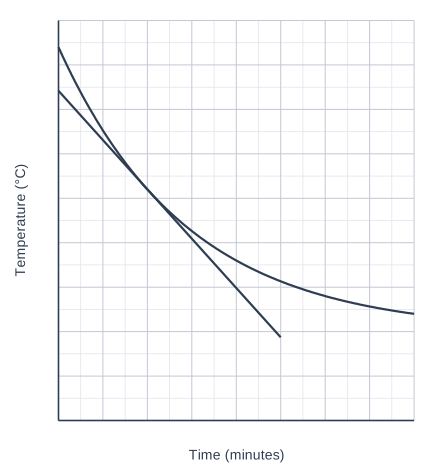
A cup of tea cools down. The graph shows its temperature, \(T\) °C, \(t\) minutes after it was made. A tangent to the curve has been drawn at \(t = 10\).

Use the tangent to estimate the rate at which the tea is cooling at \(t = 10\). Give the units of your answer.

A graph of Temperature (°C) (vertical axis, 0 to 90, marked every 10) against Time (minutes) (horizontal axis, 0 to 40, marked every 5), on a grid with 2 small squares to each large square. The curve is an exponential curve, decreasing and levelling off from left to right: it crosses the y-axis at (0, 84); it gets closer and closer to the line y = 20 as x goes further right without reaching it. The tangent is a straight line touching the curve at (10, 52), drawn from x = 0 to x = 25 crossing the y-axis at about (0, 74.2).

Model answer

The tangent passes through about (0, 74) and (25, 19).
Gradient = \(\dfrac{19 - 74}{25 - 0} = \dfrac{-55}{25} = -2.2\)
The tea is cooling at about 2.2 °C per minute at \(t = 10\).

Explanation

The gradient of the tangent is the rate of change of temperature at that moment. Read two points as far apart as possible on the tangent for accuracy. The units are the vertical units per horizontal unit: °C per minute.

Mark scheme
  1. 1 mark

    M1 for a gradient using two points on the tangent, e.g. \(\dfrac{74 - 19}{0 - 25}\)

    correct answer with no working scores full marks

  2. 1 mark

    A1 for a value from 1.8 to 2.6

    accept a negative value in this range

  3. 1 mark

    B1 for the units °C per minute

Question 4

4 marks

Points A and B lie on the curve \(y = x^2\). A has \(x\)-coordinate \(a\) and B has \(x\)-coordinate \(a + h\), where \(h\) ≠ 0.

Show that the gradient of the chord AB is \(2a + h\), and use this result to estimate the gradient of the curve at the point where \(x = 5\).

Model answer

Gradient of AB = \(\dfrac{(a + h)^2 - a^2}{(a + h) - a}\)
\(= \dfrac{a^2 + 2ah + h^2 - a^2}{h}\)
\(= \dfrac{2ah + h^2}{h}\)
\(= 2a + h\)
At \(x = 5\), \(a = 5\), so chords from A have gradient \(10 + h\). As B gets closer to A, \(h\) gets closer to 0 and the gradient gets closer to 10. The gradient of the curve at \(x = 5\) is about 10.

Explanation

The gradient of the curve at a point is the gradient of the tangent, which is what the chords approach as B moves towards A. The algebra shows the chord's gradient is always 2a plus a small extra amount h, so the tangent's gradient is 2a.

Mark scheme
  1. 1 mark

    M1 for \(\dfrac{(a + h)^2 - a^2}{h}\) oe

  2. 1 mark

    M1 for expanding to \(\dfrac{2ah + h^2}{h}\)

  3. 1 mark

    A1 for \(2a + h\) with complete working

    show that: answer only scores 0

  4. 1 mark

    C1 for 10, with a reason, e.g. when h is very small the chord is very close to the tangent and its gradient \(2a + h\) is very close to \(2 \times 5 = 10\)

Ready to try the rest? Every answer you write is marked against the mark scheme, so you can see exactly where the marks are.

AI Tutor Hints first, answers after you try

Hi! Stuck? Ask me for a hint and I’ll help you work it out. Once you’ve checked your answer I can explain exactly where the marks are.