Question 1
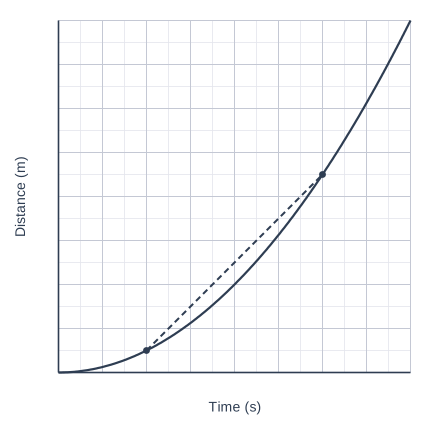
2 marksThe graph shows the distance, \(d\) metres, travelled by a car \(t\) seconds after it starts. \(P\) and \(Q\) are points on the curve, joined by a straight line.
Work out the gradient of the line \(PQ\) and explain what it represents.
Model answer
\(P = (2, 4)\) and \(Q = (6, 36)\).
Gradient of \(PQ = \dfrac{36 - 4}{6 - 2} = \dfrac{32}{4} = 8\)
This is the average speed of the car between 2 and 6 seconds: 8 m/s.
Explanation
The gradient of a chord on a distance-time graph is the distance travelled divided by the time taken, which is the average speed over that time interval. The car is speeding up, so its actual speed is less than 8 m/s at \(P\) and more than 8 m/s at \(Q\).
Mark scheme
-
1 mark
M1 for \(\dfrac{36 - 4}{6 - 2}\)
-
1 mark
A1 for 8, the average speed (in m/s) between \(t = 2\) and \(t = 6\)
both the value and the meaning needed