
Level:
Correct: 0
Incorrect: 0
Marks: 0/0
Exam Practice
Subject:
Topics:
Edexcel GCSE Maths (Non-calculator) Smart practice A mixed round aimed at your weak spots
Unit 1
Number
Unit 2
Algebra
Unit 3
Ratio, proportion and rates of change
Unit 4
Geometry and measures
Unit 5
Probability
Unit 6
Statistics
Avg
score:
–
Topics
done:
0/97

Expected outcomes

Practise 19 exam-style questions on Expected outcomes for Edexcel GCSE Maths (Non-calculator). Write your answer as you would in the exam and get it marked in seconds against the mark scheme, point by point, with an AI tutor on hand if you get stuck.

  • 19 questions
  • 1–5 marks each
  • Instant marking
  • No sign-up needed
19 questions, marked as you go

Sample questions with model answers

Here are 4 of the questions in this topic, each with a model answer, an explanation of why it earns the marks and the mark scheme an examiner would use.

Question 1

1 mark

The diagram shows a spinner with four coloured sectors.

Megan says,
"There are four colours, so each colour is equally likely. The spinner is fair."

Explain why Megan is wrong.
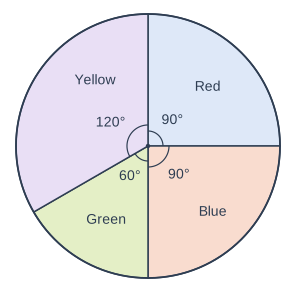
Pie chart. A circle divided into sectors, drawn clockwise from the top (12 o'clock): Red, 90° (printed); Blue, 90° (printed); Green, 60° (printed); Yellow, 120° (printed). Each printed angle is marked with a small arc at the centre.

Model answer

The sectors are not the same size: yellow is 120°, red and blue are 90° and green is 60°. So the colours are not equally likely (P(yellow) = \(\dfrac{1}{3}\) but P(green) = \(\dfrac{1}{6}\)).

Explanation

Outcomes are only equally likely if each has the same chance. On a spinner, the probability of a colour depends on the size of its sector, not on how many colours there are.

Mark scheme
  1. 1 mark

    C1 for explaining that the sectors are different sizes (angles), so the colours are not equally likely

    oe, e.g. 'yellow has the biggest angle (120°) so it is the most likely'
Question 2

2 marks

A fair coin is flipped and a fair six-sided dice is rolled.
This is done 120 times.

Work out an estimate for the number of times the coin lands on heads and the dice lands on 6.

Model answer

P(heads and 6) = \(\dfrac{1}{2} \times \dfrac{1}{6} = \dfrac{1}{12}\)
Expected number = \(\dfrac{1}{12} \times 120 = 10\)

Explanation

There are 12 equally likely combinations of coin and dice, and only one of them is heads and 6. Multiply the probability by the 120 trials to get the expected number.

Mark scheme
  1. 1 mark

    M1 for \(\dfrac{1}{2} \times \dfrac{1}{6}\) (= \(\dfrac{1}{12}\)) oe

    or a sample space showing 1 out of 12 outcomes; correct answer with no working scores full marks

  2. 1 mark

    A1 for 10

    cao

Question 3

3 marks

Ali and Ben play a game with a fair six-sided dice.
Ali wins if the dice lands on a prime number.
Ben wins if the dice lands on a square number.
Otherwise nobody wins.

They play the game 60 times.
Work out an estimate for how many more times Ali wins than Ben.

Model answer

Prime numbers: 2, 3, 5, so P(Ali wins) = \(\dfrac{3}{6} = \dfrac{1}{2}\). Expected wins: 30
Square numbers: 1, 4, so P(Ben wins) = \(\dfrac{2}{6} = \dfrac{1}{3}\). Expected wins: 20
Ali is expected to win 30 − 20 = 10 more times.

Explanation

List the outcomes for each player: 1 is a square number but not a prime number, and 6 is neither. Work out each expected number of wins (probability × 60) and find the difference. The game is not fair, because the players do not have equal chances of winning.

Mark scheme
  1. 1 mark

    B1 for P(prime) = \(\dfrac{3}{6}\) oe, or 30 wins for Ali

    prime numbers 2, 3, 5; correct answer with no working scores full marks

  2. 1 mark

    B1 for P(square) = \(\dfrac{2}{6}\) oe, or 20 wins for Ben

    square numbers 1, 4

  3. 1 mark

    A1 for 10

    cao

Question 4

4 marks

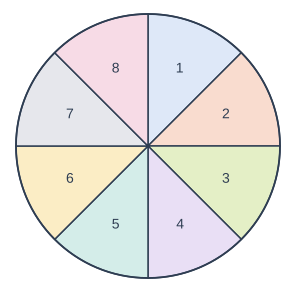
The diagram shows a fair spinner with 8 equal sections numbered 1 to 8.
At a charity event, it costs £1 to spin the spinner once.
If it lands on 8, the player wins £5.
If it lands on 1, the player wins £2.
Otherwise the player wins nothing.

The spinner is spun 200 times.
Work out an estimate for the amount of money the charity makes.

Pie chart. A circle divided into sectors, drawn clockwise from the top (12 o'clock): 1, 45°; 2, 45°; 3, 45°; 4, 45°; 5, 45°; 6, 45°; 7, 45°; 8, 45°. (Angles are not printed on the chart; these are the drawn sizes, which can be measured with a protractor.)

Model answer

Money taken: 200 × £1 = £200
Expected number of 8s: \(\dfrac{1}{8} \times 200 = 25\), prize money 25 × £5 = £125
Expected number of 1s: \(\dfrac{1}{8} \times 200 = 25\), prize money 25 × £2 = £50
Total prize money: £125 + £50 = £175
The charity makes £200 − £175 = £25

Explanation

The 8 sections are equally likely, so each number is expected 25 times in 200 spins. Work out the prize money for each winning number separately, then subtract the total from the money taken.

Mark scheme
  1. 1 mark

    P1 for the expected number of 8s or 1s, \(\dfrac{1}{8} \times 200 = 25\)

    correct answer with no working scores full marks

  2. 1 mark

    P1 for 25 × £5 = £125 or 25 × £2 = £50

    ft their 25

  3. 1 mark

    P1 for total prize money £175 and money taken £200

  4. 1 mark

    A1 for £25

    cao

Ready to try the rest? Every answer you write is marked against the mark scheme, so you can see exactly where the marks are.

AI Tutor Hints first, answers after you try

Hi! Stuck? Ask me for a hint and I’ll help you work it out. Once you’ve checked your answer I can explain exactly where the marks are.