Level:
Correct: 0
Incorrect: 0
Marks: 0/0
Exam Practice
Subject:
Topics:
Edexcel GCSE Maths (Non-calculator) Smart practice A mixed round aimed at your weak spots
Unit 1
Number
Unit 2
Algebra
Unit 3
Ratio, proportion and rates of change
Unit 4
Geometry and measures
Unit 5
Probability
Unit 6
Statistics
Avg
score:
–
Topics
done:
0/97

Frequency trees and probability experiments

Practise 28 exam-style questions on Frequency trees and probability experiments for Edexcel GCSE Maths (Non-calculator). Write your answer as you would in the exam and get it marked in seconds against the mark scheme, point by point, with an AI tutor on hand if you get stuck.

  • 28 questions
  • 1–5 marks each
  • Instant marking
  • No sign-up needed
20 questions, marked as you go

Sample questions with model answers

Here are 4 of the questions in this topic, each with a model answer, an explanation of why it earns the marks and the mark scheme an examiner would use.

Question 1

2 marks

60 students were asked how they travel to school. Each student either walks or takes the bus.
The frequency tree shows some of the information.

How many of the girls take the bus?
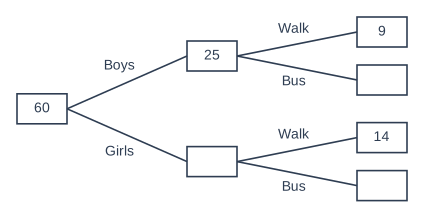
A frequency tree drawn from left to right with 2 stages of branches. It starts from a box containing 60 on the left. From the first box, branches labelled "Boys" and "Girls" lead to a box containing 25 and an empty box respectively. From the "Boys" box, branches labelled "Walk" and "Bus" lead to a box containing 9 and an empty box respectively. From the "Girls" box, branches labelled "Walk" and "Bus" lead to a box containing 14 and an empty box respectively.

Model answer

Girls = 60 − 25 = 35
Girls who take the bus = 35 − 14 = 21

Explanation

In a frequency tree the numbers at the ends of each set of branches add up to the number in the box they come from. First find the number of girls from the total, then subtract the girls who walk.

Mark scheme
  1. 1 mark

    M1 for the number of girls, 60 − 25 = 35

    correct answer with no working scores full marks

  2. 1 mark

    A1 for 21

    cao

Question 2

2 marks

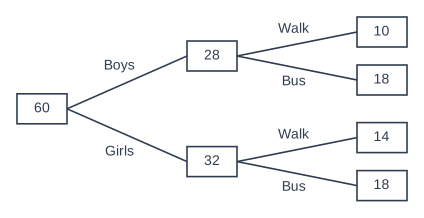
60 students were asked how they travel to school.
The frequency tree shows the results.

Raj says,
"The probability that a girl chosen at random walks to school is \(\dfrac{14}{60}\)."

Explain the mistake Raj has made and work out the correct probability.

A frequency tree drawn from left to right with 2 stages of branches. It starts from a box containing 60 on the left. From the first box, branches labelled "Boys" and "Girls" lead to a box containing 28 and a box containing 32 respectively. From the "Boys" box, branches labelled "Walk" and "Bus" lead to a box containing 10 and a box containing 18 respectively. From the "Girls" box, branches labelled "Walk" and "Bus" lead to a box containing 14 and a box containing 18 respectively.

Model answer

Raj has divided by the total number of students, 60. The girl is chosen from the girls only, and there are 32 girls.
\(\dfrac{14}{60}\) is the probability that a student chosen at random is a girl who walks.
Correct probability = \(\dfrac{14}{32} = \dfrac{7}{16}\)

Explanation

When the question says 'a girl chosen at random', the possible outcomes are only the girls, so the denominator is the number of girls. Always ask yourself which group the person is being chosen from.

Mark scheme
  1. 1 mark

    C1 for explaining that he should divide by the number of girls (32), not the total number of students

    oe, e.g. '\(\dfrac{14}{60}\) is the probability that a student chosen at random is a girl who walks'

  2. 1 mark

    B1 for \(\dfrac{14}{32}\)

    oe, e.g. \(\dfrac{7}{16}\)

Question 3

3 marks

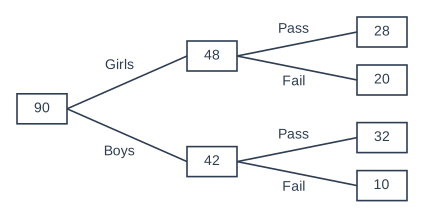
90 students took a test.
The frequency tree shows information about the results.

Ali says,
"A greater proportion of the boys than of the girls passed the test."

Is Ali correct? You must show how you get your answer.

A frequency tree drawn from left to right with 2 stages of branches. It starts from a box containing 90 on the left. From the first box, branches labelled "Girls" and "Boys" lead to a box containing 48 and a box containing 42 respectively. From the "Girls" box, branches labelled "Pass" and "Fail" lead to a box containing 28 and a box containing 20 respectively. From the "Boys" box, branches labelled "Pass" and "Fail" lead to a box containing 32 and a box containing 10 respectively.

Model answer

Boys: 32 out of 42 passed, \(\dfrac{32}{42} = \dfrac{16}{21} = \dfrac{64}{84}\)
Girls: 28 out of 48 passed, \(\dfrac{28}{48} = \dfrac{7}{12} = \dfrac{49}{84}\)
\(\dfrac{64}{84} > \dfrac{49}{84}\), so yes, Ali is correct.

Explanation

A proportion compares the number who passed with the size of the group, so you must divide by the number of boys and by the number of girls. Write the fractions with a common denominator (or as percentages) to compare them without a calculator.

Mark scheme
  1. 1 mark

    M1 for \(\dfrac{32}{42}\) (boys) and \(\dfrac{28}{48}\) (girls) oe

    e.g. \(\dfrac{16}{21}\) and \(\dfrac{7}{12}\)

  2. 1 mark

    M1 for a correct method to compare, e.g. \(\dfrac{64}{84}\) and \(\dfrac{49}{84}\), or 76% and 58%

    accept decimals or percentages truncated or rounded

  3. 1 mark

    C1 for 'Yes' with correct comparable values

    comparing 32 and 28 only scores 0

Question 4

4 marks

There are 120 students in Year 10.
Each student studies exactly one of French or German.
There are 8 more boys than girls.
\(\dfrac{3}{8}\) of the girls study German.
34 of the boys study French.

One of the 120 students is chosen at random.
Work out the probability that this student studies German.

Model answer

Girls: (120 − 8) ÷ 2 = 56, boys: 56 + 8 = 64
Girls who study German: \(\dfrac{3}{8} \times 56 = 21\)
Boys who study German: 64 − 34 = 30
Students who study German: 21 + 30 = 51
P(German) = \(\dfrac{51}{120} = \dfrac{17}{40}\)

Explanation

Find the numbers of boys and girls first: the two numbers differ by 8 and add up to 120. Then a frequency tree or two-way table (gender, then language) lets you find each German group before adding them.

Mark scheme
  1. 1 mark

    P1 for 56 girls and 64 boys

    e.g. from \(2g + 8 = 120\) or (120 − 8) ÷ 2; correct answer with no working scores full marks

  2. 1 mark

    P1 for girls who study German, \(\dfrac{3}{8} \times 56 = 21\)

    ft their 56

  3. 1 mark

    P1 for boys who study German, 64 − 34 = 30, and a total of 51

    ft their 64 and 21

  4. 1 mark

    A1 for \(\dfrac{17}{40}\)

    oe, e.g. \(\dfrac{51}{120}\), 0.425

Ready to try the rest? Every answer you write is marked against the mark scheme, so you can see exactly where the marks are.

AI Tutor Hints first, answers after you try

Hi! Stuck? Ask me for a hint and I’ll help you work it out. Once you’ve checked your answer I can explain exactly where the marks are.