Level:
Correct: 0
Incorrect: 0
Marks: 0/0
Exam Practice
Subject:
Topics:
Edexcel GCSE Maths (Non-calculator) Smart practice A mixed round aimed at your weak spots
Unit 1
Number
Unit 2
Algebra
Unit 3
Ratio, proportion and rates of change
Unit 4
Geometry and measures
Unit 5
Probability
Unit 6
Statistics
Avg
score:
–
Topics
done:
0/97

Sine rule and cosine rule

Practise 36 exam-style questions on Sine rule and cosine rule for Edexcel GCSE Maths (Non-calculator). Write your answer as you would in the exam and get it marked in seconds against the mark scheme, point by point, with an AI tutor on hand if you get stuck.

  • 36 questions
  • 1–5 marks each
  • Instant marking
  • No sign-up needed
20 questions, marked as you go

Sample questions with model answers

Here are 4 of the questions in this topic, each with a model answer, an explanation of why it earns the marks and the mark scheme an examiner would use.

Question 1

2 marks

In triangle ABC, AB = 6 cm, AC = 10 cm and \(\cos(\angle BAC) = 0.3\)

Work out the length of BC.

Model answer

\(BC^2 = 36 + 100 - 120 \times 0.3 = 136 - 36 = 100\)
BC = 10 cm

Explanation

You do not need the angle itself: the cosine rule only uses \(\cos A\), which is given. Substitute and evaluate carefully.

Mark scheme
  1. 1 mark

    M1 for \(BC^2 = 6^2 + 10^2 - 2 \times 6 \times 10 \times 0.3\)

    oe, e.g. 136 − 36; correct answer with no working scores full marks

  2. 1 mark

    A1 for 10

    cao; accept 10 cm

Question 2

3 marks

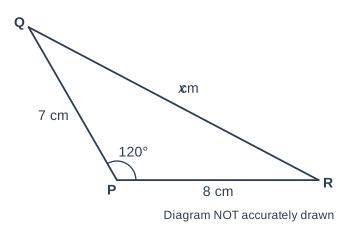
The diagram shows triangle PQR.
PQ = 7 cm, PR = 8 cm and angle QPR = 120°.

\(\cos 120° = -0.5\)

Work out the value of \(x\).

Geometry diagram, marked "Diagram NOT accurately drawn". Triangle PQR. Angle RPQ is marked 120°. Side PQ is labelled 7 cm. Side PR is labelled 8 cm. Side QR is labelled x cm.

Model answer

\(x^2 = 7^2 + 8^2 - 2 \times 7 \times 8 \times \cos 120°\)
\(x^2 = 49 + 64 - 112 \times (-0.5)\)
\(x^2 = 113 + 56 = 169\)
\(x = 13\)

Explanation

Two sides and the included angle are known, so use the cosine rule. Because \(\cos 120°\) is negative, subtracting \(2bc\cos A\) means adding 56. This makes sense: the side opposite an obtuse angle is longer than \(\sqrt{7^2 + 8^2}\).

Mark scheme
  1. 1 mark

    M1 for \(x^2 = 7^2 + 8^2 - 2 \times 7 \times 8 \times \cos 120°\)

    oe; correct answer with no working scores full marks

  2. 1 mark

    M1 for \(49 + 64 + 56\) (= 169)

    correct handling of the negative cosine

  3. 1 mark

    A1 for 13

    cao

Question 3

3 marks

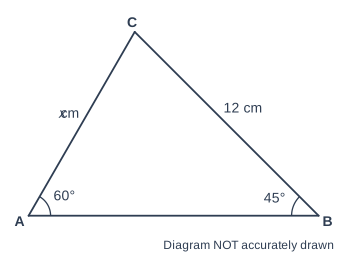
The diagram shows triangle ABC.
Angle BAC = 60°, angle ABC = 45° and BC = 12 cm.

Work out the exact value of \(x\).
Give your answer in the form \(a\sqrt{b}\), where \(a\) and \(b\) are integers.

Geometry diagram, marked "Diagram NOT accurately drawn". Triangle ABC. Angle BAC is marked 60°. Angle CBA is marked 45°. Side BC is labelled 12 cm. Side AC is labelled x cm.

Model answer

AC is opposite the 45° angle and BC is opposite the 60° angle.
\(\dfrac{x}{\sin 45°} = \dfrac{12}{\sin 60°}\)
\(x = \dfrac{12 \sin 45°}{\sin 60°} = 12 \times \dfrac{\sqrt{2}}{2} \div \dfrac{\sqrt{3}}{2} = \dfrac{12\sqrt{2}}{\sqrt{3}} = \dfrac{12\sqrt{6}}{3} = 4\sqrt{6}\)

Explanation

With two angles and a side opposite one of them, use the sine rule, pairing each side with its opposite angle. Dividing the exact values cancels the 2s; then rationalise \(\dfrac{12\sqrt{2}}{\sqrt{3}}\) by multiplying top and bottom by \(\sqrt{3}\).

Mark scheme
  1. 1 mark

    M1 for \(\dfrac{x}{\sin 45°} = \dfrac{12}{\sin 60°}\)

    oe; correct answer with no working scores full marks

  2. 1 mark

    M1 for \(x = \dfrac{12 \times \frac{\sqrt{2}}{2}}{\frac{\sqrt{3}}{2}}\) or \(\dfrac{12\sqrt{2}}{\sqrt{3}}\)

    oe

  3. 1 mark

    A1 for \(4\sqrt{6}\)

    cao

Question 4

4 marks

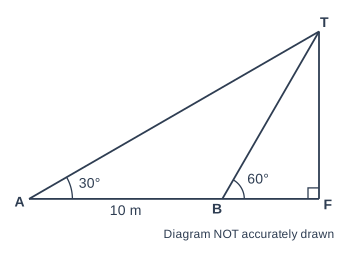
The diagram shows a vertical tree FT standing on horizontal ground.
A, B and F are points in a straight line on the ground, with AB = 10 m.
The angle of elevation of T from A is 30° and the angle of elevation of T from B is 60°.

Work out the exact height of the tree.

Geometry diagram, marked "Diagram NOT accurately drawn". Line segments AF, FT, AT and BT are drawn. B lies on AF. Angle FAT is marked 30°. Angle FBT is marked 60°. Angle TFA is marked as a right angle (90°). AB is labelled 10 m.

Model answer

Angle ABT = 180° − 60° = 120°
Angle ATB = 180° − 30° − 120° = 30°
So triangle ABT is isosceles and BT = AB = 10 m.
In the right-angled triangle BFT:
Height FT \(= 10 \sin 60° = 10 \times \dfrac{\sqrt{3}}{2} = 5\sqrt{3}\) m

Explanation

Work in triangle ABT first: the angles show it is isosceles (or use the sine rule), which gives BT. Then the right-angled triangle BFT gives the height. Trying to use triangle AFT directly fails because AF is unknown.

Mark scheme
  1. 1 mark

    P1 for angle ABT = 120° and angle ATB = 30°

    correct answer with no working scores full marks

  2. 1 mark

    P1 for BT = 10, e.g. triangle ABT is isosceles, or \(\dfrac{BT}{\sin 30°} = \dfrac{10}{\sin 30°}\)

  3. 1 mark

    P1 for height \(= BT \times \sin 60°\)

    ft their BT

  4. 1 mark

    A1 for \(5\sqrt{3}\)

    cao; accept \(5\sqrt{3}\) m

Ready to try the rest? Every answer you write is marked against the mark scheme, so you can see exactly where the marks are.

AI Tutor Hints first, answers after you try

Hi! Stuck? Ask me for a hint and I’ll help you work it out. Once you’ve checked your answer I can explain exactly where the marks are.