Practise 28 exam-style questions on Linear equations for Edexcel GCSE Maths (Non-calculator). Write your answer as you would in the exam and get it marked in seconds against the mark scheme, point by point, with an AI tutor on hand if you get stuck.
28 questions
1–5 marks each
Instant marking
No sign-up needed
20 questions, marked as you go
Sample questions with model answers
Here are 4 of the questions in this topic, each with a model answer, an explanation of why it earns the marks and the mark scheme an examiner would use.
Expand the bracket (or divide both sides by 4), then subtract 20 from both sides. The answer is negative because \(2 - 20 = -18\); solutions do not have to be positive whole numbers.
Mark scheme
1 mark
M1 for a correct first step, e.g. \(12x + 20 = 2\) or \(3x + 5 = \dfrac{1}{2}\)
correct answer with no working scores full marks
1 mark
A1 for \(x = -\dfrac{3}{2}\)
oe, e.g. \(-1.5\) or \(-\dfrac{18}{12}\)
Question 2
2 marks
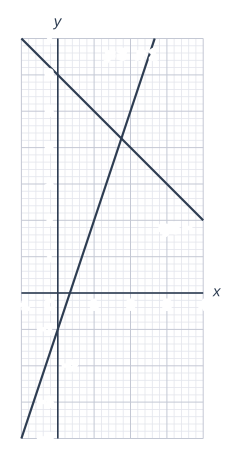
The graphs of \(y = 3x - 1\) and \(y = 6 - x\) are drawn on the grid.
Use the graphs to find an estimate for the solution of \(3x - 1 = 6 - x\)
Model answer
The lines cross at approximately \((1.75, 4.25)\). The solution is the \(x\)-coordinate: \(x \approx 1.75\)
Explanation
At the point where the two lines cross, \(3x - 1\) and \(6 - x\) have the same value, so its \(x\)-coordinate solves the equation. Give the \(x\)-coordinate, not the \(y\)-coordinate. Algebra confirms it: \(4x = 7\), so \(x = 1.75\).
Mark scheme
1 mark
M1 for using the point where the two lines cross, e.g. reading the \(x\)-coordinate of the intersection
correct answer with no working scores full marks
1 mark
A1 for an answer in the range 1.7 to 1.8
accept the exact answer 1.75 or \(\dfrac{7}{4}\) from algebra
Expand both sides fully; the \(2x^2\) terms appear on both sides and cancel, leaving a linear equation. Check: \(3 \times 6 = 18\) and \(4 \times (-1) + 22 = 18\).
Mark scheme
1 mark
M1 for expanding both sides correctly, \(2x^2 + 7x - 4\) and \(2x^2 - 6x + 22\)
allow one error in one term; correct answer with no working scores full marks
1 mark
M1 for cancelling the \(x^2\) terms and collecting, e.g. \(13x = 26\)
Factorising \(x^2 - 1\) as a difference of two squares shows that it is the common denominator of all three fractions. Multiplying every term by it clears the fractions and leaves a linear equation. The answer \(x = \dfrac{1}{2}\) does not make any denominator zero, so it is valid.
Mark scheme
1 mark
M1 for recognising that \(x^2 - 1 = (x - 1)(x + 1)\) is a common denominator
correct answer with no working scores full marks
1 mark
M1 for multiplying through to get \(3(x + 1) + 2(x - 1) = 7x\)
oe
1 mark
M1 for simplifying to a linear equation, e.g. \(5x + 1 = 7x\)
1 mark
A1 for \(x = \dfrac{1}{2}\)
oe, e.g. 0.5
Ready to try the rest? Every answer you write is marked against the mark scheme, so you can see exactly where the marks are.
Ctrl + Enter to check
AI TutorHints first, answers after you try
Hi! Stuck? Ask me for a hint and I’ll help you work it out. Once you’ve checked your answer I can explain exactly where the marks are.