Practise 28 exam-style questions on Properties of quadrilaterals and triangles for Edexcel GCSE Maths (Non-calculator). Write your answer as you would in the exam and get it marked in seconds against the mark scheme, point by point, with an AI tutor on hand if you get stuck.
28 questions
1–5 marks each
Instant marking
No sign-up needed
20 questions, marked as you go
Sample questions with model answers
Here are 4 of the questions in this topic, each with a model answer, an explanation of why it earns the marks and the mark scheme an examiner would use.
Question 1
2 marks
Amy says, "Every square is a rhombus." Ben says, "Every rhombus is a square."
Who is correct? Give reasons for your answers.
Model answer
Amy is correct: a rhombus is a quadrilateral with four equal sides, and a square has four equal sides, so every square is a rhombus. Ben is wrong: a rhombus need not have right angles. For example, a rhombus with angles 60°, 120°, 60°, 120° is not a square.
Explanation
A square is a rhombus with right angles, so the square is a special case of a rhombus, not the other way round. To show a statement is false, one counterexample is enough.
Mark scheme
1 mark
C1 for Amy is correct, because a square has four equal sides (and opposite sides parallel), so it fits the definition of a rhombus
1 mark
C1 for Ben is wrong, because a rhombus does not have to have right angles
accept a correct counterexample, e.g. a rhombus with angles 60° and 120°
Question 2
3 marks
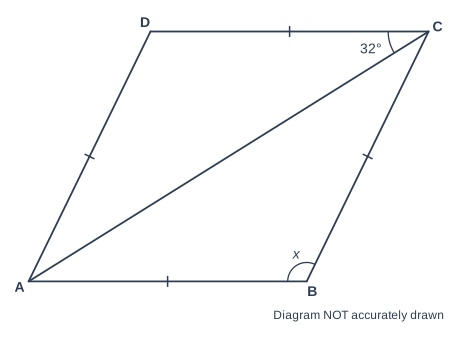
The diagram shows a rhombus ABCD with the diagonal AC drawn. Angle DCA = 32°.
Work out the size of angle ABC, marked x. Give a reason for each stage of your working.
Model answer
Angle BCD = 2 × 32° = 64° (the diagonals of a rhombus bisect its angles) AB is parallel to DC, so angles ABC and BCD are co-interior: x = 180° − 64° = 116° (co-interior angles add up to 180°)
Explanation
In a rhombus each diagonal cuts the angles at its ends exactly in half, so the full angle at C is 64°. Neighbouring angles of a rhombus add up to 180°. Another route: triangle ADC is isosceles, so angle ADC = 180 − 2 × 32 = 116°, and opposite angles are equal.
Mark scheme
1 mark
M1 for a correct first step, e.g. angle BCD = 64° or angle DAC = 32° or angle ADC = 116°
1 mark
A1 for x = 116°
1 mark
C1 for correct reasons for their method, e.g. the diagonals of a rhombus bisect its angles, and co-interior angles add up to 180°
or: triangle ADC is isosceles (DA = DC), angles in a triangle add up to 180°, opposite angles of a rhombus are equal
Question 3
3 marks
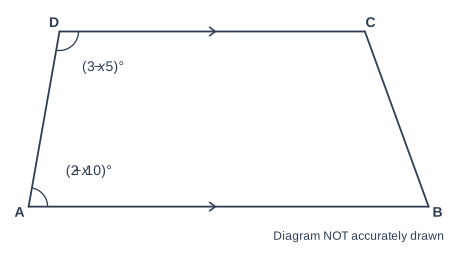
The diagram shows a trapezium ABCD in which AB is parallel to DC.
Work out the size of angle ADC.
Model answer
AB is parallel to DC, so angles DAB and ADC are co-interior and add up to 180°. \((2x + 10) + (3x - 5) = 180\) \(5x + 5 = 180\) \(x = 35\) Angle ADC = 3 × 35 − 5 = 100°
Explanation
The two labelled angles are at the ends of the slanted side AD, between the parallel sides, so they are co-interior and add up to 180°. Remember to substitute back to find the angle the question asks for.
Mark scheme
1 mark
M1 for \(2x + 10 + 3x - 5 = 180\)
co-interior angles add up to 180°; correct answer with no working scores full marks
1 mark
A1 for \(x = 35\)
1 mark
A1 for 100°
cao
Question 4
4 marks
A tile is in the shape of a rhombus. Each side of the tile is 10 cm long and one of its diagonals is 12 cm long.
Work out the area of the tile.
Model answer
The diagonals of a rhombus bisect each other at right angles. Half of the 12 cm diagonal is 6 cm. Half of the other diagonal = \(\sqrt{10^2 - 6^2} = \sqrt{64} = 8\) cm, so the other diagonal is 16 cm. The rhombus is made of four right-angled triangles, each \(\frac{1}{2} \times 6 \times 8 = 24\) cm². Area = 4 × 24 = 96 cm²
Explanation
The diagonals split a rhombus into four identical right-angled triangles, with the sides of the rhombus as hypotenuses. Pythagoras gives the other half-diagonal. The area of a rhombus (or kite) is half the product of its diagonals: ½ × 12 × 16 = 96 cm².
Mark scheme
1 mark
P1 for using that the diagonals bisect each other at right angles, giving a right-angled triangle with hypotenuse 10 cm and one side 6 cm
correct answer with no working scores full marks
1 mark
P1 for \(\sqrt{10^2 - 6^2}\) (= 8)
1 mark
P1 for a complete method for the area, e.g. \(\frac{1}{2} \times 12 \times 16\) or \(4 \times \frac{1}{2} \times 6 \times 8\)
1 mark
A1 for 96 cm²
cao
Ready to try the rest? Every answer you write is marked against the mark scheme, so you can see exactly where the marks are.
Ctrl + Enter to check
AI TutorHints first, answers after you try
Hi! Stuck? Ask me for a hint and I’ll help you work it out. Once you’ve checked your answer I can explain exactly where the marks are.