Level:
Correct: 0
Incorrect: 0
Marks: 0/0
Exam Practice
Subject:
Topics:
Edexcel GCSE Maths (Non-calculator) Smart practice A mixed round aimed at your weak spots
Unit 1
Number
Unit 2
Algebra
Unit 3
Ratio, proportion and rates of change
Unit 4
Geometry and measures
Unit 5
Probability
Unit 6
Statistics
Avg
score:
–
Topics
done:
0/97

Gradient as a rate of change

Practise 28 exam-style questions on Gradient as a rate of change for Edexcel GCSE Maths (Non-calculator). Write your answer as you would in the exam and get it marked in seconds against the mark scheme, point by point, with an AI tutor on hand if you get stuck.

  • 28 questions
  • 1–5 marks each
  • Instant marking
  • No sign-up needed
20 questions, marked as you go

Sample questions with model answers

Here are 4 of the questions in this topic, each with a model answer, an explanation of why it earns the marks and the mark scheme an examiner would use.

Question 1

2 marks

Here are the graphs of four relationships between \(x\) and \(y\), labelled A, B, C and D.

Write down the letter of the graph that shows \(y\) is directly proportional to \(x^2\), and the letter of the graph that shows \(y\) is inversely proportional to \(x\).
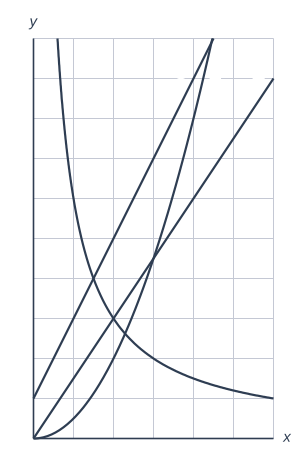
A coordinate grid with x from 0 to 6 and y from 0 to 10; each grid square is 1 unit across, and the axes cross at the origin O. Line A is a straight line sloping upwards from left to right passing through the origin and (2, 3). Curve B is a U-shaped parabola: it touches the x-axis at (0, 0). Line C is a straight line sloping upwards from left to right crossing the y-axis at (0, 1) and passing through (2, 5). Curve D is a curve: it gets closer and closer to the line y = 0 (the x-axis) at both ends without reaching it. Line A and curve B cross at (0, 0) and (3, 4.5). Line A and curve D cross at (2, 3). Curve B and line C cross at about (4.4, 9.9). Curve B and curve D cross at about (2.3, 2.6). Line C and curve D cross at (1.5, 4).

Model answer

\(y\) directly proportional to \(x^2\): graph B
\(y\) inversely proportional to \(x\): graph D

Explanation

\(y = kx^2\) is a curve through the origin that gets steeper as \(x\) increases (B). \(y = \frac{k}{x}\) is a curve that falls as \(x\) increases and gets closer to both axes without touching them (D). Graph A is direct proportion to \(x\) (a straight line through the origin), and graph C is a straight line that does not pass through the origin.

Mark scheme
  1. 1 mark

    B1 for B (directly proportional to \(x^2\))

    correct answer with no working scores full marks

  2. 1 mark

    B1 for D (inversely proportional to \(x\))
Question 2

2 marks

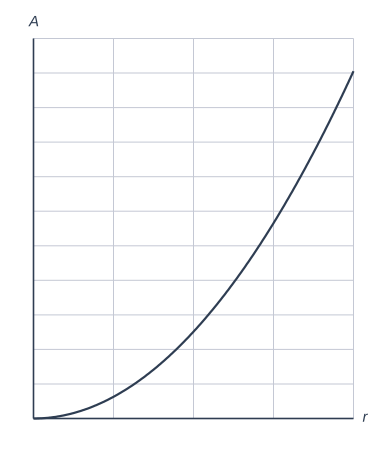
The graph shows the area, \(A\) cm², of a circle plotted against its radius, \(r\) cm.

Mia says, 'The area is directly proportional to the radius, because the graph passes through the origin.'

Is Mia correct? Give a reason for your answer.

A coordinate grid with r from 0 to 4 and A from 0 to 55; the r-axis is marked every 1 and the A-axis every 5, and the axes cross at the origin O. The curve is a U-shaped parabola: it touches the x-axis at (0, 0).

Model answer

Mia is not correct. The graph passes through the origin, but it is a curve, not a straight line, so \(A\) is not directly proportional to \(r\).
\(A = \pi r^2\), so \(A\) is directly proportional to \(r^2\).

Explanation

The graph of a direct proportion must be a straight line and pass through the origin; both conditions are needed. When the radius doubles, the area is multiplied by 4, which matches the formula \(A = \pi r^2\).

Mark scheme
  1. 1 mark

    C1 for No, with a correct reason, e.g. the graph is a curve, not a straight line; or doubling r does not double A

  2. 1 mark

    B1 for stating that \(A\) is directly proportional to \(r^2\) (\(A = \pi r^2\))

Question 3

3 marks

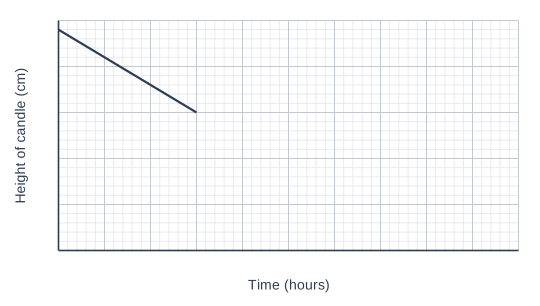
A candle burns at a constant rate. The graph shows the height of the candle for the first 3 hours.
The candle continues to burn at the same rate until it has burnt away completely.

Work out the rate at which the height of the candle decreases, and the total time for which the candle burns.

A graph of Height of candle (cm) (vertical axis, 0 to 25, marked every 5) against Time (hours) (horizontal axis, 0 to 10, marked every 1), on a grid with 5 small squares to each large square. The graph is a straight line; its values can be read from the grid.

Model answer

The height falls from 24 cm to 15 cm in 3 hours.
Rate = 9 ÷ 3 = 3 cm per hour
Total time = 24 ÷ 3 = 8 hours

Explanation

The rate of decrease is the gradient of the line. The candle starts at 24 cm, so at 3 cm per hour it lasts 24 ÷ 3 hours; this is where the line would meet the time axis if it were continued.

Mark scheme
  1. 1 mark

    M1 for \((24 - 15) \div 3\)

    correct answer with no working scores full marks

  2. 1 mark

    A1 for 3 cm per hour

    accept −3

  3. 1 mark

    A1 for 8 hours

    ft 24 ÷ their rate

Question 4

4 marks

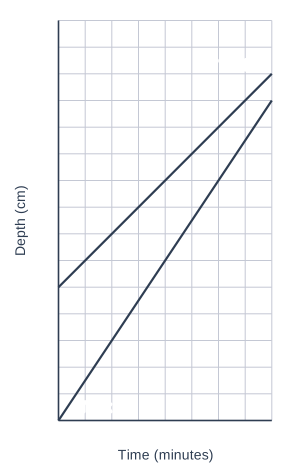
Water flows into two tanks at constant rates. The graph shows the depth of water in each tank for the first 8 minutes.
The water continues to flow into each tank at the same rate.

After how many minutes will the depth of water be the same in both tanks?

A graph of Depth (cm) (vertical axis, 0 to 30, marked every 2) against Time (minutes) (horizontal axis, 0 to 8, marked every 1), on a grid. The graph labelled "Tank A" is a straight line; its values can be read from the grid. The graph labelled "Tank B" is a straight line; its values can be read from the grid.

Model answer

Tank A starts at 10 cm and rises (26 − 10) ÷ 8 = 2 cm per minute
Tank B starts at 0 cm and rises 24 ÷ 8 = 3 cm per minute
\(10 + 2t = 3t\)
\(t = 10\)
The depths are the same (30 cm) after 10 minutes.

Explanation

Each gradient is the rate at which the depth rises. Tank B starts 10 cm behind but gains 1 cm every minute, so it catches up after 10 minutes, which is beyond the end of the graph. Writing an equation for each line is another way to find the meeting point.

Mark scheme
  1. 1 mark

    P1 for the rate for tank A: 2 cm per minute (e.g. (26 − 10) ÷ 8)

    correct answer with no working scores full marks

  2. 1 mark

    P1 for the rate for tank B: 3 cm per minute (e.g. 24 ÷ 8)

  3. 1 mark

    P1 for \(10 + 2t = 3t\) oe, or tank B gains 1 cm per minute on a 10 cm gap

  4. 1 mark

    A1 for 10 minutes

    cao

Ready to try the rest? Every answer you write is marked against the mark scheme, so you can see exactly where the marks are.

AI Tutor Hints first, answers after you try

Hi! Stuck? Ask me for a hint and I’ll help you work it out. Once you’ve checked your answer I can explain exactly where the marks are.