Practise 30 exam-style questions on Compound units: speed, density and pressure for Edexcel GCSE Maths (Non-calculator). Write your answer as you would in the exam and get it marked in seconds against the mark scheme, point by point, with an AI tutor on hand if you get stuck.
30 questions
1–5 marks each
Instant marking
No sign-up needed
20 questions, marked as you go
Sample questions with model answers
Here are 4 of the questions in this topic, each with a model answer, an explanation of why it earns the marks and the mark scheme an examiner would use.
Average speed = total distance ÷ total time, with the time in hours to get km/h. 45 minutes is 0.75 hours, not 0.45. Another way: 42 km in 105 minutes is 0.4 km per minute, and 0.4 × 60 = 24.
Mark scheme
1 mark
M1 for \(42 \div 1.75\) or \(42 \div 105 \times 60\) oe
42 ÷ 1.45 scores M0; correct answer with no working scores full marks
1 mark
A1 for 24
cao
Question 2
2 marks
The town of Exley has a population of 48 000. The area of the town is 16 km².
Work out the population density of Exley. Give the units of your answer.
Model answer
Population density = population ÷ area = 48 000 ÷ 16 = 3000 people per km²
Explanation
Population density is the number of people for each unit of area, so divide the population by the area. It is a compound unit, just like density = mass ÷ volume.
Mark scheme
1 mark
M1 for \(48\,000 \div 16\)
correct answer with no working scores full marks
1 mark
A1 for 3000 people per km²
units required for A1
Question 3
3 marks
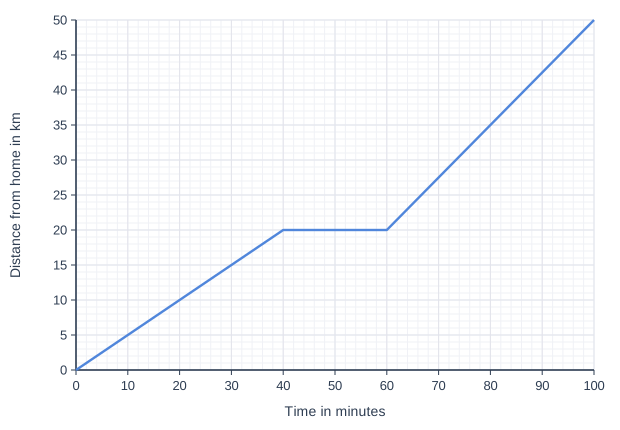
The travel graph shows Sam's car journey from his home to the beach.
Work out Sam's speed, in km/h, on the fastest part of the journey.
Model answer
First part: 20 km in 40 minutes Last part: 50 − 20 = 30 km in 100 − 60 = 40 minutes The last part is the fastest (more distance in the same time). Speed = 30 km in \(\dfrac{2}{3}\) hour = \(30 \div \dfrac{2}{3} = 45\) km/h
Explanation
On a travel graph, the steeper the line, the faster the speed, and a horizontal line means stopped. Read the distance travelled and the time taken for each moving part, then change the time to hours to get km/h.
Mark scheme
1 mark
M1 for the distance and time of one moving part, e.g. 20 km in 40 minutes or 30 km in 40 minutes
correct answer with no working scores full marks
1 mark
M1 for \(30 \div 40 \times 60\) oe
1 mark
A1 for 45
cao; 30 (the first part) scores M1 M0 A0
Question 4
4 marks
Hassan runs a 10 km race. He runs the first 6 km at an average speed of 12 km/h. He runs the rest of the race at an average speed of 4 m/s.
Work out the total time Hassan takes to run the race. Give your answer in minutes and seconds.
Model answer
First 6 km: time = 6 ÷ 12 = 0.5 hours = 30 minutes Last 4 km = 4000 m: time = 4000 ÷ 4 = 1000 seconds 1000 seconds = 16 minutes 40 seconds (16 × 60 = 960) Total time = 30 min + 16 min 40 s = 46 minutes 40 seconds
Explanation
The two parts use different units of speed, so find each time separately with time = distance ÷ speed, making sure the distance is in the same units as the speed. Then add the times, converting seconds into minutes and seconds.
Mark scheme
1 mark
P1 for 6 ÷ 12 = 0.5 hours (= 30 minutes)
correct answer with no working scores full marks
1 mark
P1 for 4000 ÷ 4 (= 1000 seconds)
1 mark
P1 for converting to the same units, e.g. 1000 seconds = 16 minutes 40 seconds, or 30 minutes = 1800 seconds
1 mark
A1 for 46 minutes 40 seconds
cao
Ready to try the rest? Every answer you write is marked against the mark scheme, so you can see exactly where the marks are.
Ctrl + Enter to check
AI TutorHints first, answers after you try
Hi! Stuck? Ask me for a hint and I’ll help you work it out. Once you’ve checked your answer I can explain exactly where the marks are.