
Level:
Correct: 0
Incorrect: 0
Marks: 0/0
Exam Practice
Subject:
Topics:
Edexcel GCSE Maths (Non-calculator) Smart practice A mixed round aimed at your weak spots
Unit 1
Number
Unit 2
Algebra
Unit 3
Ratio, proportion and rates of change
Unit 4
Geometry and measures
Unit 5
Probability
Unit 6
Statistics
Avg
score:
–
Topics
done:
0/97

Standard form

Practise 36 exam-style questions on Standard form for Edexcel GCSE Maths (Non-calculator). Write your answer as you would in the exam and get it marked in seconds against the mark scheme, point by point, with an AI tutor on hand if you get stuck.

  • 36 questions
  • 1–5 marks each
  • Instant marking
  • No sign-up needed
20 questions, marked as you go

Sample questions with model answers

Here are 4 of the questions in this topic, each with a model answer, an explanation of why it earns the marks and the mark scheme an examiner would use.

Question 1

2 marks

Work out \((3 \times 10^{4}) \times (2.5 \times 10^{6})\)

Give your answer in standard form.

Model answer

\(3 \times 2.5 = 7.5\)
\(10^{4} \times 10^{6} = 10^{10}\)
Answer: \(7.5 \times 10^{10}\)

Explanation

Multiply the number parts and multiply the powers of 10 separately. When multiplying powers of the same base you add the indices, so \(10^{4} \times 10^{6} = 10^{10}\). Here 7.5 is already between 1 and 10, so no adjustment is needed.

Mark scheme
  1. 1 mark

    M1 for \(3 \times 2.5 = 7.5\) or \(10^{4} \times 10^{6} = 10^{10}\)

    or for 75 000 000 000 or \(7.5 \times 10^{n}\) or \(a \times 10^{10}\); correct answer with no working scores full marks

  2. 1 mark

    A1 for \(7.5 \times 10^{10}\)

    cao
Question 2

2 marks

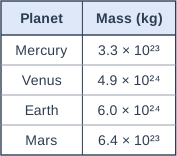
The table shows the masses of four planets.

Kim says,
"The mass of the Earth is more than 10 times the mass of Mars."

Is Kim correct? You must show how you get your answer.

Table with columns "Planet", "Mass (kg)". Planet: Mercury; Mass (kg): 3.3 × 10²³ | Planet: Venus; Mass (kg): 4.9 × 10²⁴ | Planet: Earth; Mass (kg): 6.0 × 10²⁴ | Planet: Mars; Mass (kg): 6.4 × 10²³.

Model answer

10 × mass of Mars \(= 10 \times 6.4 \times 10^{23} = 6.4 \times 10^{24}\) kg
Mass of the Earth \(= 6.0 \times 10^{24}\) kg
\(6.0 \times 10^{24} < 6.4 \times 10^{24}\)
So the Earth is less than 10 times the mass of Mars. Kim is not correct.

Explanation

Multiplying by 10 adds 1 to the power, so 10 times the mass of Mars is \(6.4 \times 10^{24}\) kg. Now both masses have the same power of 10, so you can compare 6.0 and 6.4 directly. The Earth's power of 10 is one bigger, which tempts people to say "more than 10 times" without checking the number parts.

Mark scheme
  1. 1 mark

    M1 for \(10 \times 6.4 \times 10^{23} = 6.4 \times 10^{24}\), or for \(6.0 \times 10^{24} \div (6.4 \times 10^{23})\) worked out as 9.375 or as \(60 \div 6.4\) shown to be less than 10

    oe, e.g. writing both masses with the same power of 10 (60 × 10²³ and 6.4 × 10²³) and comparing 60 with 64

  2. 1 mark

    C1 for No, with a correct comparison, e.g. 10 times the mass of Mars is \(6.4 \times 10^{24}\) kg, which is more than \(6.0 \times 10^{24}\) kg

Question 3

3 marks

The population of a town is \(2.4 \times 10^{5}\).
The population of a city is \(1.6 \times 10^{6}\).

Write the population of the town as a percentage of the population of the city.

Model answer

\(\dfrac{2.4 \times 10^{5}}{1.6 \times 10^{6}} = \dfrac{240\,000}{1\,600\,000} = \dfrac{24}{160} = \dfrac{3}{20} = 0.15\)
\(0.15 \times 100 = 15\%\)

Explanation

To write one amount as a percentage of another, divide it by the other amount and multiply by 100. Here \(2.4 \div 1.6 = 1.5\) and \(10^{5} \div 10^{6} = 10^{-1}\), giving 0.15, which is 15%. Dividing the wrong way round gives a percentage over 100, which cannot be right for a smaller town.

Mark scheme
  1. 1 mark

    M1 for \(\dfrac{2.4 \times 10^{5}}{1.6 \times 10^{6}}\)

    oe, e.g. \(\dfrac{240\,000}{1\,600\,000}\); correct answer with no working scores full marks

  2. 1 mark

    M1 for simplifying to 0.15 or \(\dfrac{3}{20}\) or \(1.5 \times 10^{-1}\), or for multiplying their fraction by 100

  3. 1 mark

    A1 for 15(%)

    cao

Question 4

4 marks

A country has a population of \(6.4 \times 10^{7}\).
In one year the country produced \(3.2 \times 10^{7}\) tonnes of waste. 40% of this waste was recycled.
1 tonne = 1000 kg

Work out the mean mass of waste recycled per person, in kg.

Model answer

Recycled: 40% of \(3.2 \times 10^{7} = 0.4 \times 3.2 \times 10^{7} = 1.28 \times 10^{7}\) tonnes
Per person: \((1.28 \times 10^{7}) \div (6.4 \times 10^{7}) = 0.2\) tonnes
\(0.2 \times 1000 = 200\) kg

Explanation

Find the recycled amount first, then share it between the people. The powers of 10 are the same, so they cancel and you just need \(1.28 \div 6.4 = 0.2\). Finally change tonnes to kilograms by multiplying by 1000.

Mark scheme
  1. 1 mark

    P1 for 40% of \(3.2 \times 10^{7}\), e.g. \(1.28 \times 10^{7}\) (tonnes)

    oe; correct answer with no working scores full marks

  2. 1 mark

    P1 for dividing a mass of waste by \(6.4 \times 10^{7}\)

    e.g. \(3.2 \times 10^{7} \div 6.4 \times 10^{7} = 0.5\)

  3. 1 mark

    P1 for converting tonnes to kg (multiplying by 1000) at any stage

  4. 1 mark

    A1 for 200 (kg)

    cao

Ready to try the rest? Every answer you write is marked against the mark scheme, so you can see exactly where the marks are.

AI Tutor Hints first, answers after you try

Hi! Stuck? Ask me for a hint and I’ll help you work it out. Once you’ve checked your answer I can explain exactly where the marks are.