Level:
Correct: 0
Incorrect: 0
Marks: 0/0
Exam Practice
Subject:
Topics:
Edexcel GCSE Maths (Non-calculator) Smart practice A mixed round aimed at your weak spots
Unit 1
Number
Unit 2
Algebra
Unit 3
Ratio, proportion and rates of change
Unit 4
Geometry and measures
Unit 5
Probability
Unit 6
Statistics
Avg
score:
–
Topics
done:
0/97

Conditional probability

Practise 36 exam-style questions on Conditional probability for Edexcel GCSE Maths (Non-calculator). Write your answer as you would in the exam and get it marked in seconds against the mark scheme, point by point, with an AI tutor on hand if you get stuck.

  • 36 questions
  • 1–5 marks each
  • Instant marking
  • No sign-up needed
20 questions, marked as you go

Sample questions with model answers

Here are 4 of the questions in this topic, each with a model answer, an explanation of why it earns the marks and the mark scheme an examiner would use.

Question 1

2 marks

The two-way table shows information about the snacks chosen by 120 people at a cinema. Each person chose popcorn, nachos or no snack.

One of the people who chose popcorn is chosen at random.

Work out the probability that this person is a child.
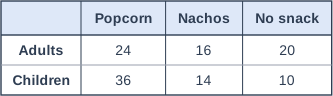
Table with columns (row headings), "Popcorn", "Nachos", "No snack". Adults; Popcorn: 24; Nachos: 16; No snack: 20 | Children; Popcorn: 36; Nachos: 14; No snack: 10.

Model answer

Number of people who chose popcorn \(= 24 + 36 = 60\)
Probability \(= \dfrac{36}{60} = \dfrac{3}{5}\)

Explanation

The person is chosen from those who chose popcorn, so the denominator is the popcorn total, 24 + 36 = 60. The numerator is the number of those 60 who are children. Dividing by 120 would give the probability of being a child who chose popcorn, which is a different question.

Mark scheme
  1. 1 mark

    M1 for 24 + 36 (= 60) used as the denominator, e.g. \(\dfrac{36}{60}\)

    correct answer with no working scores full marks

  2. 1 mark

    A1 for \(\dfrac{3}{5}\) oe

    accept \(\dfrac{36}{60}\) or 0.6; do not accept \(\dfrac{36}{120}\) or a ratio such as 36 : 60
Question 2

3 marks

There are 80 students in a sports club. Each student plays exactly one of hockey or netball.
35 of the students are boys.
20 of the boys play hockey.
27 of the girls play netball.

One of the students who plays hockey is chosen at random.

Work out the probability that this student is a girl.

Model answer

Girls \(= 80 - 35 = 45\)
Girls who play hockey \(= 45 - 27 = 18\)
Students who play hockey \(= 20 + 18 = 38\)
Probability \(= \dfrac{18}{38} = \dfrac{9}{19}\)

Explanation

Organise the information in a two-way table (boys/girls against hockey/netball) and fill in the missing values by subtracting from the totals. The student is chosen from the hockey players, so the denominator is the hockey total (38), and the numerator is the girls who play hockey (18).

Mark scheme
  1. 1 mark

    P1 for finding the number of girls, 80 − 35 (= 45)

    may be seen in a two-way table

  2. 1 mark

    P1 for finding that 45 − 27 (= 18) girls play hockey and 20 + 18 (= 38) students play hockey

    ft their number of girls; may be seen in a two-way table

  3. 1 mark

    A1 for \(\dfrac{9}{19}\) oe

    accept \(\dfrac{18}{38}\); do not accept \(\dfrac{18}{80}\) or \(\dfrac{18}{45}\); correct answer with no working scores 3 marks

Question 3

3 marks

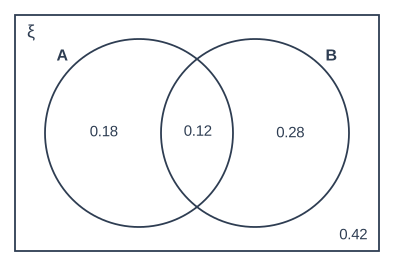
The Venn diagram shows the probabilities of two events, A and B.

Show that the probability that A happens, given that B happens, is equal to the probability that A happens.
What does this tell you about events A and B?

A Venn diagram: a rectangle labelled ξ (the universal set) containing two overlapping circles labelled A and B. The numbers written in each region are: A ∩ B′ (in A only): 0.18; A ∩ B (in both A and B): 0.12; A′ ∩ B (in B only): 0.28; A′ ∩ B′ (outside both circles): 0.42.

Model answer

P(B) \(= 0.12 + 0.28 = 0.4\)
P(A given B) \(= \dfrac{0.12}{0.4} = 0.3\)
P(A) \(= 0.18 + 0.12 = 0.3\)
The two probabilities are equal, so knowing that B has happened does not change the probability of A.
A and B are independent events.

Explanation

For the conditional probability, restrict to circle B (total 0.4) and find the fraction of it that is also in A. Events are independent when one happening does not affect the probability of the other, which is exactly what equal probabilities show. You could also check that \(0.3 \times 0.4 = 0.12\), the probability of both.

Mark scheme
  1. 1 mark

    M1 for P(A given B) \(= \dfrac{0.12}{0.12 + 0.28}\) (= 0.3)

  2. 1 mark

    M1 for P(A) = 0.18 + 0.12 (= 0.3)

  3. 1 mark

    C1 for showing both are 0.3 and stating that A and B are independent

    accept 'B happening does not change the probability of A' oe; needs both values correct

Question 4

4 marks

There are 60 members in a fitness club.
G = {members who use the gym}
S = {members who use the swimming pool}
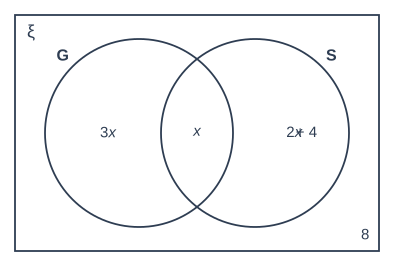
The Venn diagram shows information about the members.

A member who uses the swimming pool is chosen at random.

Work out the probability that this member also uses the gym.

A Venn diagram: a rectangle labelled ξ (the universal set) containing two overlapping circles labelled G and S. The numbers written in each region are: G ∩ S′ (in G only): 3x; G ∩ S (in both G and S): x; G′ ∩ S (in S only): 2x + 4; G′ ∩ S′ (outside both circles): 8.

Model answer

\(3x + x + 2x + 4 + 8 = 60\)
\(6x + 12 = 60\)
\(x = 8\)
Members who use the pool \(= x + 2x + 4 = 8 + 20 = 28\)
Members who use the pool and the gym \(= x = 8\)
Probability \(= \dfrac{8}{28} = \dfrac{2}{7}\)

Explanation

All the regions, including the 8 outside the circles, add up to the 60 members, which gives an equation for \(x\). The member is chosen from the swimming pool circle (28 members), and the 8 in the overlap also use the gym.

Mark scheme
  1. 1 mark

    M1 for \(3x + x + 2x + 4 + 8 = 60\) oe

    e.g. \(6x + 12 = 60\); correct answer with no working scores full marks

  2. 1 mark

    A1 for \(x = 8\)

  3. 1 mark

    M1 for \(\dfrac{x}{x + 2x + 4}\) with their value of x, e.g. \(\dfrac{8}{28}\)

    ft their x

  4. 1 mark

    A1 for \(\dfrac{2}{7}\) oe

    accept \(\dfrac{8}{28}\)

Ready to try the rest? Every answer you write is marked against the mark scheme, so you can see exactly where the marks are.

AI Tutor Hints first, answers after you try

Hi! Stuck? Ask me for a hint and I’ll help you work it out. Once you’ve checked your answer I can explain exactly where the marks are.