Level:
Correct: 0
Incorrect: 0
Marks: 0/0
Exam Practice
Subject:
Topics:
Edexcel GCSE Maths (Non-calculator) Smart practice A mixed round aimed at your weak spots
Unit 1
Number
Unit 2
Algebra
Unit 3
Ratio, proportion and rates of change
Unit 4
Geometry and measures
Unit 5
Probability
Unit 6
Statistics
Avg
score:
–
Topics
done:
0/97

Combined events and tree diagrams

Practise 36 exam-style questions on Combined events and tree diagrams for Edexcel GCSE Maths (Non-calculator). Write your answer as you would in the exam and get it marked in seconds against the mark scheme, point by point, with an AI tutor on hand if you get stuck.

  • 36 questions
  • 1–5 marks each
  • Instant marking
  • No sign-up needed
20 questions, marked as you go

Sample questions with model answers

Here are 4 of the questions in this topic, each with a model answer, an explanation of why it earns the marks and the mark scheme an examiner would use.

Question 1

2 marks

Lucy drives through two junctions, A and B, on her way to work.
The probability that the traffic light is red when she arrives at junction A is 0.3
The probability that the traffic light is red when she arrives at junction B is 0.5
These two events are independent.

Work out the probability that the traffic light is red at both junctions.

Model answer

The events are independent, so
P(red at A and red at B) = 0.3 × 0.5 = 0.15

Explanation

For independent events, P(A and B) = P(A) × P(B). Adding the probabilities (0.8) is a common error - that would be the method for 'or' with mutually exclusive events.

Mark scheme
  1. 1 mark

    M1 for 0.3 × 0.5

    correct answer with no working scores full marks

  2. 1 mark

    A1 for 0.15

    oe

Question 2

2 marks

A factory has two machines, A and B.
Machine A makes 60% of the items and machine B makes the rest.
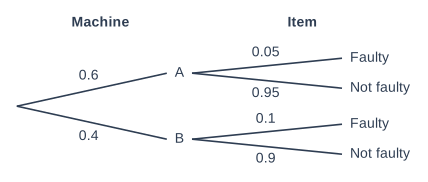
The tree diagram shows the probability that an item made by each machine is faulty.

An item is chosen at random. Work out the probability that it is faulty.

A probability tree diagram drawn from left to right with 2 stages of branches, headed "Machine" and "Item". Each branch has its outcome written at its end and its probability written beside it. First stage, 2 branches: "A" with probability 0.6, "B" with probability 0.4. After "A", the second stage branches are "Faulty" with probability 0.05, "Not faulty" with probability 0.95. After "B", the second stage branches are "Faulty" with probability 0.1, "Not faulty" with probability 0.9.

Model answer

Machine A and faulty: 0.6 × 0.05 = 0.03
Machine B and faulty: 0.4 × 0.1 = 0.04
P(faulty) = 0.03 + 0.04 = 0.07

Explanation

A faulty item can come from either machine, so multiply along each 'faulty' path and add. The probability of being faulty depends on the machine, which is why the second-stage branches are different.

Mark scheme
  1. 1 mark

    M1 for 0.6 × 0.05 + 0.4 × 0.1

    or one of the products 0.03 or 0.04 with the intention to add; correct answer with no working scores full marks

  2. 1 mark

    A1 for 0.07

    oe

Question 3

3 marks

A bag contains 6 red counters and 4 blue counters.
Two counters are taken at random from the bag, without replacement.

Show that the probability that the two counters are different colours is \(\dfrac{8}{15}\).

Model answer

P(red then blue) = \(\dfrac{6}{10} \times \dfrac{4}{9} = \dfrac{24}{90}\)
P(blue then red) = \(\dfrac{4}{10} \times \dfrac{6}{9} = \dfrac{24}{90}\)
P(different colours) = \(\dfrac{24}{90} + \dfrac{24}{90} = \dfrac{48}{90} = \dfrac{8}{15}\)

Explanation

Different colours can happen in two orders, red then blue or blue then red, so add both paths. In a 'show that' question every step must be written down, ending with the given fraction.

Mark scheme
  1. 1 mark

    M1 for \(\dfrac{6}{10} \times \dfrac{4}{9}\) or \(\dfrac{4}{10} \times \dfrac{6}{9}\)

  2. 1 mark

    M1 for \(\dfrac{24}{90} + \dfrac{24}{90}\)

    or 1 − (\(\dfrac{30}{90} + \dfrac{12}{90}\))

  3. 1 mark

    A1 for \(\dfrac{48}{90} = \dfrac{8}{15}\) from correct working

    answer only scores 0 (show that)

Question 4

4 marks

Kim and Lee take turns to roll a fair six-sided dice. Kim rolls first.
The first person to roll a 6 wins the game.

Work out the probability that Kim wins the game on her first or second roll.

Model answer

Kim wins on her first roll: \(\dfrac{1}{6} = \dfrac{36}{216}\)
Kim wins on her second roll: Kim not 6, Lee not 6, Kim 6: \(\dfrac{5}{6} \times \dfrac{5}{6} \times \dfrac{1}{6} = \dfrac{25}{216}\)
P(Kim wins on her first or second roll) = \(\dfrac{36}{216} + \dfrac{25}{216} = \dfrac{61}{216}\)

Explanation

Kim's second roll is the third roll of the game, so Kim and Lee must both fail first. Draw a tree that stops when someone rolls a 6, multiply along the two winning paths for Kim and add them.

Mark scheme
  1. 1 mark

    P1 for P(Kim wins on her first roll) = \(\dfrac{1}{6}\)

    correct answer with no working scores full marks

  2. 1 mark

    P1 for P(Kim wins on her second roll) = \(\dfrac{5}{6} \times \dfrac{5}{6} \times \dfrac{1}{6}\)

    Kim misses, Lee misses, Kim gets 6

  3. 1 mark

    P1 for adding, e.g. \(\dfrac{36}{216} + \dfrac{25}{216}\)

  4. 1 mark

    A1 for \(\dfrac{61}{216}\)

    cao

Ready to try the rest? Every answer you write is marked against the mark scheme, so you can see exactly where the marks are.

AI Tutor Hints first, answers after you try

Hi! Stuck? Ask me for a hint and I’ll help you work it out. Once you’ve checked your answer I can explain exactly where the marks are.