Level:
Correct: 0
Incorrect: 0
Marks: 0/0
Exam Practice
Subject:
Topics:
Edexcel GCSE Maths (Non-calculator) Smart practice A mixed round aimed at your weak spots
Unit 1
Number
Unit 2
Algebra
Unit 3
Ratio, proportion and rates of change
Unit 4
Geometry and measures
Unit 5
Probability
Unit 6
Statistics
Avg
score:
–
Topics
done:
0/97

Parts of a circle

Practise 19 exam-style questions on Parts of a circle for Edexcel GCSE Maths (Non-calculator). Write your answer as you would in the exam and get it marked in seconds against the mark scheme, point by point, with an AI tutor on hand if you get stuck.

  • 19 questions
  • 1–5 marks each
  • Instant marking
  • No sign-up needed
19 questions, marked as you go

Sample questions with model answers

Here are 4 of the questions in this topic, each with a model answer, an explanation of why it earns the marks and the mark scheme an examiner would use.

Question 1

2 marks

The diagram shows a circle with centre O.
A, B, D and E are points on the circle.
The region labelled R is shaded. The region labelled S is between the lines OD and OE.

Write down the mathematical name of the region R and the mathematical name of the region S.
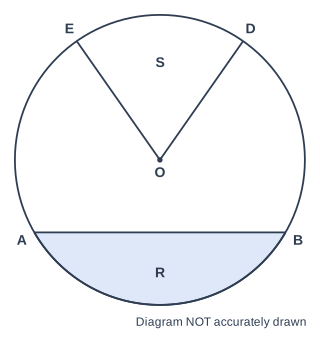
Geometry diagram, marked "Diagram NOT accurately drawn". A circle with centre O; A, B, D and E lie on it, in that order going anticlockwise. A minor arc from A to B with centre O (the region between the arc and AB is shaded). Line segments AB, OD and OE are drawn. The text "R" is written inside the circle. The text "S" is written inside the circle.

Model answer

R is a segment.
S is a sector.

Explanation

A segment is the region between a chord and an arc, so the region cut off by the chord AB is a segment. A sector is the region between two radii and an arc, like a slice of pizza, so the region between OD and OE is a sector. Students often mix up the two words: a sector always has its point at the centre.

Mark scheme
  1. 1 mark

    B1 for R is a segment

    accept minor segment; do not accept sector; correct answer with no working scores full marks

  2. 1 mark

    B1 for S is a sector

    accept minor sector; do not accept segment
Question 2

2 marks

A and B are two points on a circle with centre O.
The length of the minor arc AB is \(\frac{1}{5}\) of the circumference of the circle.

Work out the size of the reflex angle AOB.

Model answer

The minor arc is \(\frac{1}{5}\) of the circle, so the angle at the centre is \(\frac{1}{5} \times 360 = 72^\circ\).
Reflex angle AOB \(= 360 - 72 = 288^\circ\)

Explanation

The angle at the centre is the same fraction of 360° as the arc is of the whole circumference. The minor arc gives the angle under 180°; the reflex angle goes round the other way, so subtract from 360°.

Mark scheme
  1. 1 mark

    M1 for \(360 \div 5\) (= 72) or \(\frac{4}{5} \times 360\)

    correct answer with no working scores full marks

  2. 1 mark

    A1 for 288°

    cao; 72 on its own scores M1 A0

Question 3

3 marks

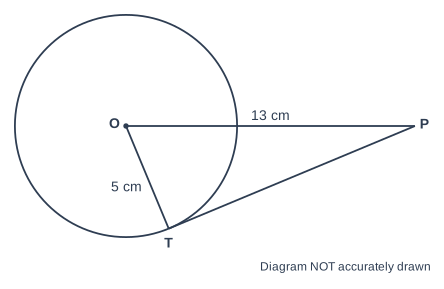
The diagram shows a circle with centre O and radius 5 cm.
PT is a tangent to the circle at T.
OP = 13 cm.

Work out the length of PT.

Geometry diagram, marked "Diagram NOT accurately drawn". A circle with centre O; T lies on it. Line segments PT, OT and OP are drawn. PT touches the circle at T (it is a tangent). OT is labelled 5 cm. OP is labelled 13 cm.

Model answer

OT is a radius, so OT = 5 cm, and the tangent PT is perpendicular to the radius OT, so angle OTP = 90°.
\(PT^2 = 13^2 - 5^2 = 169 - 25 = 144\)
PT = 12 cm

Explanation

A tangent always meets the radius at the point of contact at 90°, so triangle OTP is right-angled at T with hypotenuse OP. Use Pythagoras' theorem; a common error is adding the squares (giving \(\sqrt{194}\)) instead of subtracting.

Mark scheme
  1. 1 mark

    B1 for angle OTP = 90° (a tangent is perpendicular to the radius at the point of contact)

    may be implied by using Pythagoras' theorem in triangle OTP

  2. 1 mark

    M1 for \(13^2 - 5^2\) (= 144) or \(\sqrt{13^2 - 5^2}\)

  3. 1 mark

    A1 for 12 (cm)

    cao

Question 4

4 marks

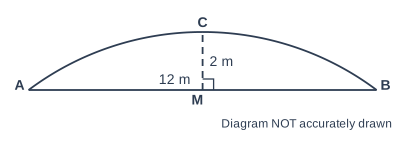
The diagram shows the entrance to a tunnel.
The curved edge of the entrance is an arc of a circle. The base AB is a chord of the circle.
AB = 12 m. M is the midpoint of AB.
The highest point of the arc, C, is vertically above M, and MC = 2 m.

Work out the radius of the circle.

Geometry diagram, marked "Diagram NOT accurately drawn". A minor arc from B to A. Line segment AB is drawn. Dashed line segment MC is drawn. M lies on AB. Angle CMB is marked as a right angle (90°). AB is labelled 12 m. MC is labelled 2 m.

Model answer

Let the centre be O and the radius be \(r\) m. O lies on the line CM extended (the perpendicular bisector of the chord AB passes through the centre).
OM \(= r - 2\) and AM = 6, OA = \(r\).
\(r^2 = 6^2 + (r - 2)^2\)
\(r^2 = 36 + r^2 - 4r + 4\)
\(4r = 40\)
\(r = 10\) m

Explanation

The perpendicular bisector of a chord always passes through the centre, so the centre is directly below C on the line through M. Join the centre to A to make a right-angled triangle with hypotenuse \(r\), then form an equation with Pythagoras' theorem. The \(r^2\) terms cancel, leaving a linear equation.

Mark scheme
  1. 1 mark

    P1 for a right-angled triangle with sides 6 and \(r - 2\) and hypotenuse \(r\) (O on the line CM extended, OA = r)

    may be seen on a diagram; correct answer with no working scores full marks

  2. 1 mark

    P1 for \(r^2 = 6^2 + (r - 2)^2\)

    oe

  3. 1 mark

    P1 for expanding and simplifying to a linear equation, e.g. \(r^2 = 36 + r^2 - 4r + 4\) leading to \(4r = 40\)

  4. 1 mark

    A1 for 10 (m)

    cao

Ready to try the rest? Every answer you write is marked against the mark scheme, so you can see exactly where the marks are.

AI Tutor Hints first, answers after you try

Hi! Stuck? Ask me for a hint and I’ll help you work it out. Once you’ve checked your answer I can explain exactly where the marks are.