Practise 36 exam-style questions on Estimation and approximation for Edexcel GCSE Maths (Non-calculator). Write your answer as you would in the exam and get it marked in seconds against the mark scheme, point by point, with an AI tutor on hand if you get stuck.
36 questions
1–5 marks each
Instant marking
No sign-up needed
20 questions, marked as you go
Sample questions with model answers
Here are 4 of the questions in this topic, each with a model answer, an explanation of why it earns the marks and the mark scheme an examiner would use.
Question 1
2 marks
Work out an estimate for \(48.7 \times 3.1\)
Model answer
\(48.7 \times 3.1 \approx 50 \times 3 = 150\)
Explanation
To estimate, round each number to 1 significant figure: 48.7 is about 50 and 3.1 is about 3. Then work out the simpler calculation. Working out the exact answer is not an estimate and may not score the method mark.
Mark scheme
1 mark
M1 for rounding both numbers to 1 significant figure, e.g. \(50 \times 3\)
accept other sensible roundings, e.g. \(49 \times 3\); correct answer with no working scores full marks
1 mark
A1 for 150
accept answers from 147 to 155 from sensible rounding
Question 2
2 marks
Dan estimates the value of \(61.3 \div 0.192\) as \(60 \div 0.2 = 300\)
Is Dan's estimate greater than or less than the exact value? Give a reason for your answer.
Model answer
61.3 has been rounded down to 60, which makes the answer smaller. 0.192 has been rounded up to 0.2; dividing by a bigger number makes the answer smaller too. So 300 is less than the exact value (an underestimate).
Explanation
In a division, rounding the number being divided down makes the answer smaller, and rounding the divisor up also makes the answer smaller. Both changes push the same way, so the estimate is too small. (The exact value is about 319.)
Mark scheme
1 mark
B1 for less than (an underestimate)
1 mark
C1 for a correct reason, e.g. 61.3 was rounded down and 0.192 was rounded up, and dividing a smaller number by a bigger number gives a smaller answer
Question 3
3 marks
Work out an estimate for \(\dfrac{\sqrt{98.7} \times 3.02^{2}}{0.0496}\)
98.7 rounds to 100, which has an exact square root. Dividing by 0.05 is the same as multiplying by 20, so \(90 \div 0.05 = 1800\). A common error is getting 180 or 4.5 at the last step.
Mark scheme
1 mark
M1 for rounding to \(\dfrac{\sqrt{100} \times 3^{2}}{0.05}\)
at least two of the three values correct; correct answer with no working scores full marks
1 mark
M1 for \(\dfrac{90}{0.05}\)
1 mark
A1 for 1800
cao
Question 4
4 marks
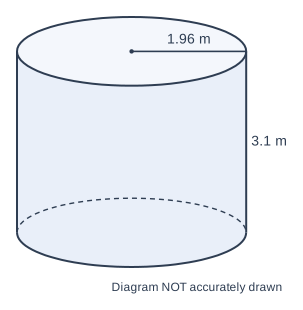
The diagram shows a tank in the shape of a cylinder. The tank is full of water. Water flows out of the tank at a rate of 48 litres per minute. 1 m³ = 1000 litres
Work out an estimate for the time it takes the tank to empty. Give your answer in hours.
Use volume of a cylinder \(= \pi r^{2}h\) with rounded values (\(\pi \approx 3\), \(r \approx 2\), \(h \approx 3\)). Change to litres, divide by the flow rate to get minutes, then divide by 60 for hours.
Mark scheme
1 mark
P1 for an estimate of the volume with rounded values, e.g. \(3 \times 2^{2} \times 3 = 36\) (m³)
correct answer with no working scores full marks
1 mark
P1 for converting their volume to litres, e.g. 36 000 litres
1 mark
P1 for their litres \(\div 50\) and dividing by 60, e.g. 720 minutes
1 mark
A1 for 12 (hours)
accept answers from 10 to 14 hours from sensible rounding
Ready to try the rest? Every answer you write is marked against the mark scheme, so you can see exactly where the marks are.
Ctrl + Enter to check
AI TutorHints first, answers after you try
Hi! Stuck? Ask me for a hint and I’ll help you work it out. Once you’ve checked your answer I can explain exactly where the marks are.