Practise 28 exam-style questions on Scale drawings and bearings for Edexcel GCSE Maths (Non-calculator). Write your answer as you would in the exam and get it marked in seconds against the mark scheme, point by point, with an AI tutor on hand if you get stuck.
28 questions
1–5 marks each
Instant marking
No sign-up needed
20 questions, marked as you go
Sample questions with model answers
Here are 4 of the questions in this topic, each with a model answer, an explanation of why it earns the marks and the mark scheme an examiner would use.
Question 1
2 marks
The bearing of B from A is 295°.
Work out the bearing of A from B.
Model answer
The bearing back the other way differs by 180°. \(295 - 180 = 115^\circ\)
Explanation
The direction from B back to A is exactly opposite, so the two bearings differ by 180°. Add 180° if the bearing is less than 180°, otherwise subtract 180°, so the answer stays between 000° and 360°.
Mark scheme
1 mark
M1 for \(295 - 180\)
or a correct diagram showing the angle 65° and parallel north lines; correct answer with no working scores full marks
1 mark
A1 for 115°
cao
Question 2
2 marks
A model of a car is made using a scale of 1 : 24. The real car is 4.2 m long.
Work out the length of the model car in centimetres.
Model answer
4.2 m = 420 cm \(420 \div 24 = 17.5\) cm
Explanation
The model is \(\frac{1}{24}\) of the size of the real car, so divide the real length by 24 after changing it into centimetres. \(420 \div 24 = 105 \div 6 = 17.5\).
Mark scheme
1 mark
M1 for \(420 \div 24\)
or \(4.2 \div 24 = 0.175\) m; correct answer with no working scores full marks
1 mark
A1 for 17.5 (cm)
cao
Question 3
3 marks
A map has a scale of 1 : 50 000. On the map, the distance along a straight path from a car park to a church is 8 cm. Anna walks along the path at an average speed of 5 km/h. She leaves the car park at 10:20.
At what time does Anna arrive at the church?
Model answer
Real distance \(= 8 \times 50\,000 = 400\,000\) cm = 4 km Time \(= 4 \div 5 = 0.8\) hours \(= 0.8 \times 60 = 48\) minutes 10:20 + 48 minutes = 11:08
Explanation
Use the scale to get the real distance in kilometres to match the speed in km/h. Change 0.8 hours into minutes by multiplying by 60 (0.8 hours is not 80 minutes).
Mark scheme
1 mark
M1 for \(8 \times 50\,000 = 400\,000\) cm (= 4 km)
correct answer with no working scores full marks
1 mark
M1 for \(4 \div 5\) (= 0.8 hours = 48 minutes)
ft their distance in km
1 mark
A1 for 11:08
accept 11.08 am
Question 4
4 marks
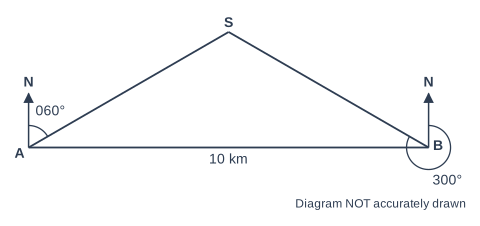
The diagram shows two coastguard stations, A and B. B is 10 km due east of A. A ship S is on a bearing of 060° from A and on a bearing of 300° from B.
Work out the exact distance AS.
Model answer
Angle SAB \(= 90 - 60 = 30^\circ\) (AB points due east). Angle SBA \(= 300 - 270 = 30^\circ\) (BA points due west). So triangle ASB is isosceles and the perpendicular from S meets AB at its midpoint M, with AM = 5 km. \(\cos 30^\circ = \dfrac{5}{AS}\), so \(AS = \dfrac{5}{\frac{\sqrt{3}}{2}} = \dfrac{10}{\sqrt{3}} = \dfrac{10\sqrt{3}}{3}\) km
Explanation
Turn both bearings into angles inside triangle ASB: both base angles are 30°, so the triangle is isosceles. Splitting it down the middle gives a right-angled triangle with an exact cosine. Rationalise the denominator for a neat exact answer.
Mark scheme
1 mark
P1 for angle SAB \(= 90 - 60 = 30^\circ\)
correct answer with no working scores full marks
1 mark
P1 for angle SBA \(= 300 - 270 = 30^\circ\), so triangle ASB is isosceles and the foot of the perpendicular from S is the midpoint of AB (5 km from A)
1 mark
P1 for \(\cos 30^\circ = \dfrac{5}{AS}\), or the sine rule \(\dfrac{AS}{\sin 30^\circ} = \dfrac{10}{\sin 120^\circ}\)
1 mark
A1 for \(\dfrac{10\sqrt{3}}{3}\) (km)
oe, e.g. \(\dfrac{10}{\sqrt{3}}\)
Ready to try the rest? Every answer you write is marked against the mark scheme, so you can see exactly where the marks are.
Ctrl + Enter to check
AI TutorHints first, answers after you try
Hi! Stuck? Ask me for a hint and I’ll help you work it out. Once you’ve checked your answer I can explain exactly where the marks are.