Practise 30 exam-style questions on Forming and solving equations for Edexcel GCSE Maths (Non-calculator). Write your answer as you would in the exam and get it marked in seconds against the mark scheme, point by point, with an AI tutor on hand if you get stuck.
30 questions
1–5 marks each
Instant marking
No sign-up needed
20 questions, marked as you go
Sample questions with model answers
Here are 4 of the questions in this topic, each with a model answer, an explanation of why it earns the marks and the mark scheme an examiner would use.
Question 1
2 marks
Ali thinks of a number. He multiplies it by 3 and then subtracts 7. His answer is the same as when he adds 9 to the number he first thought of.
Work out the number Ali thought of.
Model answer
Let the number be \(n\). \(3n - 7 = n + 9\) \(2n = 16\) \(n = 8\)
Explanation
Write each procedure as an expression in \(n\) and set them equal, because the results are the same. Check: \(3 \times 8 - 7 = 17\) and \(8 + 9 = 17\).
Mark scheme
1 mark
M1 for forming the equation \(3n - 7 = n + 9\)
oe; correct answer with no working scores full marks
1 mark
A1 for 8
cao
Question 2
3 marks
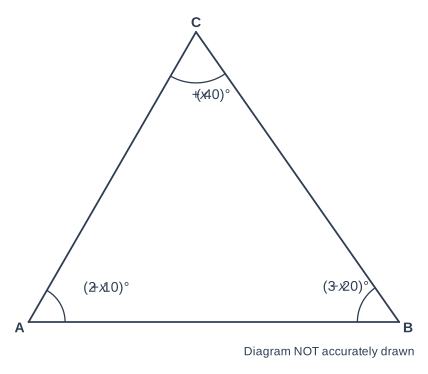
The diagram shows a triangle ABC. The sizes of its angles are given in terms of \(x\).
Work out the size of the largest angle of the triangle.
Model answer
Angles in a triangle add up to 180°. \((2x + 10) + (3x - 20) + (x + 40) = 180\) \(6x + 30 = 180\) \(x = 25\) Angles: \(2(25) + 10 = 60^\circ\), \(3(25) - 20 = 55^\circ\), \(25 + 40 = 65^\circ\) The largest angle is 65°.
Explanation
Use the angle sum of a triangle to form an equation and solve for \(x\). Then substitute back to find every angle: the term with the largest coefficient of \(x\) does not always give the largest angle. Check: \(60 + 55 + 65 = 180\).
Mark scheme
1 mark
M1 for forming the equation \(2x + 10 + 3x - 20 + x + 40 = 180\)
oe, e.g. \(6x + 30 = 180\); correct answer with no working scores full marks
1 mark
A1 for \(x = 25\)
1 mark
A1 for 65°
cao
Question 3
3 marks
The product of two consecutive positive odd numbers is 195.
Use algebra to find the two numbers.
Model answer
Let the numbers be \(n\) and \(n + 2\). \(n(n + 2) = 195\) \(n^2 + 2n - 195 = 0\) \((n + 15)(n - 13) = 0\) \(n = 13\) (the numbers are positive, so reject \(n = -15\)) The numbers are 13 and 15.
Explanation
Consecutive odd numbers differ by 2. The product gives a quadratic; look for factors of 195 that differ by 2 (13 and 15). Reject the negative solution because the numbers are positive.
Mark scheme
1 mark
P1 for forming an equation, e.g. \(n(n + 2) = 195\)
oe, e.g. \((2k - 1)(2k + 1) = 195\)
1 mark
P1 for rearranging and solving, e.g. \(n^2 + 2n - 195 = 0\), \((n + 15)(n - 13) = 0\)
1 mark
A1 for 13 and 15
answer only with no algebra scores 0
Question 4
4 marks
Coffee A costs £8 per kg. Coffee B costs £14 per kg. A shop mixes the two coffees to make 30 kg of a blend that costs £10 per kg.
How many kilograms of each coffee are in the blend?
Model answer
Let the blend contain \(a\) kg of A and \(b\) kg of B. \(a + b = 30\) Total cost \(= 30 \times 10 = 300\), so \(8a + 14b = 300\) Substitute \(b = 30 - a\): \(8a + 420 - 14a = 300\) \(-6a = -120\) \(a = 20\), \(b = 10\) 20 kg of coffee A and 10 kg of coffee B
Explanation
One equation comes from the total mass and the other from the total cost (30 kg at £10 per kg is £300). Check: \(20 \times 8 + 10 \times 14 = 160 + 140 = 300\).
Mark scheme
1 mark
P1 for forming the equation for the mass, \(a + b = 30\)
correct answer with no working scores full marks
1 mark
P1 for forming the equation for the cost, \(8a + 14b = 300\)
1 mark
P1 for a correct method to solve their equations, e.g. \(8a + 14(30 - a) = 300\)
1 mark
A1 for 20 kg of A and 10 kg of B
both needed
Ready to try the rest? Every answer you write is marked against the mark scheme, so you can see exactly where the marks are.
Ctrl + Enter to check
AI TutorHints first, answers after you try
Hi! Stuck? Ask me for a hint and I’ll help you work it out. Once you’ve checked your answer I can explain exactly where the marks are.