
Level:
Correct: 0
Incorrect: 0
Marks: 0/0
Exam Practice
Subject:
Topics:
Edexcel GCSE Maths (Non-calculator) Smart practice A mixed round aimed at your weak spots
Unit 1
Number
Unit 2
Algebra
Unit 3
Ratio, proportion and rates of change
Unit 4
Geometry and measures
Unit 5
Probability
Unit 6
Statistics
Avg
score:
–
Topics
done:
0/97

Equations for direct and inverse proportion

Practise 28 exam-style questions on Equations for direct and inverse proportion for Edexcel GCSE Maths (Non-calculator). Write your answer as you would in the exam and get it marked in seconds against the mark scheme, point by point, with an AI tutor on hand if you get stuck.

  • 28 questions
  • 1–5 marks each
  • Instant marking
  • No sign-up needed
20 questions, marked as you go

Sample questions with model answers

Here are 4 of the questions in this topic, each with a model answer, an explanation of why it earns the marks and the mark scheme an examiner would use.

Question 1

2 marks

\(y\) is directly proportional to \(x^2\).
When \(x = 3\), \(y = 36\).

Find a formula for \(y\) in terms of \(x\).

Model answer

\(y = kx^2\)
\(36 = k \times 9\), so \(k = 4\)
\(y = 4x^2\)

Explanation

Write the proportion as an equation with a constant \(k\), substitute the given pair of values to find \(k\), then write the formula with \(k\) replaced by its value.

Mark scheme
  1. 1 mark

    M1 for \(36 = k \times 3^2\) oe

    correct answer with no working scores full marks

  2. 1 mark

    A1 for \(y = 4x^2\)

    k = 4 only (no formula) scores M1 A0
Question 2

2 marks

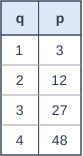
The table shows some values of \(p\) and \(q\).

Is \(p\) directly proportional to \(q\), to \(q^2\) or to \(q^3\)? You must show how you get your answer.

Table with columns "q", "p". q: 1; p: 3 | q: 2; p: 12 | q: 3; p: 27 | q: 4; p: 48.

Model answer

\(\dfrac{p}{q}\): 3, 6, 9, 12, which is not constant.
\(\dfrac{p}{q^2}\): \(\dfrac{3}{1} = 3\), \(\dfrac{12}{4} = 3\), \(\dfrac{27}{9} = 3\), \(\dfrac{48}{16} = 3\), which is constant.
So \(p = 3q^2\): \(p\) is directly proportional to \(q^2\).

Explanation

If \(p\) is directly proportional to \(q^n\), then \(\frac{p}{q^n}\) is the same for every pair. Test the possibilities until one gives a constant. Another clue: when \(q\) doubles, \(p\) is multiplied by 4 = \(2^2\).

Mark scheme
  1. 1 mark

    M1 for working out \(\dfrac{p}{q^2}\) for at least two pairs (= 3), or showing \(\dfrac{p}{q}\) is not constant and that doubling \(q\) (1 to 2, or 2 to 4) multiplies \(p\) by 4

  2. 1 mark

    C1 for \(p\) is directly proportional to \(q^2\), with \(\dfrac{p}{q^2} = 3\) shown for every pair (or \(p = 3q^2\) checked for every pair)

Question 3

3 marks

The cost, £\(C\), of a circular rug is directly proportional to the square of its diameter, \(d\) metres.
A rug with diameter 1.2 m costs £72.

Work out the cost of a rug with diameter 1.8 m.

Model answer

\(C = kd^2\)
\(72 = k \times 1.44\), so \(k = 50\)
\(C = 50 \times 1.8^2 = 50 \times 3.24 = £162\)

Explanation

Since \(C = kd^2\), multiplying the diameter by 1.5 multiplies the cost by \(1.5^2 = 2.25\): 72 × 2.25 = 162. Working with the scale factor avoids dividing by 1.44.

Mark scheme
  1. 1 mark

    M1 for \(C = kd^2\), or the diameter scale factor \(\dfrac{1.8}{1.2} = 1.5\)

    correct answer with no working scores full marks

  2. 1 mark

    M1 for \(k = 72 \div 1.44 = 50\), or \(1.5^2 = 2.25\)

  3. 1 mark

    A1 for £162

    cao; £108 (direct proportion to d) scores M1 M0 A0

Question 4

4 marks

\(y\) is inversely proportional to \(x^n\), where \(n\) is a positive integer.
When \(x = 2\), \(y = 18\).
When \(x = 6\), \(y = 2\).

Find the value of \(n\).

Model answer

\(k = x^n y\), so \(18 \times 2^n = 2 \times 6^n\)
\(9 \times 2^n = 6^n\)
\(9 = \dfrac{6^n}{2^n} = 3^n\)
\(n = 2\)
Check: \(k = 18 \times 4 = 72\) and \(\dfrac{72}{6^2} = 2\)

Explanation

The product \(x^n y\) is the same for both pairs, which gives an equation in \(n\). Dividing \(6^n\) by \(2^n\) gives \(3^n\). Another way: \(x\) is multiplied by 3 and \(y\) is divided by 9 = \(3^2\), so \(n = 2\).

Mark scheme
  1. 1 mark

    P1 for \(y = \dfrac{k}{x^n}\), so \(k = 18 \times 2^n\) and \(k = 2 \times 6^n\)

    correct answer with no working scores full marks

  2. 1 mark

    P1 for \(18 \times 2^n = 2 \times 6^n\) oe

  3. 1 mark

    P1 for \(3^n = 9\) oe

    or testing n = 1 (36 and 12) and n = 2 (72 and 72)

  4. 1 mark

    A1 for \(n = 2\)

    cao

Ready to try the rest? Every answer you write is marked against the mark scheme, so you can see exactly where the marks are.

AI Tutor Hints first, answers after you try

Hi! Stuck? Ask me for a hint and I’ll help you work it out. Once you’ve checked your answer I can explain exactly where the marks are.