Practise 36 exam-style questions on Similarity: lengths, areas and volumes for Edexcel GCSE Maths (Non-calculator). Write your answer as you would in the exam and get it marked in seconds against the mark scheme, point by point, with an AI tutor on hand if you get stuck.
36 questions
1–5 marks each
Instant marking
No sign-up needed
20 questions, marked as you go
Sample questions with model answers
Here are 4 of the questions in this topic, each with a model answer, an explanation of why it earns the marks and the mark scheme an examiner would use.
Question 1
1 mark
Zainab says, "Two triangles that both have angles of 40°, 60° and 80° must be congruent."
Explain why Zainab is wrong.
Model answer
Triangles with the same angles are similar, but one could be an enlargement of the other, so their sides could be different lengths. AAA is not a condition for congruence.
Explanation
Congruent shapes are identical in shape and size. Equal angles guarantee the same shape (similarity) but not the same size, which is why every congruence condition (SSS, SAS, ASA, RHS) includes at least one side.
Mark scheme
1 mark
C1 for explaining that the triangles are similar but could be different sizes (equal angles do not fix the lengths of the sides)
oe, e.g. 'AAA is not a condition for congruence'; accept a correct counter-example description
Question 2
2 marks
A photograph has width 10 cm and area 150 cm². The photograph is enlarged to make a similar photograph with area 600 cm².
The area has been multiplied by 4, so each length has been multiplied by \(\sqrt{4} = 2\). Multiplying the width by 4 would make the area 16 times bigger.
Mark scheme
1 mark
M1 for area scale factor 4 and length scale factor \(\sqrt{4} = 2\)
oe; correct answer with no working scores full marks
1 mark
A1 for 20
cao; 40 scores 0
Question 3
3 marks
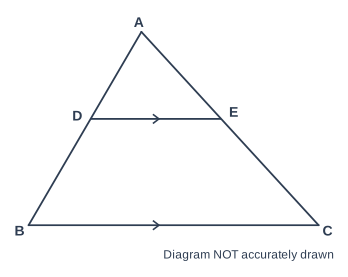
The diagram shows triangle ABC. D is a point on AB and E is a point on AC. DE is parallel to BC.
Prove that triangle ADE is similar to triangle ABC.
Model answer
angle ADE = angle ABC (corresponding angles, DE parallel to BC) angle AED = angle ACB (corresponding angles, DE parallel to BC) angle DAE = angle BAC (common angle) All three pairs of angles are equal, so triangle ADE is similar to triangle ABC.
Explanation
Two triangles are similar when their angles are equal. The parallel lines give two pairs of corresponding angles, and angle A is shared by both triangles. Always give a reason for each pair of equal angles.
Mark scheme
1 mark
B1 for angle ADE = angle ABC (corresponding angles)
or angle AED = angle ACB (corresponding angles)
1 mark
B1 for a second pair of equal angles with a reason, e.g. angle DAE = angle BAC (common angle) or angle AED = angle ACB (corresponding angles)
1 mark
C1 for concluding the triangles are similar because all three pairs of angles are equal (AA)
dependent on two correct pairs of angles with reasons
Question 4
4 marks
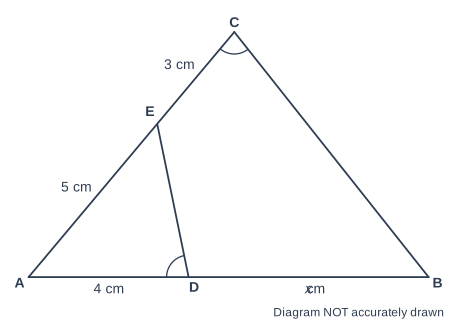
In the diagram, D is a point on AB and E is a point on AC. Angle ADE = angle ACB. AD = 4 cm, AE = 5 cm and EC = 3 cm.
Work out the length of DB.
Model answer
Angle A is common and angle ADE = angle ACB, so triangle ADE is similar to triangle ACB. Corresponding sides: AD with AC, AE with AB. AC = 5 + 3 = 8 cm, so the scale factor from ADE to ACB is \(\dfrac{8}{4} = 2\) AB \(= 5 \times 2 = 10\) cm DB = 10 − 4 = 6 cm
Explanation
Here DE is not parallel to BC, so the triangles are 'flipped': the equal angles show that D matches C and E matches B. So AD corresponds to AC, not to AB. Matching the sides by their opposite angles avoids this trap.
Mark scheme
1 mark
M1 for identifying that triangles ADE and ACB are similar with AD corresponding to AC (and AE to AB)
may be implied by a correct ratio
1 mark
M1 for \(\dfrac{AB}{5} = \dfrac{8}{4}\)
oe, e.g. scale factor 2 from ADE to ACB
1 mark
A1 for AB = 10
1 mark
A1 for DB = 6
cao; accept 6 cm
Ready to try the rest? Every answer you write is marked against the mark scheme, so you can see exactly where the marks are.
Ctrl + Enter to check
AI TutorHints first, answers after you try
Hi! Stuck? Ask me for a hint and I’ll help you work it out. Once you’ve checked your answer I can explain exactly where the marks are.