Practise 29 exam-style questions on Area of a triangle: \\\\u00bdab sin C for Edexcel GCSE Maths (Non-calculator). Write your answer as you would in the exam and get it marked in seconds against the mark scheme, point by point, with an AI tutor on hand if you get stuck.
29 questions
1–5 marks each
Instant marking
No sign-up needed
20 questions, marked as you go
Sample questions with model answers
Here are 4 of the questions in this topic, each with a model answer, an explanation of why it earns the marks and the mark scheme an examiner would use.
Question 1
2 marks
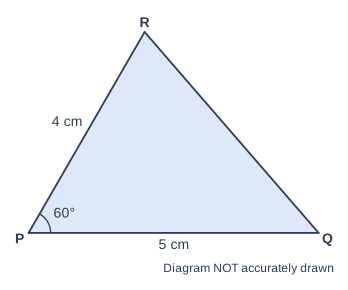
The diagram shows triangle PQR. PQ = 5 cm, PR = 4 cm and angle QPR = 60°.
Use \(\dfrac{1}{2}ab\sin C\) with the two sides that meet at the marked angle. The exact value \(\sin 60° = \dfrac{\sqrt{3}}{2}\) gives an exact surd answer.
Mark scheme
1 mark
M1 for \(\dfrac{1}{2} \times 5 \times 4 \times \sin 60°\)
oe; correct answer with no working scores full marks
1 mark
A1 for \(5\sqrt{3}\)
cao; accept \(5\sqrt{3}\) cm²
Question 2
2 marks
A triangle has two sides of length 6 cm and 8 cm.
Explain why the area of the triangle cannot be more than 24 cm².
Model answer
Let C be the angle between the 6 cm and 8 cm sides. Area \(= \dfrac{1}{2} \times 6 \times 8 \times \sin C = 24\sin C\) The greatest possible value of \(\sin C\) is 1 (when C = 90°), so the area cannot be more than 24 cm².
Explanation
For fixed sides, the area depends only on \(\sin C\), which can never exceed 1. The largest area happens when the two sides are perpendicular.
Mark scheme
1 mark
M1 for area \(= \dfrac{1}{2} \times 6 \times 8 \times \sin C = 24\sin C\)
C is the angle between the two sides
1 mark
C1 for stating that \(\sin C\) is at most 1, so the area is at most 24 cm² (when C = 90°)
Question 3
3 marks
Triangle P has two sides of length 6 cm and 10 cm with an angle of 30° between them. Triangle Q has two sides of length 5 cm and 8 cm with an angle of 60° between them.
Which triangle has the larger area? You must show how you get your answer.
Model answer
Area of P \(= \dfrac{1}{2} \times 6 \times 10 \times \dfrac{1}{2} = 15\) cm² Area of Q \(= \dfrac{1}{2} \times 5 \times 8 \times \dfrac{\sqrt{3}}{2} = 10\sqrt{3}\) cm² \(10\sqrt{3} = \sqrt{300}\) and \(15 = \sqrt{225}\), so \(10\sqrt{3} > 15\). Triangle Q has the larger area.
Explanation
Work out both areas exactly. To compare a surd with a whole number without a calculator, write both as square roots: \(10\sqrt{3} = \sqrt{100 \times 3} = \sqrt{300}\), which is bigger than \(\sqrt{225}\).
Mark scheme
1 mark
M1 for \(\dfrac{1}{2} \times 6 \times 10 \times \sin 30°\) or \(\dfrac{1}{2} \times 5 \times 8 \times \sin 60°\)
oe
1 mark
A1 for both areas: 15 and \(10\sqrt{3}\)
1 mark
C1 for 'Q' with a valid comparison, e.g. \(10\sqrt{3} = \sqrt{300}\) and \(15 = \sqrt{225}\), or \(10\sqrt{3} \approx 17.3\)
ft their areas
Question 4
4 marks
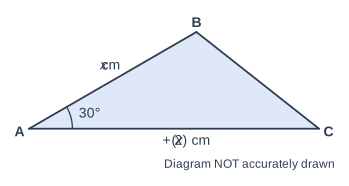
The diagram shows triangle ABC. AB = \(x\) cm, AC = \((x + 2)\) cm and angle BAC = 30°. The area of triangle ABC is 6 cm².
Form an equation using the area formula with the algebraic sides. Multiplying out gives a quadratic; reject the negative root because \(x\) is a length. Check: \(\dfrac{1}{2} \times 4 \times 6 \times \dfrac{1}{2} = 6\).
Mark scheme
1 mark
M1 for \(\dfrac{1}{2} \times x \times (x + 2) \times \sin 30° = 6\)
oe; correct answer with no working scores full marks
1 mark
M1 for \(x^2 + 2x - 24 = 0\)
oe, e.g. \(x(x + 2) = 24\)
1 mark
M1 for \((x + 6)(x - 4) = 0\)
or any correct method to solve their 3-term quadratic
1 mark
A1 for 4
cao; −6 must be rejected
Ready to try the rest? Every answer you write is marked against the mark scheme, so you can see exactly where the marks are.
Ctrl + Enter to check
AI TutorHints first, answers after you try
Hi! Stuck? Ask me for a hint and I’ll help you work it out. Once you’ve checked your answer I can explain exactly where the marks are.