Practise 28 exam-style questions on Combined transformations for Edexcel GCSE Maths (Non-calculator). Write your answer as you would in the exam and get it marked in seconds against the mark scheme, point by point, with an AI tutor on hand if you get stuck.
28 questions
1–5 marks each
Instant marking
No sign-up needed
20 questions, marked as you go
Sample questions with model answers
Here are 4 of the questions in this topic, each with a model answer, an explanation of why it earns the marks and the mark scheme an examiner would use.
Question 1
2 marks
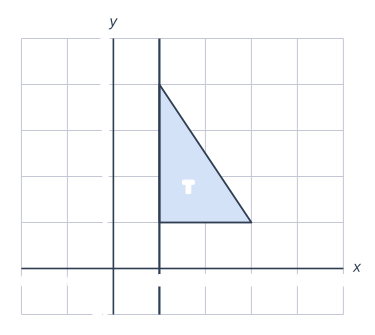
The grid shows triangle T and the line \(x = 1\). Triangle T is reflected in the line \(x = 1\).
Write down the coordinates of the vertices of T that are invariant under this reflection.
Model answer
Invariant points do not move. Under a reflection, the points on the mirror line are invariant. The vertices (1, 1) and (1, 4) lie on x = 1, so they are invariant. (3, 1) maps to (−1, 1), so it is not invariant.
Explanation
A point is invariant if the transformation maps it to itself. In a reflection, exactly the points on the mirror line stay where they are, so check which vertices have x-coordinate 1.
Mark scheme
1 mark
B1 for (1, 1)
correct answer with no working scores full marks
1 mark
B1 for (1, 4)
deduct one mark for (3, 1) included
Question 2
2 marks
A shape is reflected in the x-axis and then the image is reflected in the y-axis.
Find all the points that are invariant under this combined transformation. Give a reason for your answer.
Model answer
(x, y) → (x, −y) → (−x, −y), which is a rotation of 180° about the origin. A point is invariant if (−x, −y) = (x, y), so x = 0 and y = 0. The only invariant point is the origin (0, 0).
Explanation
Points on the x-axis are fixed by the first reflection, and points on the y-axis by the second, but a point must survive both to be invariant overall. Only the origin, where the mirror lines cross, does.
Mark scheme
1 mark
B1 for (0, 0) only
1 mark
C1 for the combination is a rotation of 180° about the origin, (x, y) → (−x, −y), and only the centre is fixed
or −x = x and −y = y give x = 0 and y = 0
Question 3
3 marks
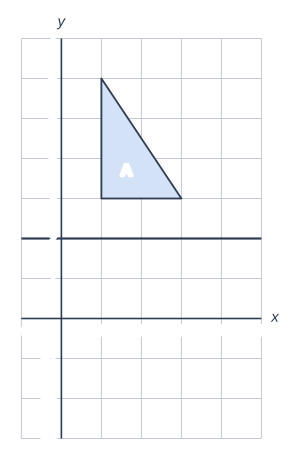
The grid shows shape A and the line \(y = 2\). Shape A is reflected in the line \(y = 2\) to give shape B. Shape B is then translated by the vector \(\begin{pmatrix}0\\4\end{pmatrix}\) to give shape C.
Describe fully the single transformation that maps shape A onto shape C.
Model answer
Reflect in y = 2: (x, y) → (x, 4 − y). B has vertices (1, 1), (3, 1), (1, −2). Translate by (0, 4): C has vertices (1, 5), (3, 5), (1, 2). Overall (x, y) → (x, 8 − y): e.g. (1, 3) → (1, 5), and the midpoint is (1, 4). Single transformation: reflection in the line \(y = 4\).
Explanation
The translation is at right angles to the mirror line, so the combination is still a reflection, in a line moved half the translation distance (2 units) up from y = 2. Check: each point of A and its image in C are the same distance either side of y = 4.
Mark scheme
1 mark
M1 for correct vertices of B, (1, 1), (3, 1), (1, −2), or of C, (1, 5), (3, 5), (1, 2)
at least two correct vertices of C
1 mark
A1 for reflection
1 mark
A1 for in the line \(y = 4\)
B0 for any second transformation
Question 4
4 marks
A shape is rotated 90° clockwise about the origin. The image is then rotated 90° clockwise about the point (2, 0).
Describe fully the single transformation that is equivalent to these two rotations.
Model answer
First rotation (90° clockwise about O): (x, y) → (y, −x). Second rotation (90° clockwise about (2, 0)): (x, y) → (2 + y, 2 − x). Combined: (x, y) → (y, −x) → (2 − x, 2 − y). The point (1, 1) maps to itself, and every other point goes to the other side of (1, 1) at the same distance. Single transformation: rotation of 180° about (1, 1).
Explanation
Two quarter turns in the same direction make a half turn, but because the centres are different the centre of the half turn moves. Find the rule for the combination, or follow two points, then look for the invariant point: here (1, 1).
Mark scheme
1 mark
M1 for the correct images of at least two points after both rotations, e.g. (0, 0) → (0, 0) → (2, 2) and (1, 1) → (1, −1) → (1, 1)
or the rule (x, y) → (2 − x, 2 − y)
1 mark
A1 for rotation
accept enlargement with scale factor −1 for A1 A1 A1
1 mark
A1 for 180°
1 mark
A1 for centre (1, 1)
Ready to try the rest? Every answer you write is marked against the mark scheme, so you can see exactly where the marks are.
Ctrl + Enter to check
AI TutorHints first, answers after you try
Hi! Stuck? Ask me for a hint and I’ll help you work it out. Once you’ve checked your answer I can explain exactly where the marks are.