
Level:
Correct: 0
Incorrect: 0
Marks: 0/0
Exam Practice
Subject:
Topics:
Edexcel GCSE Maths (Non-calculator) Smart practice A mixed round aimed at your weak spots
Unit 1
Number
Unit 2
Algebra
Unit 3
Ratio, proportion and rates of change
Unit 4
Geometry and measures
Unit 5
Probability
Unit 6
Statistics
Avg
score:
–
Topics
done:
0/97

Geometric notation, polygons and symmetry

Practise 20 exam-style questions on Geometric notation, polygons and symmetry for Edexcel GCSE Maths (Non-calculator). Write your answer as you would in the exam and get it marked in seconds against the mark scheme, point by point, with an AI tutor on hand if you get stuck.

  • 20 questions
  • 1–5 marks each
  • Instant marking
  • No sign-up needed
20 questions, marked as you go

Sample questions with model answers

Here are 4 of the questions in this topic, each with a model answer, an explanation of why it earns the marks and the mark scheme an examiner would use.

Question 1

1 mark

The diagram shows a regular pentagon ABCDE.
The diagonal BE is drawn.

Write down the side of the pentagon that is parallel to BE.
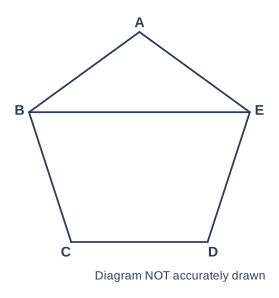
Geometry diagram, marked "Diagram NOT accurately drawn". Regular pentagon ABCDE. Line segment BE is drawn.

Model answer

CD is parallel to BE.

Explanation

A regular pentagon has a line of symmetry through A and the midpoint of CD. Both BE and CD are perpendicular to this line of symmetry, so they are parallel. In a regular pentagon every diagonal is parallel to the one side that it does not touch.

Mark scheme
  1. 1 mark

    B1 for CD

    accept DC

Question 2

2 marks

ABCD is a square. The vertices are in order around the square.
A is the point (1, 2), B is the point (4, 6) and C is the point (8, 3).

Work out the coordinates of D.

Model answer

From B to C: 4 right and 3 down, \(\begin{pmatrix}4\\-3\end{pmatrix}\)
AD is equal and parallel to BC, so D = (1 + 4, 2 − 3)
D = (5, −1)

Explanation

In a square, opposite sides are equal and parallel, so the same translation that takes B to C also takes A to D. You can check that AB and BC are both 5 units long and perpendicular, so the answer really is a square.

Mark scheme
  1. 1 mark

    M1 for a correct method, e.g. using that the move from B to C (4 right, 3 down) also takes A to D, or the move from B to A (3 left, 4 down) also takes C to D

    may be shown on a sketch or as a column vector; correct answer with no working scores full marks

  2. 1 mark

    A1 for (5, −1)

    cao

Question 3

3 marks

Triangle XYZ is labelled using the standard convention for the sides and angles of a triangle.
x = 7 cm, y = 7 cm and angle Z = 40°.

Work out the size of angle X.

Model answer

Side x is opposite angle X, so x = YZ.
Side y is opposite angle Y, so y = XZ.
YZ = XZ = 7 cm, so triangle XYZ is isosceles with angle X = angle Y.
Angle X = (180° − 40°) ÷ 2 = 70°

Explanation

In the standard convention a lower-case letter names the side opposite the angle with the same capital letter. Equal sides x and y are opposite angles X and Y, so those base angles are equal and share the 140° left over from angle Z. A common mistake is to think angle X is opposite side y.

Mark scheme
  1. 1 mark

    B1 for identifying that side x is YZ and side y is XZ, so angle X = angle Y

    oe, e.g. 'the sides opposite X and Y are equal, so angles X and Y are equal'; may be implied by the method that follows

  2. 1 mark

    M1 for (180 − 40) ÷ 2

  3. 1 mark

    A1 for 70°

    cao

Question 4

4 marks

Regular polygon P has rotational symmetry of order n.
Regular polygon Q has twice as many lines of symmetry as polygon P.
Each interior angle of Q is 30° greater than each interior angle of P.

Work out the value of n.

Model answer

A regular polygon has the same number of sides, lines of symmetry and order of rotational symmetry.
P has n sides and Q has 2n sides.
Exterior angle of P \(= \dfrac{360}{n}\), exterior angle of Q \(= \dfrac{360}{2n} = \dfrac{180}{n}\)
The interior angle of Q is 30° more, so the exterior angle of Q is 30° less:
\(\dfrac{360}{n} - \dfrac{180}{n} = 30\)
\(\dfrac{180}{n} = 30\)
\(n = 6\)

Explanation

For a regular polygon, the number of sides equals the number of lines of symmetry and the order of rotational symmetry, so P has n sides and Q has 2n. Working with exterior angles (360 ÷ number of sides) is quickest: a larger interior angle means a smaller exterior angle. Check: a regular hexagon has interior angle 120° and a regular 12-sided polygon has 150°.

Mark scheme
  1. 1 mark

    P1 for recognising that P has n sides and Q has 2n sides

    correct answer with no working scores full marks

  2. 1 mark

    P1 for correct expressions for the exterior or interior angles, e.g. \(\dfrac{360}{n}\) and \(\dfrac{360}{2n}\), or \(180 - \dfrac{360}{n}\) and \(180 - \dfrac{360}{2n}\)

  3. 1 mark

    P1 for a correct equation, e.g. \(\dfrac{360}{n} - \dfrac{180}{n} = 30\) or \(\dfrac{180}{n} = 30\)

    oe

  4. 1 mark

    A1 for \(n = 6\)

    cao; a correct answer from trials must be supported by a check, e.g. hexagon 120°, dodecagon 150°

Ready to try the rest? Every answer you write is marked against the mark scheme, so you can see exactly where the marks are.

AI Tutor Hints first, answers after you try

Hi! Stuck? Ask me for a hint and I’ll help you work it out. Once you’ve checked your answer I can explain exactly where the marks are.