Practise 37 exam-style questions on Circles, surface area and volume of solids for Edexcel GCSE Maths (Non-calculator). Write your answer as you would in the exam and get it marked in seconds against the mark scheme, point by point, with an AI tutor on hand if you get stuck.
37 questions
1–5 marks each
Instant marking
No sign-up needed
20 questions, marked as you go
Sample questions with model answers
Here are 4 of the questions in this topic, each with a model answer, an explanation of why it earns the marks and the mark scheme an examiner would use.
Question 1
2 marks
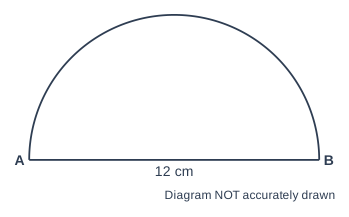
The diagram shows a semicircle with diameter AB = 12 cm.
Work out the perimeter of the semicircle. Give your answer in terms of \(\pi\).
Model answer
Curved part \(= \frac{1}{2} \times \pi \times 12 = 6\pi\) cm Straight part = 12 cm Perimeter \(= 6\pi + 12\) cm
Explanation
The perimeter is the distance all the way round: half the circumference of the full circle plus the straight diameter. Forgetting the diameter is the most common mistake.
Mark scheme
1 mark
M1 for the curved part \(\frac{1}{2} \times \pi \times 12\) (= \(6\pi\))
correct answer with no working scores full marks
1 mark
A1 for \(6\pi + 12\) (cm)
oe; \(6\pi\) alone scores M1 A0
Question 2
2 marks
A cone has base radius \(r\) and slant height \(3r\).
Show that the total surface area of the cone is \(4\pi r^2\). (Curved surface area of a cone \(= \pi r l\), where \(l\) is the slant height)
Model answer
Curved surface area \(= \pi r l = \pi \times r \times 3r = 3\pi r^2\) Area of base \(= \pi r^2\) Total surface area \(= 3\pi r^2 + \pi r^2 = 4\pi r^2\)
Explanation
The total surface area of a solid cone is the curved surface plus the circular base. Substitute \(l = 3r\) and collect like terms.
Mark scheme
1 mark
M1 for \(\pi \times r \times 3r + \pi r^2\)
1 mark
C1 for \(3\pi r^2 + \pi r^2 = 4\pi r^2\)
answer only scores 0 (show that); omitting the base scores M0
Question 3
3 marks
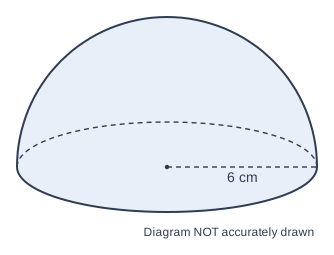
The diagram shows a solid hemisphere with radius 6 cm.
Work out the total surface area of the hemisphere. Give your answer in terms of \(\pi\). (Surface area of a sphere \(= 4\pi r^2\))
A solid hemisphere has half the surface of a sphere plus a flat circle. Forgetting the flat face is the most common mistake.
Mark scheme
1 mark
M1 for the curved surface \(\frac{1}{2} \times 4 \times \pi \times 6^2\) (= \(72\pi\))
correct answer with no working scores full marks
1 mark
M1 for the flat base \(\pi \times 6^2\) (= \(36\pi\))
1 mark
A1 for \(108\pi\) (cm²)
cao
Question 4
4 marks
A cylindrical jug has radius 6 cm and height 8 cm. It is full of water. All the water is poured into an empty bowl in the shape of a hemisphere with radius 6 cm.
Show that the bowl cannot hold all the water, and work out the volume of water that overflows. Give your answer in terms of \(\pi\). (Volume of a sphere \(= \frac{4}{3}\pi r^3\))
Model answer
Volume of water \(= \pi \times 6^2 \times 8 = 288\pi\) cm³ Volume of bowl \(= \frac{1}{2} \times \frac{4}{3} \times \pi \times 216 = 144\pi\) cm³ \(144\pi < 288\pi\), so the bowl cannot hold all the water. Overflow \(= 288\pi - 144\pi = 144\pi\) cm³
Explanation
Compare the volume of water with the capacity of the bowl. Keeping both in terms of \(\pi\) makes the comparison easy; the jug holds exactly twice as much as the bowl.
Mark scheme
1 mark
M1 for the volume of the jug \(\pi \times 6^2 \times 8\) (= \(288\pi\))
1 mark
M1 for the volume of the bowl \(\frac{1}{2} \times \frac{4}{3} \times \pi \times 6^3\) (= \(144\pi\))
1 mark
M1 for comparing or subtracting: \(288\pi - 144\pi\)
1 mark
C1 for the bowl holds only \(144\pi\), which is less than \(288\pi\), and \(144\pi\) cm³ overflows
Ready to try the rest? Every answer you write is marked against the mark scheme, so you can see exactly where the marks are.
Ctrl + Enter to check
AI TutorHints first, answers after you try
Hi! Stuck? Ask me for a hint and I’ll help you work it out. Once you’ve checked your answer I can explain exactly where the marks are.