Practise 19 exam-style questions on Properties of 3D shapes for Edexcel GCSE Maths (Non-calculator). Write your answer as you would in the exam and get it marked in seconds against the mark scheme, point by point, with an AI tutor on hand if you get stuck.
19 questions
1–5 marks each
Instant marking
No sign-up needed
19 questions, marked as you go
Sample questions with model answers
Here are 4 of the questions in this topic, each with a model answer, an explanation of why it earns the marks and the mark scheme an examiner would use.
Question 1
2 marks
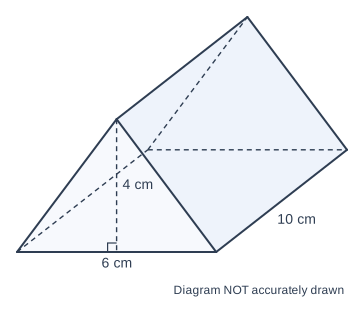
The diagram shows a triangular prism.
Write down the number of faces, the number of edges and the number of vertices of the prism.
Model answer
Faces: 5 (2 triangles and 3 rectangles) Edges: 9 (3 on each triangle and 3 joining them) Vertices: 6
Explanation
Count systematically: a prism has two end faces plus one rectangular face for each side of the cross-section. Each triangular end has 3 edges and 3 vertices, and 3 more edges join the two ends.
Mark scheme
1 mark
B1 for two of: 5 faces, 9 edges, 6 vertices
1 mark
B1 for all three correct: 5 faces, 9 edges, 6 vertices
all three correct scores 2 marks
Question 2
2 marks
Explain why the number of edges of any prism is a multiple of 3.
Model answer
Let the cross-section of the prism have \(n\) sides. Each of the two end faces has \(n\) edges: \(2n\) edges. Each vertex of one end is joined to the matching vertex of the other end: \(n\) more edges. Total \(= 2n + n = 3n\), which is always a multiple of 3.
Explanation
An explanation must work for every prism, so use \(n\) for the number of sides of the cross-section rather than checking one example. The edges come in three groups of \(n\).
Mark scheme
1 mark
M1 for using a cross-section with \(n\) sides: \(n\) edges on each end face and \(n\) edges joining the two ends
oe in words
1 mark
C1 for total \(n + n + n = 3n\), which is a multiple of 3
a numerical example alone scores 0
Question 3
3 marks
A regular tetrahedron is a triangular-based pyramid whose four faces are all equilateral triangles. Every edge of a regular tetrahedron is 4 cm long.
Work out the exact total surface area of the tetrahedron.
Model answer
Area of one face \(= \frac{1}{2} \times 4 \times 4 \times \sin 60^\circ = 8 \times \dfrac{\sqrt{3}}{2} = 4\sqrt{3}\) cm² There are 4 faces. Total surface area \(= 4 \times 4\sqrt{3} = 16\sqrt{3}\) cm²
Explanation
A tetrahedron has 4 triangular faces, and here they are identical equilateral triangles. Use area \(= \frac{1}{2}ab\sin C\) with the exact value \(\sin 60^\circ = \frac{\sqrt{3}}{2}\), or find the height by Pythagoras' theorem.
Mark scheme
1 mark
M1 for the area of one face: \(\frac{1}{2} \times 4 \times 4 \times \sin 60^\circ\) or \(\frac{1}{2} \times 4 \times \sqrt{12}\)
height of each triangle \(= \sqrt{4^2 - 2^2} = \sqrt{12} = 2\sqrt{3}\); correct answer with no working scores full marks
1 mark
M1 for \(4 \times\) their area of one face
1 mark
A1 for \(16\sqrt{3}\) (cm²)
oe, e.g. \(8\sqrt{12}\); do not accept a decimal
Question 4
4 marks
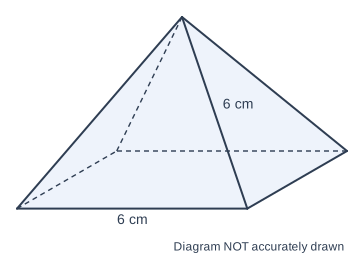
The diagram shows a square-based pyramid. All 8 edges of the pyramid are 6 cm long.
Work out the exact total surface area of the pyramid.
Model answer
The faces are one square of side 6 cm and four equilateral triangles of side 6 cm. Area of square \(= 6^2 = 36\) cm² Area of one triangle \(= \frac{1}{2} \times 6 \times 6 \times \sin 60^\circ = 18 \times \dfrac{\sqrt{3}}{2} = 9\sqrt{3}\) cm² Total surface area \(= 36 + 4 \times 9\sqrt{3} = 36 + 36\sqrt{3}\) cm²
Explanation
Because every edge is 6 cm, each sloping face has three 6 cm sides, so it is equilateral. Use the exact value of \(\sin 60^\circ\) (or Pythagoras for the triangle's height) to keep the answer exact.
Mark scheme
1 mark
B1 for identifying the faces: one square of side 6 cm and four equilateral triangles of side 6 cm
may be implied by working
1 mark
M1 for the area of one triangle: \(\frac{1}{2} \times 6 \times 6 \times \sin 60^\circ\) or \(\frac{1}{2} \times 6 \times \sqrt{27}\)
height of each triangle \(= \sqrt{6^2 - 3^2} = \sqrt{27} = 3\sqrt{3}\)
1 mark
M1 for \(36 + 4 \times\) their triangle area
1 mark
A1 for \(36 + 36\sqrt{3}\) (cm²)
oe, e.g. \(36(1 + \sqrt{3})\)
Ready to try the rest? Every answer you write is marked against the mark scheme, so you can see exactly where the marks are.
Ctrl + Enter to check
AI TutorHints first, answers after you try
Hi! Stuck? Ask me for a hint and I’ll help you work it out. Once you’ve checked your answer I can explain exactly where the marks are.