Practise 28 exam-style questions on Recognising and sketching graphs for Edexcel GCSE Maths (Non-calculator). Write your answer as you would in the exam and get it marked in seconds against the mark scheme, point by point, with an AI tutor on hand if you get stuck.
28 questions
1–5 marks each
Instant marking
No sign-up needed
20 questions, marked as you go
Sample questions with model answers
Here are 4 of the questions in this topic, each with a model answer, an explanation of why it earns the marks and the mark scheme an examiner would use.
Question 1
2 marks
Write down the equations of the two asymptotes of the graph of \(y = \dfrac{1}{x}\).
Model answer
\(x = 0\) and \(y = 0\)
Explanation
An asymptote is a line the graph gets closer and closer to but never meets. \(\frac{1}{x}\) cannot be worked out when \(x = 0\), so the graph never meets the y-axis (\(x = 0\)). \(\frac{1}{x}\) is never 0, so the graph never meets the x-axis (\(y = 0\)).
Mark scheme
1 mark
B1 for \(x = 0\)
accept 'the y-axis'; correct answer with no working scores full marks
1 mark
B1 for \(y = 0\)
accept 'the x-axis'
Question 2
2 marks
The graph of \(y = x^2 + c\) passes through the point \((3, 5)\).
Find the value of \(c\), and write down the coordinates of the turning point of the graph.
Model answer
\(5 = 3^2 + c\), so \(c = -4\) \(y = x^2 - 4\) has its turning point (minimum) at \((0, -4)\).
Explanation
Substitute the point to find \(c\). The graph of \(y = x^2 + c\) is the graph of \(y = x^2\) moved up or down, so its minimum point is on the y-axis at \((0, c)\).
Mark scheme
1 mark
B1 for \(c = -4\)
correct answer with no working scores full marks
1 mark
B1 for \((0, -4)\)
ft \((0, c)\)
Question 3
3 marks
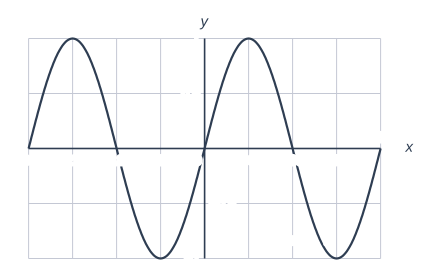
Here is the graph of \(y = \sin x\) for \(-360^\circ \le x \le 360^\circ\).
You are given that \(\sin 30^\circ = 0.5\).
Solve \(2\sin x + 1 = 0\) for \(-360^\circ \le x \le 360^\circ\).
Model answer
\(2\sin x + 1 = 0\), so \(\sin x = -0.5\) Between 0° and 360°: \(180^\circ + 30^\circ = 210^\circ\) and \(360^\circ - 30^\circ = 330^\circ\) Between \(-360^\circ\) and 0°: subtract 360°: \(210^\circ - 360^\circ = -150^\circ\) and \(330^\circ - 360^\circ = -30^\circ\) \(x = -150^\circ, -30^\circ, 210^\circ, 330^\circ\)
Explanation
Rearrange to get \(\sin x\) on its own first. The sine graph is negative between 180° and 360°, and by symmetry the solutions there are \(180^\circ + 30^\circ\) and \(360^\circ - 30^\circ\). The graph repeats every 360°, so subtract 360° to find the solutions in the negative range.
Mark scheme
1 mark
B1 for \(\sin x = -0.5\)
correct answer with no working scores full marks
1 mark
B1 for 210° and 330°
1 mark
B1 for \(-30^\circ\) and \(-150^\circ\), with no incorrect values
Question 4
4 marks
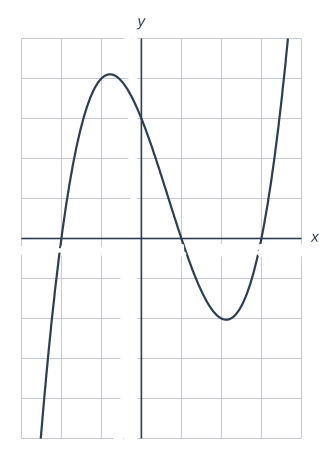
The diagram shows a cubic curve. The points where the curve crosses the axes can be read from the grid.
Show that the equation of the curve can be written as \(y = x^3 - 2x^2 - 5x + 6\).
Model answer
The curve crosses the x-axis at \(x = -2\), 1 and 3, so \(y = a(x + 2)(x - 1)(x - 3)\). \((x + 2)(x - 1) = x^2 + x - 2\) \((x^2 + x - 2)(x - 3) = x^3 - 3x^2 + x^2 - 3x - 2x + 6 = x^3 - 2x^2 - 5x + 6\) When \(x = 0\), \(a \times 6\) must equal the y-intercept 6 read from the graph, so \(a = 1\). So \(y = x^3 - 2x^2 - 5x + 6\).
Explanation
Each root \(x = r\) gives a factor \((x - r)\). The roots alone do not fix the vertical stretch, so check the y-intercept as well. Expand two brackets first, then multiply each term by the third bracket and collect like terms.
Mark scheme
1 mark
B1 for using the roots \(-2\), 1 and 3 to write \((x + 2)(x - 1)(x - 3)\)
1 mark
M1 for expanding two of the brackets correctly, e.g. \(x^2 + x - 2\)
1 mark
A1 for a fully correct expansion to \(x^3 - 2x^2 - 5x + 6\)
1 mark
C1 for using the y-intercept 6 to confirm there is no other constant factor (the coefficient of \(x^3\) is 1)
oe, e.g. showing \(y = 6\) when \(x = 0\) and that this matches the graph
Ready to try the rest? Every answer you write is marked against the mark scheme, so you can see exactly where the marks are.
Ctrl + Enter to check
AI TutorHints first, answers after you try
Hi! Stuck? Ask me for a hint and I’ll help you work it out. Once you’ve checked your answer I can explain exactly where the marks are.