Level:
Correct: 0
Incorrect: 0
Marks: 0/0
Exam Practice
Subject:
Topics:
Edexcel GCSE Maths (Non-calculator) Smart practice A mixed round aimed at your weak spots
Unit 1
Number
Unit 2
Algebra
Unit 3
Ratio, proportion and rates of change
Unit 4
Geometry and measures
Unit 5
Probability
Unit 6
Statistics
Avg
score:
–
Topics
done:
0/97

Plans and elevations

Practise 19 exam-style questions on Plans and elevations for Edexcel GCSE Maths (Non-calculator). Write your answer as you would in the exam and get it marked in seconds against the mark scheme, point by point, with an AI tutor on hand if you get stuck.

  • 19 questions
  • 1–5 marks each
  • Instant marking
  • No sign-up needed
19 questions, marked as you go

Sample questions with model answers

Here are 4 of the questions in this topic, each with a model answer, an explanation of why it earns the marks and the mark scheme an examiner would use.

Question 1

2 marks

The diagram shows a cuboid.

Describe the front elevation and the side elevation of the cuboid, giving their dimensions.
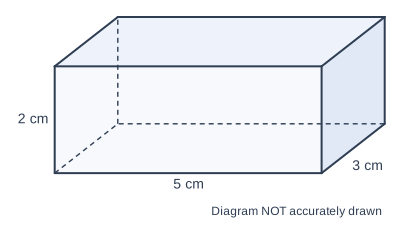
A cuboid drawn in 3D with hidden edges shown as dashed lines. The length is labelled 5 cm (along the front bottom edge). The width (the edge going back) is labelled 3 cm (along the bottom edge going back on the right). The height is labelled 2 cm (along the front left vertical edge). The diagram is labelled "Diagram NOT accurately drawn".

Model answer

Front elevation (looking at the front face): a rectangle 5 cm wide and 2 cm high.
Side elevation (looking from the side): a rectangle 3 cm wide and 2 cm high.

Explanation

An elevation is the view from the front or side, looking horizontally, so it shows the height and one of the horizontal lengths. The front shows the length (5 cm) and the side shows the width (3 cm); both show the height of 2 cm.

Mark scheme
  1. 1 mark

    B1 for front elevation: a rectangle 5 cm by 2 cm

  2. 1 mark

    B1 for side elevation: a rectangle 3 cm by 2 cm

    accept the two views the other way round only if the student clearly takes the 3 cm face as the front
Question 2

2 marks

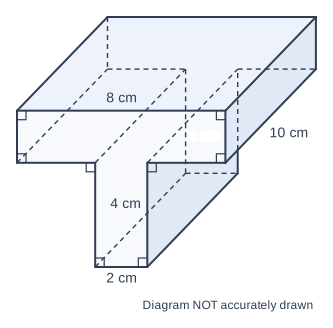
The diagram shows a prism with a T-shaped cross-section at the front. The T-shape is symmetrical.
The front elevation is drawn on a coordinate grid, in centimetres, with the bottom of the stem from (3, 0) to (5, 0) and the top edge of the bar from (0, 6) to (8, 6).

Write down the coordinates of the other four vertices of the front elevation.

A prism drawn in 3D with hidden edges shown as dashed lines. Its front face (the cross-section) is a 8-sided shape with corners at (3, 0), (5, 0), (5, 4), (8, 4), (8, 6), (0, 6), (0, 4), (3, 4) (in order). The length of the prism is labelled 10 cm (along the edge going back from the lowest right-hand corner of the front face). On the front face, the edge from corner 1 to corner 2 is labelled 2 cm, the edge from corner 2 to corner 3 is labelled 4 cm, the edge from corner 4 to corner 5 is labelled 2 cm and the edge from corner 5 to corner 6 is labelled 8 cm. Right angles are marked on the front face. The diagram is labelled "Diagram NOT accurately drawn".

Model answer

The stem is 4 cm high and the bar is 2 cm thick, so the bottom of the bar is at y = 4.
The other vertices are (5, 4), (8, 4), (0, 4) and (3, 4).

Explanation

The front elevation of this prism is the T-shaped cross-section itself. The stem rises 4 cm from the bottom, so the underside of the bar is 4 cm up, and the bar reaches from x = 0 to x = 8.

Mark scheme
  1. 1 mark

    B1 for at least two of (5, 4), (8, 4), (0, 4), (3, 4)

    correct answer with no working scores full marks

  2. 1 mark

    B1 for all four: (5, 4), (8, 4), (0, 4), (3, 4)

    in any order

Question 3

3 marks

A solid is made from centimetre cubes stacked on a 3 by 3 square base.
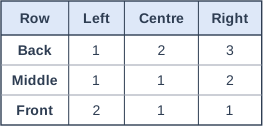
The table shows the plan of the solid. Each number shows how many cubes are stacked on that square.

Work out the number of cubes in the solid and the area of the front elevation.

Table with columns "Row", "Left", "Centre", "Right". Row: Back; Left: 1; Centre: 2; Right: 3 | Row: Middle; Left: 1; Centre: 1; Right: 2 | Row: Front; Left: 2; Centre: 1; Right: 1.

Model answer

Number of cubes \(= 1 + 2 + 3 + 1 + 1 + 2 + 2 + 1 + 1 = 14\)
From the front, each column shows its tallest stack:
Left column: tallest 2, centre column: tallest 2, right column: tallest 3
Area of front elevation \(= 2 + 2 + 3 = 7\) cm²

Explanation

The front elevation shows the outline of the solid seen from the front, so stacks behind each other overlap and only the tallest in each column counts. Each square of the elevation is the 1 cm² face of a cube.

Mark scheme
  1. 1 mark

    B1 for 14 cubes

    correct answer with no working scores full marks

  2. 1 mark

    M1 for using the tallest stack in each column seen from the front: 2, 2 and 3

  3. 1 mark

    A1 for 7 (cm²)

    cao; 14 or 4 (front row only) for the area scores M0 A0

Question 4

4 marks

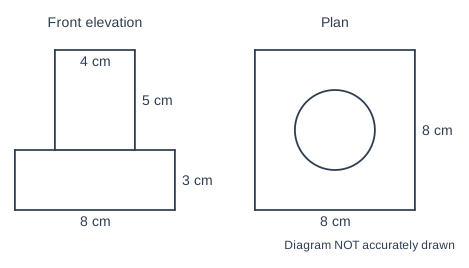
A solid is made from a cuboid with a cylinder on top. Here are its front elevation and plan.
Front elevation: a rectangle 8 cm wide and 3 cm high, with a rectangle 4 cm wide and 5 cm high on top of it in the middle.
Plan: a square of side 8 cm with a circle of diameter 4 cm at its centre.

Work out the volume of the solid.
Give your answer in terms of \(\pi\).

Geometry diagram, marked "Diagram NOT accurately drawn". A circle. A octagon with vertices 8 unlabelled points in order. A horizontal line with no labelled ends is drawn. A square with vertices 4 unlabelled points in order. Side an unlabelled line going to the right is labelled 8 cm. Side an unlabelled line going upwards is labelled 3 cm. Side an unlabelled line going upwards is labelled 5 cm. Side an unlabelled line going to the left is labelled 4 cm. Side an unlabelled line going to the right is labelled 8 cm. Side an unlabelled line going upwards is labelled 8 cm. The text "Front elevation" is written. The text "Plan" is written.

Model answer

The plan shows the cuboid has an 8 cm by 8 cm square base, and the front elevation shows it is 3 cm high.
The cylinder has diameter 4 cm (radius 2 cm) and height 5 cm.
Volume of cuboid \(= 8 \times 8 \times 3 = 192\) cm³
Volume of cylinder \(= \pi \times 2^2 \times 5 = 20\pi\) cm³
Total volume \(= 192 + 20\pi\) cm³

Explanation

Combine the views: the plan gives the cuboid's length and width and shows the cylinder is circular; the front elevation gives the heights. Use the radius, not the diameter, in \(\pi r^2 h\).

Mark scheme
  1. 1 mark

    B1 for identifying a cuboid 8 cm by 8 cm by 3 cm and a cylinder of radius 2 cm and height 5 cm

    may be implied by working

  2. 1 mark

    M1 for \(8 \times 8 \times 3\) (= 192)

  3. 1 mark

    M1 for \(\pi \times 2^2 \times 5\) (= \(20\pi\))

  4. 1 mark

    A1 for \(192 + 20\pi\) (cm³)

    oe, e.g. \(4(48 + 5\pi)\)

Ready to try the rest? Every answer you write is marked against the mark scheme, so you can see exactly where the marks are.

AI Tutor Hints first, answers after you try

Hi! Stuck? Ask me for a hint and I’ll help you work it out. Once you’ve checked your answer I can explain exactly where the marks are.