Practise 29 exam-style questions on Comparing lengths, areas and volumes with ratio for Edexcel GCSE Maths (Non-calculator). Write your answer as you would in the exam and get it marked in seconds against the mark scheme, point by point, with an AI tutor on hand if you get stuck.
29 questions
1–5 marks each
Instant marking
No sign-up needed
20 questions, marked as you go
Sample questions with model answers
Here are 4 of the questions in this topic, each with a model answer, an explanation of why it earns the marks and the mark scheme an examiner would use.
Question 1
2 marks
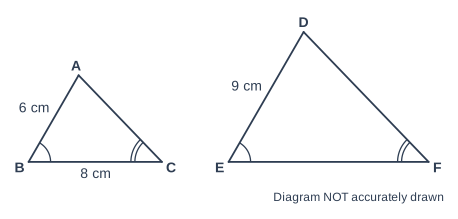
The diagram shows two triangles, ABC and DEF, which are mathematically similar. Angle ABC = angle DEF and angle ACB = angle DFE. AB = 6 cm, BC = 8 cm and DE = 9 cm.
Work out the length of EF.
Model answer
Scale factor = 9 ÷ 6 = 1.5 EF = 8 × 1.5 = 12 cm
Explanation
AB corresponds to DE and BC corresponds to EF, because they lie between the same pairs of equal angles. Find the scale factor from the pair of corresponding sides you know, then multiply.
Mark scheme
1 mark
M1 for the scale factor \(\dfrac{9}{6}\) (= 1.5) oe
or \(\dfrac{8}{6} \times 9\); correct answer with no working scores full marks
1 mark
A1 for 12 cm
cao
Question 2
2 marks
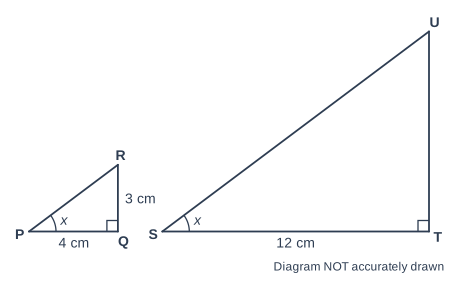
The diagram shows two right-angled triangles, PQR and STU. Angle QPR = angle TSU = \(x\). PQ = 4 cm, QR = 3 cm and ST = 12 cm.
Use the ratio \(\tan x = \dfrac{\text{opposite}}{\text{adjacent}}\) to work out the length of TU.
Model answer
In triangle PQR, \(\tan x = \dfrac{3}{4}\) In triangle STU, \(\tan x = \dfrac{\text{TU}}{12}\) \(\text{TU} = 12 \times \dfrac{3}{4} = 9\) cm
Explanation
The two triangles have the same angles, so they are similar and the ratio opposite ÷ adjacent is the same in both: this is why \(\tan x\) has one value for each angle. Equivalently, the scale factor is 12 ÷ 4 = 3, so TU = 3 × 3 = 9 cm.
Mark scheme
1 mark
M1 for \(\tan x = \dfrac{3}{4}\) and \(\dfrac{\text{TU}}{12} = \dfrac{3}{4}\) oe
or the scale factor 3; correct answer with no working scores full marks
1 mark
A1 for 9 cm
cao
Question 3
3 marks
Triangles A and B are mathematically similar. The area of triangle A is 20 cm² and the area of triangle B is 45 cm². The longest side of triangle B is 12 cm.
Work out the length of the longest side of triangle A.
Model answer
Area ratio A : B = 20 : 45 = 4 : 9 Length ratio A : B = \(\sqrt{4} : \sqrt{9} = 2 : 3\) Longest side of A = \(12 \times \dfrac{2}{3} = 8\) cm
Explanation
Simplify the area ratio first so that both parts are square numbers, then square root to get the length ratio. Triangle A is the smaller triangle, so its side must be less than 12 cm.
Mark scheme
1 mark
M1 for the area ratio 20 : 45 = 4 : 9 oe
correct answer with no working scores full marks
1 mark
M1 for the length ratio 2 : 3, or length scale factor \(\dfrac{2}{3}\) or \(\dfrac{3}{2}\)
1 mark
A1 for 8 cm
cao
Question 4
4 marks
A container is a cone with its vertex at the bottom. The container is 20 cm tall and holds 1600 cm³ of water when it is full. Water is poured into the empty container until the depth of the water is 15 cm.
Work out how much more water is needed to fill the container.
Model answer
The water forms a cone similar to the container. Length scale factor = 15 ÷ 20 = \(\dfrac{3}{4}\) Volume scale factor = \(\left(\dfrac{3}{4}\right)^3 = \dfrac{27}{64}\) Volume of water = \(1600 \times \dfrac{27}{64} = 25 \times 27 = 675\) cm³ More water needed = 1600 − 675 = 925 cm³
Explanation
Because the vertex is at the bottom, the water itself is a smaller cone similar to the whole container, so its volume is the full volume multiplied by the cube of the scale factor. Three-quarters of the depth holds much less than three-quarters of the water.
Mark scheme
1 mark
P1 for the length scale factor \(\dfrac{15}{20} = \dfrac{3}{4}\) oe
correct answer with no working scores full marks
1 mark
P1 for the volume scale factor \(\left(\dfrac{3}{4}\right)^3 = \dfrac{27}{64}\)
1 mark
P1 for the volume of water \(1600 \times \dfrac{27}{64}\) (= 675 cm³)
1 mark
A1 for 925 cm³
cao; 400 (using 3/4) scores P1 P0 P0 A0
Ready to try the rest? Every answer you write is marked against the mark scheme, so you can see exactly where the marks are.
Ctrl + Enter to check
AI TutorHints first, answers after you try
Hi! Stuck? Ask me for a hint and I’ll help you work it out. Once you’ve checked your answer I can explain exactly where the marks are.