Practise 28 exam-style questions on Areas and volumes of prisms for Edexcel GCSE Maths (Non-calculator). Write your answer as you would in the exam and get it marked in seconds against the mark scheme, point by point, with an AI tutor on hand if you get stuck.
28 questions
1–5 marks each
Instant marking
No sign-up needed
20 questions, marked as you go
Sample questions with model answers
Here are 4 of the questions in this topic, each with a model answer, an explanation of why it earns the marks and the mark scheme an examiner would use.
Question 1
2 marks
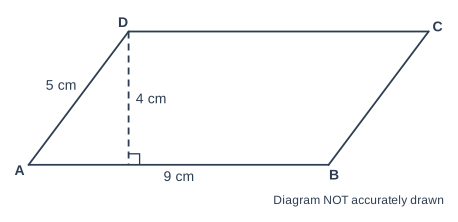
The diagram shows a parallelogram ABCD. AB = 9 cm, AD = 5 cm and the perpendicular height is 4 cm.
Work out the area of the parallelogram.
Model answer
Area = base × perpendicular height \(= 9 \times 4 = 36\) cm²
Explanation
The area of a parallelogram is the base times the perpendicular height, not the sloping side. Cutting off the triangle at one end and moving it to the other end turns the parallelogram into a 9 cm by 4 cm rectangle.
Mark scheme
1 mark
M1 for \(9 \times 4\)
correct answer with no working scores full marks
1 mark
A1 for 36 (cm²)
cao; 45 (using the sloping side) scores M0 A0
Question 2
2 marks
A triangle has an area of 42 cm². The base of the triangle is 12 cm.
Work out the perpendicular height of the triangle.
Model answer
\(\frac{1}{2} \times 12 \times h = 42\) \(6h = 42\) \(h = 7\) cm
Explanation
Substitute into area \(= \frac{1}{2} \times\) base \(\times\) height and solve. Half of 12 is 6, so the height is \(42 \div 6\).
Mark scheme
1 mark
M1 for \(\frac{1}{2} \times 12 \times h = 42\) or \(42 \times 2 \div 12\)
correct answer with no working scores full marks
1 mark
A1 for 7 (cm)
cao; 3.5 (forgetting the half) scores M0 A0
Question 3
3 marks
Cylinder A has radius 6 cm and height 10 cm. It is full of water. All the water is poured into an empty cylinder B, which has radius 4 cm and is tall enough to hold all the water.
Work out the depth of the water in cylinder B.
Model answer
Volume of water \(= \pi \times 6^2 \times 10 = 360\pi\) cm³ In cylinder B: \(\pi \times 4^2 \times h = 360\pi\) \(16h = 360\) \(h = 22.5\) cm
Explanation
The volume of water stays the same when it is poured. Set the volume in cylinder B equal to the volume from cylinder A; the \(\pi\) cancels so no value for \(\pi\) is needed.
Mark scheme
1 mark
M1 for the volume of water \(= \pi \times 6^2 \times 10\) (= \(360\pi\))
correct answer with no working scores full marks
1 mark
M1 for \(360\pi \div (\pi \times 4^2)\)
oe, e.g. \(16\pi h = 360\pi\)
1 mark
A1 for 22.5 (cm)
cao
Question 4
4 marks
A shop sells soup in two sizes of cylindrical can. Can A has radius 3 cm and height 10 cm, and costs 90p. Can B has radius 4 cm and height 9 cm, and costs £1.50.
Which can is the better value for money? You must show your working.
Model answer
Volume of A \(= \pi \times 3^2 \times 10 = 90\pi\) cm³ Volume of B \(= \pi \times 4^2 \times 9 = 144\pi\) cm³ A: 90p for \(90\pi\) cm³, so 1p for each \(\pi\) cm³. At that rate, \(144\pi\) cm³ would cost 144p = £1.44, but B costs £1.50. Can A is the better value.
Explanation
Compare the amount of soup you get for your money. Leaving the volumes in terms of \(\pi\) is fine because \(\pi\) is the same for both cans. Make sure both prices are in the same units (pence).
Mark scheme
1 mark
M1 for the volume of one can: A \(= \pi \times 3^2 \times 10 = 90\pi\) or B \(= \pi \times 4^2 \times 9 = 144\pi\)
1 mark
M1 for the volumes of both cans
1 mark
M1 for comparable values, e.g. cost per \(\pi\) cm³: A 1p, B \(150 \div 144\) (> 1p); or volume per penny: A \(\pi\), B \(0.96\pi\)
or comparing 144π for £1.44 (at A's rate) with £1.50
1 mark
C1 for 'Can A' with correct comparable values
Ready to try the rest? Every answer you write is marked against the mark scheme, so you can see exactly where the marks are.
Ctrl + Enter to check
AI TutorHints first, answers after you try
Hi! Stuck? Ask me for a hint and I’ll help you work it out. Once you’ve checked your answer I can explain exactly where the marks are.