
Level:
Correct: 0
Incorrect: 0
Marks: 0/0
Exam Practice
Course:
Topics:
AQA GCSE Maths (Higher non-calculator) Smart practice A mixed round aimed at your weak spots
Unit 1
Number
Unit 2
Algebra
Unit 3
Ratio, proportion and rates of change
Unit 4
Geometry and measures
Unit 5
Probability
Unit 6
Statistics
Avg
score:
–
Topics
done:
0/97

Venn diagrams and sets

Practise 29 exam-style questions on Venn diagrams and sets for AQA GCSE Maths (Higher non-calculator). Write your answer as you would in the exam and get it marked in seconds against the mark scheme, point by point, with the Study Helper on hand if you get stuck.

  • 29 questions
  • 1–5 marks each
  • Instant marking
  • No sign-up needed
20 questions, marked as you go

Sample questions with model answers

Here are 4 of the questions in this topic, each with a model answer, an explanation of why it earns the marks and the mark scheme an examiner would use.

Question 1

1 mark

\(\xi = \{1, 2, 3, \ldots, 12\}\)
A = {multiples of 3}
B = {factors of 12}

List the elements of \(A \cap B\).

Model answer

\(A = \{3, 6, 9, 12\}\)
\(B = \{1, 2, 3, 4, 6, 12\}\)
\(A \cap B = \{3, 6, 12\}\)

Explanation

List each set systematically from \(\xi\) first. The intersection \(A \cap B\) contains the numbers that appear in both lists. 9 is a multiple of 3 but not a factor of 12, so it is not included.

Mark scheme
  1. 1 mark

    B1 for \(\{3, 6, 12\}\)

    accept 3, 6, 12 in any order, with or without brackets
Question 2

2 marks

\(\xi = \{1, 2, 3, \ldots, 12\}\)
A = {even numbers}
B = {multiples of 3}
C = {factors of 12}

List the elements of \((A \cup B)' \cap C\).

Model answer

\(A = \{2, 4, 6, 8, 10, 12\}\), \(B = \{3, 6, 9, 12\}\)
\(A \cup B = \{2, 3, 4, 6, 8, 9, 10, 12\}\)
\((A \cup B)' = \{1, 5, 7, 11\}\)
\(C = \{1, 2, 3, 4, 6, 12\}\)
\((A \cup B)' \cap C = \{1\}\)

Explanation

Work from the inside of the brackets outwards: find \(A \cup B\), then its complement (the numbers in neither A nor B), then keep only those that are also in C. 1 is a factor of 12 but is neither even nor a multiple of 3.

Mark scheme
  1. 1 mark

    M1 for \(A \cup B = \{2, 3, 4, 6, 8, 9, 10, 12\}\) or \((A \cup B)' = \{1, 5, 7, 11\}\)

    or \(C = \{1, 2, 3, 4, 6, 12\}\) with A and B listed correctly

  2. 1 mark

    A1 for \(\{1\}\)

    accept 1; correct answer with no working scores full marks

Question 3

3 marks

Spinner A is fair and numbered 1, 2, 3 and 4
Spinner B is fair and numbered 1, 2 and 3
In a game, both spinners are spun and the difference between the two numbers is found.

Player 1 wins if the difference is 0 or 1
Otherwise, Player 2 wins.

Is the game fair?
You must show your working.

Model answer

Differences (spinner A down, spinner B across 1, 2, 3):
A = 1: 0, 1, 2
A = 2: 1, 0, 1
A = 3: 2, 1, 0
A = 4: 3, 2, 1
Difference 0 or 1: 8 of the 12 outcomes.
P(Player 1 wins) \(= \dfrac{8}{12} = \dfrac{2}{3}\), P(Player 2 wins) \(= \dfrac{4}{12} = \dfrac{1}{3}\)
No, the game is not fair. Player 1 is twice as likely to win.

Explanation

A game is fair when each player has the same probability of winning. A grid lists all \(4 \times 3 = 12\) equally likely outcomes systematically. Differences of 0 and 1 are much more common than 2 and 3, so Player 1 is favoured.

Mark scheme
  1. 1 mark

    M1 for a sample space of the 12 differences

    e.g. a grid with rows 0 1 2, 1 0 1, 2 1 0, 3 2 1

  2. 1 mark

    M1 for 8 outcomes with a difference of 0 or 1, or 4 outcomes with a difference of 2 or 3

    ft their sample space

  3. 1 mark

    A1 for No with \(\dfrac{8}{12}\) and \(\dfrac{4}{12}\) oe

    e.g. No, Player 1 has a probability of \(\dfrac{2}{3}\) of winning; answer only scores 0

Question 4

4 marks

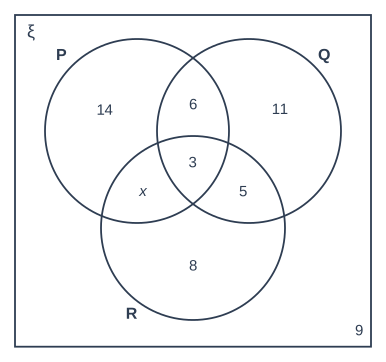
There are 60 people in \(\xi\).
The Venn diagram shows the number of people in each region.

One of the people in set R is chosen at random.
Work out the probability that this person is also in set P.

A Venn diagram: a rectangle labelled ξ (the universal set) containing three overlapping circles labelled P, Q and R, each overlapping the other two. The numbers written in each region are: P ∩ Q′ ∩ R′ (in P only): 14; P′ ∩ Q ∩ R′ (in Q only): 11; P′ ∩ Q′ ∩ R (in R only): 8; P ∩ Q ∩ R′ (in P and Q but not R): 6; P ∩ Q′ ∩ R (in P and R but not Q): x; P′ ∩ Q ∩ R (in Q and R but not P): 5; P ∩ Q ∩ R (in all three): 3; P′ ∩ Q′ ∩ R′ (outside all three circles): 9.

Model answer

\(14 + 11 + 8 + 6 + 5 + 3 + 9 = 56\)
\(x = 60 - 56 = 4\)
People in R \(= 8 + 4 + 5 + 3 = 20\)
People in both P and R \(= 4 + 3 = 7\)
Probability \(= \dfrac{7}{20}\)

Explanation

All eight regions add up to the 60 people in \(\xi\), which gives \(x\). The person is chosen from set R, so the denominator is everyone inside circle R (four regions). Those also in P are in the two regions where R overlaps P, including the centre.

Mark scheme
  1. 1 mark

    M1 for \(60 - (14 + 11 + 8 + 6 + 5 + 3 + 9)\)

    oe, e.g. \(56 + x = 60\)

  2. 1 mark

    A1 for \(x = 4\)

  3. 1 mark

    M1 for their \(8 + 4 + 5 + 3\) or 20 people in R

    and \(4 + 3\) or 7 in both P and R

  4. 1 mark

    A1 for \(\dfrac{7}{20}\)

    oe, e.g. 0.35; correct answer with no working scores full marks; \(\dfrac{7}{60}\) scores M1 A1 M0 A0

Ready to try the rest? Every answer you write is marked against the mark scheme, so you can see exactly where the marks are.

Study Helper Hints first, answers after you try

Stuck on this one? Ask for a hint and I’ll point you in the right direction, without giving the answer away. Once you’ve checked your answer, I’ll show you how the marks are awarded.