
Level:
Correct: 0
Incorrect: 0
Marks: 0/0
Exam Practice
Course:
Topics:
AQA GCSE Maths (Higher non-calculator) Smart practice A mixed round aimed at your weak spots
Unit 1
Number
Unit 2
Algebra
Unit 3
Ratio, proportion and rates of change
Unit 4
Geometry and measures
Unit 5
Probability
Unit 6
Statistics
Avg
score:
–
Topics
done:
0/97

Gradient as a rate of change

Practise 28 exam-style questions on Gradient as a rate of change for AQA GCSE Maths (Higher non-calculator). Write your answer as you would in the exam and get it marked in seconds against the mark scheme, point by point, with the Study Helper on hand if you get stuck.

  • 28 questions
  • 1–5 marks each
  • Instant marking
  • No sign-up needed
20 questions, marked as you go

Sample questions with model answers

Here are 4 of the questions in this topic, each with a model answer, an explanation of why it earns the marks and the mark scheme an examiner would use.

Question 1

2 marks

The graph shows the depth of water in a tank as it is emptied.

Work out the rate at which the depth of the water decreases.
Give the units of your answer.
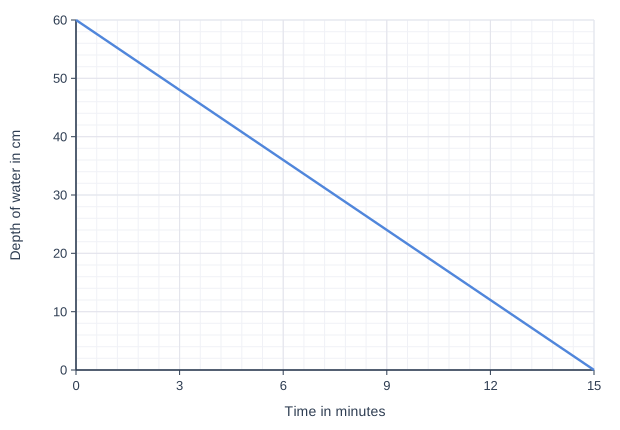
Line graph of depth of water in cm (y-axis, 0 to 60) against time in minutes (x-axis, 0 to 15). The line joins the points (0, 60), (15, 0).

Model answer

The depth falls from 60 cm to 0 cm in 15 minutes.
Rate \(= 60 \div 15 = 4\)
The depth decreases at 4 cm per minute.

Explanation

The rate of change is the gradient of the line: change in depth ÷ change in time. The gradient is negative (−4) because the depth is going down, so the depth decreases at 4 cm per minute. The units are the vertical units per horizontal unit.

Mark scheme
  1. 1 mark

    M1 for \(60 \div 15\)

    oe, e.g. \(20 \div 5\) from two points read from the graph

  2. 1 mark

    A1 for 4 cm per minute

    units required; accept 4 cm/min or −4 cm per minute; correct answer with no working scores full marks
Question 2

2 marks

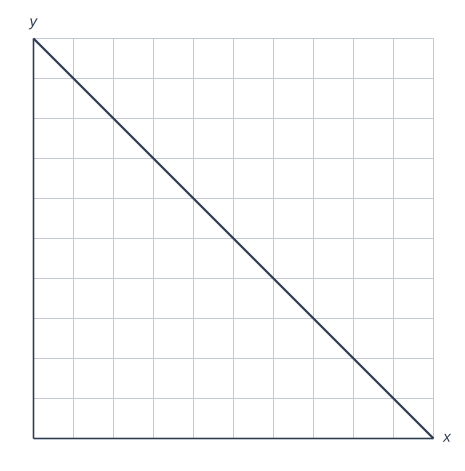
Here is a graph of \(y\) against \(x\).

Tom says,
"The graph shows that \(y\) is inversely proportional to \(x\), because \(y\) decreases as \(x\) increases."

Is Tom correct?
Give a reason for your answer.

A coordinate grid with x from 0 to 10 and y from 0 to 10; each grid square is 1 unit across, and the axes cross at the origin O. The line is a straight line sloping downwards from left to right crossing the y-axis at (0, 10) and crossing the x-axis at (10, 0).

Model answer

No.
If \(y\) were inversely proportional to \(x\), then \(xy\) would be constant.
The line passes through (2, 8) and (5, 5): \(2 \times 8 = 16\) but \(5 \times 5 = 25\)
Also, the graph of inverse proportion is a curve that never meets the axes, but this is a straight line crossing both axes.

Explanation

"\(y\) decreases as \(x\) increases" is true of many graphs, including any straight line with a negative gradient. Inverse proportion is special: \(y = \dfrac{k}{x}\), so \(xy\) is the same for every point and the graph is a curve. This graph is the line \(y = 10 - x\).

Mark scheme
  1. 1 mark

    B1 for a correct reason, e.g. the graph of inverse proportion is a curve that never meets the axes, but this graph is a straight line that crosses both axes

    or showing \(xy\) is not constant, e.g. \(2 \times 8 = 16\) but \(5 \times 5 = 25\); or doubling \(x\) from 2 to 4 does not halve \(y\) (8 to 6)

  2. 1 mark

    B1dep for No with a correct reason

    No alone scores 0

Question 3

3 marks

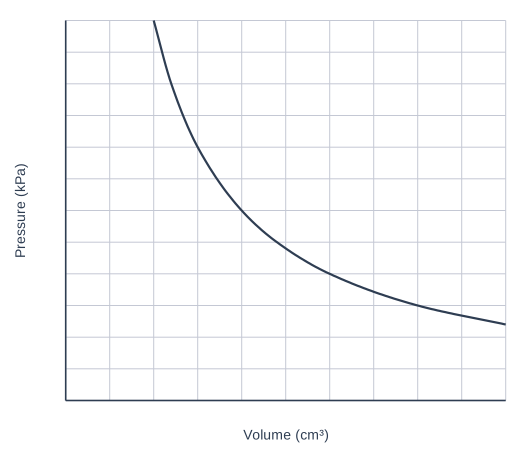
The graph shows how the pressure, \(P\) kPa, of a gas changes with its volume, \(V\) cm³.
\(P\) is inversely proportional to \(V\).

Use the graph to work out an equation for \(P\) in terms of \(V\).

A graph of Pressure (kPa) (vertical axis, 0 to 240, marked every 20) against Volume (cm³) (horizontal axis, 0 to 100, marked every 10), on a grid. The curve is a smooth curve through (20, 240), (24, 200), (30, 160), (40, 120), (48, 100), (60, 80), (80, 60) and (100, 48).

Model answer

\(P = \dfrac{k}{V}\)
From the graph, when \(V = 40\), \(P = 120\)
\(120 = \dfrac{k}{40}\), so \(k = 4800\)
\(P = \dfrac{4800}{V}\)
Check: when \(V = 60\), \(P = 80\), and \(60 \times 80 = 4800\)

Explanation

For inverse proportion, \(P = \dfrac{k}{V}\), so \(PV = k\) for every point on the curve. Read one point accurately from the graph, choosing one where the curve crosses grid lines, then multiply to find \(k\). Checking a second point confirms the value.

Mark scheme
  1. 1 mark

    M1 for reading a correct pair of values from the curve, e.g. \(V = 40\), \(P = 120\)

    e.g. (20, 240), (30, 160), (60, 80), (80, 60)

  2. 1 mark

    M1dep for \(k = 4800\)

    e.g. \(120 = \dfrac{k}{40}\) or \(40 \times 120\)

  3. 1 mark

    A1 for \(P = \dfrac{4800}{V}\)

    oe, e.g. \(PV = 4800\); k = 4800 not written in an equation scores M1 M1 A0

Question 4

4 marks

Water flows from a tap into a tank with vertical sides at a constant rate.
The tank also has a leak, which lets water out at a constant rate all the time.
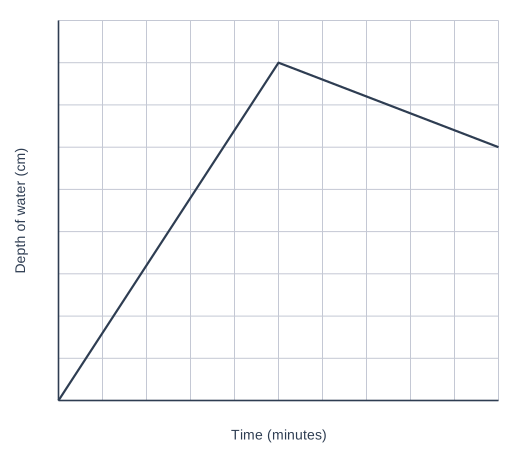
The graph shows the depth of water in the tank.
After 10 minutes the tap is turned off.

Work out the rate at which the depth would increase if the tap was on and there was no leak.

A graph of Depth of water (cm) (vertical axis, 0 to 90, marked every 10) against Time (minutes) (horizontal axis, 0 to 20, marked every 2), on a grid. The graph is made of straight-line sections joining (0, 0), (10, 80) and (20, 60).

Model answer

First 10 minutes (tap on, leak on): depth rises \(80 \div 10 = 8\) cm per minute.
Next 10 minutes (leak only): depth falls \((80 - 60) \div 10 = 2\) cm per minute.
So while the tap was on, the leak was taking away 2 cm per minute.
Tap alone \(= 8 + 2 = 10\) cm per minute

Explanation

Each gradient is a rate of change of depth. The first section is the tap's rate minus the leak's rate, and the second section is the leak on its own. Adding them back together gives the tap's rate; giving 8 cm per minute forgets that the leak was working during the first 10 minutes.

Mark scheme
  1. 1 mark

    M1 for 8 (cm per minute) for the first 10 minutes

    e.g. \(80 \div 10\)

  2. 1 mark

    M1 for 2 (cm per minute) for the leak

    e.g. \((80 - 60) \div 10\)

  3. 1 mark

    M1dep for \(8 + 2\)

    ft their rates

  4. 1 mark

    A1 for 10 cm per minute

    units not required; correct answer with no working scores full marks
Ready to try the rest? Every answer you write is marked against the mark scheme, so you can see exactly where the marks are.

Study Helper Hints first, answers after you try

Stuck on this one? Ask for a hint and I’ll point you in the right direction, without giving the answer away. Once you’ve checked your answer, I’ll show you how the marks are awarded.