Practise 37 exam-style questions on Quadratic equations for AQA GCSE Maths (Higher non-calculator). Write your answer as you would in the exam and get it marked in seconds against the mark scheme, point by point, with the Study Helper on hand if you get stuck.
37 questions
1–5 marks each
Instant marking
No sign-up needed
20 questions, marked as you go
Sample questions with model answers
Here are 4 of the questions in this topic, each with a model answer, an explanation of why it earns the marks and the mark scheme an examiner would use.
Look for two numbers that multiply to 12 and add to 7: 3 and 4. Each bracket gives a solution with the opposite sign, so the solutions are −3 and −4; giving 3 and 4 is the most common error.
Mark scheme
1 mark
M1 for \((x + 3)(x + 4)\) \((= 0)\)
oe, e.g. a correct substitution into the quadratic formula
1 mark
A1 for \(x = -3\) and \(x = -4\)
both values needed; correct answer with no working scores full marks
Question 2
2 marks
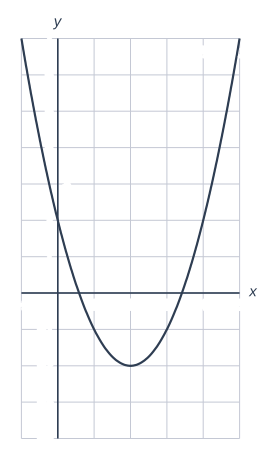
Here is the graph of \(y = x^2 - 4x + 2\)
Joe says,
"The equation \(x^2 - 4x + 2 = -3\) has two solutions."
Is Joe correct? Use the graph to give a reason for your answer.
Model answer
The lowest point of the curve is \((2, -2)\), so \(y\) is never less than −2. The line \(y = -3\) is below the whole curve, so it never meets the curve. \(x^2 - 4x + 2 = -3\) has no solutions, so Joe is not correct.
Explanation
The solutions of \(x^2 - 4x + 2 = k\) are the \(x\)-coordinates where the horizontal line \(y = k\) crosses the curve. The minimum value of \(y\) is −2, so a line at \(y = -3\) does not cross the curve at all. Algebraically, \(x^2 - 4x + 5 = (x - 2)^2 + 1\), which is never 0.
Mark scheme
1 mark
B1 for identifying that the lowest value of \(y\) on the curve is −2, or that the turning point is \((2, -2)\)
accept 'the curve does not go below −2'
1 mark
B1dep for "No", because the line \(y = -3\) is below the curve and does not meet it, so there are no solutions
do not accept 'No' on its own
Question 3
3 marks
The product of two consecutive positive odd numbers is 143
Form and solve a quadratic equation to work out the two numbers.
Model answer
Let the numbers be \(n\) and \(n + 2\) \(n(n + 2) = 143\) \(n^2 + 2n - 143 = 0\) \((n + 13)(n - 11) = 0\) \(n = 11\) (\(n = -13\) is not positive) The numbers are 11 and 13
Explanation
Consecutive odd numbers differ by 2, so call them \(n\) and \(n + 2\). To factorise, look for two factors of 143 that differ by 2: \(11 \times 13\). The negative solution is rejected because the question says the numbers are positive.
Mark scheme
1 mark
M1 for \(n(n + 2) = 143\)
oe, e.g. \((2k - 1)(2k + 1) = 143\)
1 mark
M1dep for \(n^2 + 2n - 143 = 0\) and a correct method to solve it, e.g. \((n + 13)(n - 11) = 0\)
Clear all the fractions at once by multiplying every term by the common denominator \(3x(x + 2)\). Collect the terms into a quadratic equal to zero and divide by the common factor 2. Both solutions are valid because neither makes a denominator zero: check \(\frac{1}{1} + \frac{1}{3} = \frac{4}{3}\).
Mark scheme
1 mark
M1 for multiplying through by \(3x(x + 2)\), e.g. \(3(x + 2) + 3x = 4x(x + 2)\)
M1dep for a correct quadratic equation, e.g. \(4x^2 + 2x - 6 = 0\) or \(2x^2 + x - 3 = 0\)
oe
1 mark
M1dep for a correct method to solve their quadratic, e.g. \((2x + 3)(x - 1) = 0\)
1 mark
A1 for \(x = 1\) and \(x = -\dfrac{3}{2}\)
accept −1.5; both values needed
Ready to try the rest? Every answer you write is marked against the mark scheme, so you can see exactly where the marks are.
Ctrl + Enter to check
Study HelperHints first, answers after you try
Stuck on this one? Ask for a hint and I’ll point you in the right direction, without giving the answer away. Once you’ve checked your answer, I’ll show you how the marks are awarded.