Practise 19 exam-style questions on One quantity as a fraction of another for AQA GCSE Maths (Higher non-calculator). Write your answer as you would in the exam and get it marked in seconds against the mark scheme, point by point, with the Study Helper on hand if you get stuck.
19 questions
1–5 marks each
Instant marking
No sign-up needed
19 questions, marked as you go
Sample questions with model answers
Here are 4 of the questions in this topic, each with a model answer, an explanation of why it earns the marks and the mark scheme an examiner would use.
Question 1
2 marks
Write 45p as a fraction of £3.60 Give your answer in its simplest form.
Write both amounts in pence, put the first amount over the second, then simplify (divide by 5, then by 9). Writing \(\dfrac{45}{3.60}\) mixes pence with pounds.
Mark scheme
1 mark
M1 for \(\dfrac{45}{360}\)
oe, e.g. \(\dfrac{0.45}{3.6}\) or \(\dfrac{9}{72}\)
1 mark
A1 for \(\dfrac{1}{8}\)
correct answer with no working scores full marks
Question 2
2 marks
Cuboid A measures 4 cm by 5 cm by 6 cm. Cube B has edges of length 4 cm.
Write the volume of cuboid A as a fraction of the volume of cube B. Give your answer in its simplest form.
Model answer
Volume of A = 4 × 5 × 6 = 120 cm³ Volume of B = 4 × 4 × 4 = 64 cm³ \(\dfrac{120}{64} = \dfrac{15}{8}\)
Explanation
Work out both volumes, then write the volume of A over the volume of B and simplify by dividing by 8. The cuboid is bigger, so the fraction is greater than 1.
Mark scheme
1 mark
M1 for 120 and 64 or \(\dfrac{120}{64}\)
oe
1 mark
A1 for \(\dfrac{15}{8}\)
accept \(1\dfrac{7}{8}\); correct answer with no working scores full marks
Question 3
3 marks
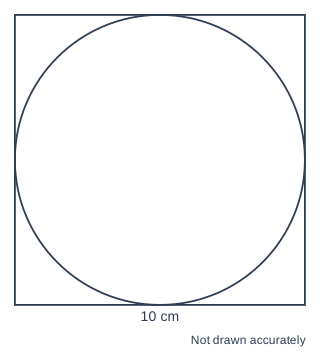
The diagram shows a circle inside a square. The circle touches all four sides of the square. The square has side length 10 cm.
Write the area of the circle as a fraction of the area of the square. Give your answer in terms of \(\pi\).
Model answer
Radius of circle = 10 ÷ 2 = 5 cm Area of circle \(= \pi \times 5^2 = 25\pi\) cm² Area of square = 10 × 10 = 100 cm² \(\dfrac{25\pi}{100} = \dfrac{\pi}{4}\)
Explanation
The circle touches all four sides, so its diameter equals the side of the square and its radius is 5 cm. Write the circle's area over the square's area and cancel the 25, leaving \(\pi\) in the answer. Using 10 as the radius is a common mistake.
Mark scheme
1 mark
M1 for \(\pi \times 5^2\) or \(25\pi\)
radius = 5 cm
1 mark
M1 for their \(25\pi\) over 100
area of square = 100 cm²
1 mark
A1 for \(\dfrac{\pi}{4}\)
oe, e.g. \(\dfrac{1}{4}\pi\); do not accept a decimal; correct answer with no working scores full marks
Question 4
4 marks
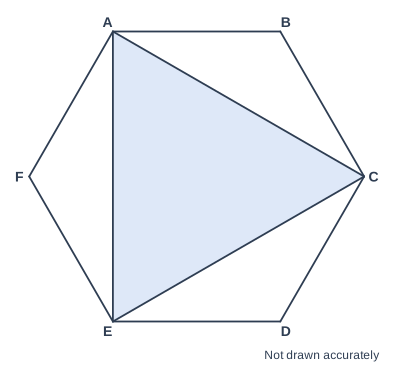
The diagram shows a regular hexagon ABCDEF. Triangle ACE is shaded.
Show that the area of triangle ACE is \(\dfrac{1}{2}\) of the area of the hexagon.
Model answer
Let O be the centre of the hexagon. Joining O to each vertex splits the hexagon into 6 congruent equilateral triangles. OA = AB = BC = CO, so OABC is a rhombus. The diagonal AC splits the rhombus into two congruent triangles, so area ABC = area AOC = 1 small triangle. In the same way, area CDE = area COE and area EFA = area EOA. Triangle ACE = AOC + COE + EOA = 3 small triangles. The hexagon = 6 small triangles. So area ACE \(= \dfrac{3}{6} = \dfrac{1}{2}\) of the hexagon.
Explanation
A regular hexagon is made of 6 equilateral triangles meeting at its centre. Each outside triangle (ABC, CDE, EFA) is half of a rhombus made from two of these, so it is worth one small triangle. That leaves 3 of the 6 small triangles for triangle ACE, which is one half.
Mark scheme
1 mark
M1 for splitting the hexagon into 6 congruent equilateral triangles meeting at the centre O
or for the area of triangle ABC as \(\dfrac{1}{2}s^2 \sin 120^\circ\) with the hexagon as \(6 \times \dfrac{1}{2}s^2 \sin 60^\circ\), where s is the side length
1 mark
M1 for showing that triangle ABC has the same area as one of these triangles, e.g. OABC is a rhombus, so diagonal AC splits it into two congruent triangles ABC and AOC
or \(\sin 120^\circ = \sin 60^\circ\) so area ABC = area of one small triangle = \(\dfrac{1}{6}\) of the hexagon
1 mark
M1 for the hexagon = triangle ACE + triangles ABC, CDE and EFA, which are congruent (each \(\dfrac{1}{6}\) of the hexagon)
or triangle ACE = triangles AOC + COE + EOA = 3 small triangles
1 mark
A1 for a complete, correct argument concluding area ACE = \(\dfrac{3}{6} = \dfrac{1}{2}\) of the hexagon
answer only scores 0
Ready to try the rest? Every answer you write is marked against the mark scheme, so you can see exactly where the marks are.
Ctrl + Enter to check
Study HelperHints first, answers after you try
Stuck on this one? Ask for a hint and I’ll point you in the right direction, without giving the answer away. Once you’ve checked your answer, I’ll show you how the marks are awarded.