Practise 28 exam-style questions on Equation of a circle and tangents for AQA GCSE Maths (Higher non-calculator). Write your answer as you would in the exam and get it marked in seconds against the mark scheme, point by point, with the Study Helper on hand if you get stuck.
28 questions
1–5 marks each
Instant marking
No sign-up needed
20 questions, marked as you go
Sample questions with model answers
Here are 4 of the questions in this topic, each with a model answer, an explanation of why it earns the marks and the mark scheme an examiner would use.
Question 1
1 mark
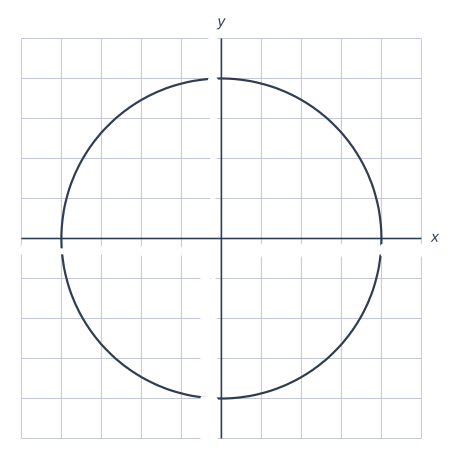
The diagram shows a circle with centre O, drawn on a grid.
Write down the equation of the circle.
Model answer
The circle crosses the x-axis at (4, 0), so the radius is 4. \(x^2 + y^2 = 4^2\) \(x^2 + y^2 = 16\)
Explanation
Read the radius from where the circle crosses an axis: 4 units from O. The equation of a circle with centre the origin is \(x^2 + y^2 = r^2\), so the right-hand side is \(4^2 = 16\), not 4.
Mark scheme
1 mark
B1 for \(x^2 + y^2 = 16\)
do not accept \(x^2 + y^2 = 4\)
Question 2
2 marks
Explain why the line \(y = 6\) is a tangent to the circle \(x^2 + y^2 = 36\)
Model answer
Substitute \(y = 6\): \(x^2 + 36 = 36\), so \(x^2 = 0\) and \(x = 0\) only. The line meets the circle at just one point, (0, 6), so it touches the circle without crossing it: it is a tangent.
Explanation
The circle has radius 6, so its highest point is (0, 6). The horizontal line \(y = 6\) just touches the circle there and is perpendicular to the vertical radius. Showing there is only one point of intersection is the algebraic way to prove a line is a tangent.
Mark scheme
1 mark
M1 for substituting \(y = 6\): \(x^2 + 36 = 36\), so \(x^2 = 0\)
or the radius is 6, so (0, 6) is the top of the circle
1 mark
A1 for \(x = 0\) is the only solution, so the line meets the circle at exactly one point, (0, 6), and is a tangent
Alt: the line \(y = 6\) is horizontal and the radius to (0, 6) is vertical, so the line is perpendicular to the radius at a point on the circle (B1 B1)
Question 3
3 marks
Show that the point P(−4, 6) lies on the circle \(x^2 + y^2 = 52\), and work out the gradient of the tangent to the circle at P.
Model answer
\((-4)^2 + 6^2 = 16 + 36 = 52\), so P lies on the circle. Gradient of OP = \(\dfrac{6}{-4} = -\dfrac{3}{2}\) The tangent is perpendicular to OP, so its gradient is \(\dfrac{2}{3}\).
Explanation
A point lies on the circle if its coordinates satisfy the equation. The radius OP and the tangent at P are perpendicular, and perpendicular gradients multiply to −1: \(-\frac{3}{2} \times \frac{2}{3} = -1\). Turn the fraction upside down and change its sign.
Mark scheme
1 mark
B1 for \((-4)^2 + 6^2 = 16 + 36 = 52\)
must show the substitution and the total
1 mark
M1 for the gradient of OP: \(\frac{6}{-4}\) or \(-\frac{3}{2}\)
O is the origin
1 mark
A1 for \(\frac{2}{3}\)
Question 4
4 marks
The point P lies on the circle \(x^2 + y^2 = 40\) The x-coordinate of P is 6 and its y-coordinate is negative.
Work out the equation of the tangent to the circle at P. Give your answer in the form \(y = mx + c\)
Model answer
\(6^2 + y^2 = 40\), so \(y^2 = 4\) and \(y = -2\) (negative). P is (6, −2). Gradient of OP = \(\dfrac{-2}{6} = -\dfrac{1}{3}\) Gradient of tangent = 3 \(y + 2 = 3(x - 6)\) \(y = 3x - 20\)
Explanation
First find P by substituting x = 6 into the circle's equation and choosing the negative root. The tangent is perpendicular to the radius OP, so its gradient is the negative reciprocal of \(-\frac{1}{3}\), which is 3. Check that P is on your line: \(3 \times 6 - 20 = -2\).
Mark scheme
1 mark
B1 for the y-coordinate −2, i.e. P(6, −2)
1 mark
M1 for the gradient of OP: \(-\frac{1}{3}\)
ft their P
1 mark
M1 for the gradient of the tangent, 3, used with their P, e.g. \(y + 2 = 3(x - 6)\)
ft the negative reciprocal of their gradient of OP
1 mark
A1 for \(y = 3x - 20\)
correct answer with no working scores full marks
Ready to try the rest? Every answer you write is marked against the mark scheme, so you can see exactly where the marks are.
Ctrl + Enter to check
Study HelperHints first, answers after you try
Stuck on this one? Ask for a hint and I’ll point you in the right direction, without giving the answer away. Once you’ve checked your answer, I’ll show you how the marks are awarded.