Practise 36 exam-style questions on Growth, decay and compound interest for AQA GCSE Maths (Higher non-calculator). Write your answer as you would in the exam and get it marked in seconds against the mark scheme, point by point, with the Study Helper on hand if you get stuck.
36 questions
1–5 marks each
Instant marking
No sign-up needed
20 questions, marked as you go
Sample questions with model answers
Here are 4 of the questions in this topic, each with a model answer, an explanation of why it earns the marks and the mark scheme an examiner would use.
Question 1
2 marks
Sam invests £6000. In the first year the investment earns 5% interest. In the second year it earns 2% interest. The interest is added to the investment at the end of each year.
Work out the value of the investment at the end of the 2 years.
Model answer
End of year 1: \(6000 \times 1.05 = 6300\) End of year 2: \(6300 \times 1.02 = 6300 + 126 = 6426\) £6426
Explanation
Each year's interest is worked out on the value at the start of that year, so multiply by 1.05 and then by 1.02. Adding 7% of £6000 (£420) gives £6420, which ignores the interest earned on the first year's interest.
Mark scheme
1 mark
M1 for \(6000 \times 1.05\) or 6300, or \(6000 \times 1.05 \times 1.02\)
oe
1 mark
A1 for £6426
correct answer with no working scores full marks
Question 2
2 marks
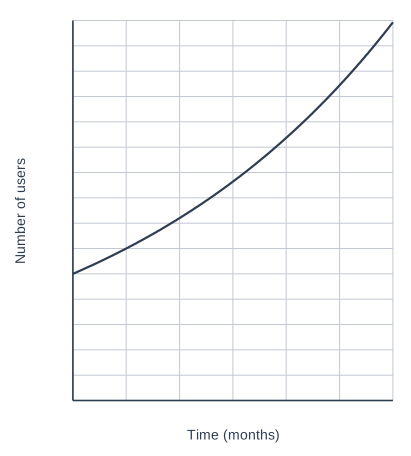
The graph shows the number of users of a new app. The number of users increases by the same percentage each month.
Use the graph to work out the percentage increase each month.
Model answer
At 0 months there are 1000 users. At 1 month there are 1200 users. \(1200 \div 1000 = 1.2\) The multiplier is 1.2, so the increase is 20% each month.
Explanation
For exponential growth, the number is multiplied by the same amount each month. Read two values one month apart and divide to find the multiplier, then turn it into a percentage increase. Reading values that are 2 months apart would give the multiplier for 2 months, \(1.2^2 = 1.44\).
Mark scheme
1 mark
M1 for reading 1000 at 0 months and 1200 at 1 month, and \(1200 \div 1000\) or 1.2
or 200 ÷ 1000; other readings one month apart, e.g. 1200 and 1440 (accept [1400, 1480])
1 mark
A1 for 20(%)
correct answer with no working scores full marks
Question 3
3 marks
Bank A pays 10% interest once a year. Bank B pays 5% interest every 6 months. At each bank, the interest is added to the account each time it is paid.
Liam has £8000 to invest for 1 year. Which bank should he choose? You must show your working.
Model answer
Bank A: \(8000 \times 1.1 = £8800\) Bank B: after 6 months \(8000 \times 1.05 = 8400\), after 1 year \(8400 \times 1.05 = £8820\) Bank B gives £20 more, so Liam should choose Bank B.
Explanation
With Bank B the interest for the second 6 months is paid on £8400, which includes the first lot of interest. Over the year the multiplier is \(1.05^2 = 1.1025\), an increase of 10.25%, which beats 10%.
Mark scheme
1 mark
M1 for Bank A: \(8000 \times 1.1 = 8800\)
or interest £800
1 mark
M1 for Bank B: \(8000 \times 1.05^2\) or \(8400 \times 1.05\)
or 8820 or interest £820
1 mark
A1 for Bank B with £8800 and £8820
or interest £800 and £820; answer only scores 0
Question 4
4 marks
A patient takes 200 mg of a medicine at 8 am. Every 4 hours, the amount of medicine in the patient's body halves. The patient takes another 200 mg of the medicine at 4 pm.
Work out the amount of medicine in the patient's body at midnight.
Model answer
8 am: 200 mg 12 pm: 100 mg 4 pm: 50 mg, then the second dose: 50 + 200 = 250 mg 8 pm: 125 mg Midnight: 62.5 mg
Explanation
Halve the amount every 4 hours and add the second dose at the right time. The first dose has been in the body for 16 hours (4 halvings, 12.5 mg left) and the second for 8 hours (2 halvings, 50 mg left), which also gives 62.5 mg.
Mark scheme
1 mark
M1 for 100 (at 12 pm) and 50 (at 4 pm)
or \(200 \times 0.5^2\)
1 mark
M1 for adding the second dose, 250 (at 4 pm)
ft their amount at 4 pm
1 mark
M1dep for halving twice more, 125 and 62.5
or \(250 \times 0.5^2\)
1 mark
A1 for 62.5 (mg)
correct answer with no working scores full marks
Ready to try the rest? Every answer you write is marked against the mark scheme, so you can see exactly where the marks are.
Ctrl + Enter to check
Study HelperHints first, answers after you try
Stuck on this one? Ask for a hint and I’ll point you in the right direction, without giving the answer away. Once you’ve checked your answer, I’ll show you how the marks are awarded.