Practise 36 exam-style questions on Circle theorems for AQA GCSE Maths (Higher non-calculator). Write your answer as you would in the exam and get it marked in seconds against the mark scheme, point by point, with the Study Helper on hand if you get stuck.
36 questions
1–5 marks each
Instant marking
No sign-up needed
20 questions, marked as you go
Sample questions with model answers
Here are 4 of the questions in this topic, each with a model answer, an explanation of why it earns the marks and the mark scheme an examiner would use.
Question 1
2 marks
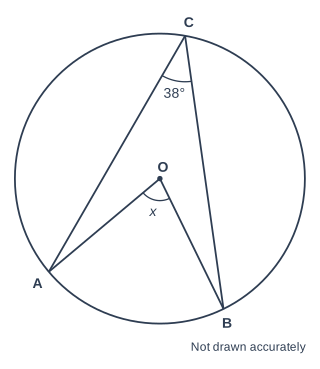
In the diagram, A, B and C are points on a circle, centre O. Angle ACB = 38°
Work out the size of angle x. Give a reason for your answer.
Model answer
\(x = 2 \times 38 = 76\)° The angle at the centre is twice the angle at the circumference.
Explanation
Angle AOB and angle ACB are both subtended by the arc AB, one at the centre and one at the circumference, so the angle at the centre is double. Halving 38° instead of doubling is a common error.
Mark scheme
1 mark
B1 for 76(°)
1 mark
B1 for the angle at the centre is twice the angle at the circumference
oe; accept 'angle subtended by an arc at the centre is twice the angle at the circumference'
Question 2
3 marks
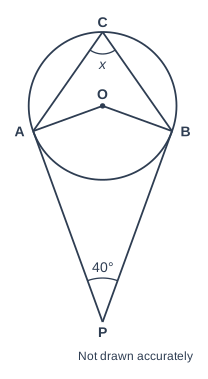
In the diagram, A, B and C are points on a circle, centre O. PA and PB are tangents to the circle. Angle APB = 40°
Work out the size of angle x.
Model answer
Angle OAP = angle OBP = 90° (tangent is perpendicular to the radius) Angles in quadrilateral OAPB add up to 360°: angle AOB \(= 360 - 90 - 90 - 40 = 140\)° Angle at the centre is twice the angle at the circumference: \(x = 140 \div 2 = 70\)°
Explanation
Each tangent meets its radius at 90°, so the quadrilateral OAPB has two right angles and angle AOB = 180° − 40° = 140°. Angle ACB stands on the same arc AB at the circumference, so it is half of 140°.
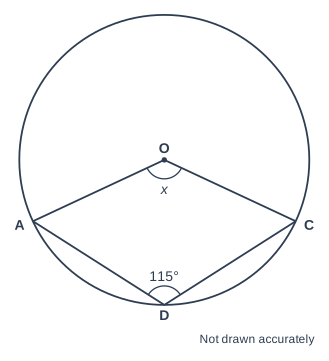
In the diagram, A, C and D are points on a circle, centre O. Angle ADC = 115°
Work out the size of angle x.
Model answer
Angle ADC stands on the major arc AC, so the angle at the centre on that arc is the reflex angle AOC. Reflex angle AOC \(= 2 \times 115 = 230\)° (the angle at the centre is twice the angle at the circumference) \(x = 360 - 230 = 130\)° (angles around a point add up to 360°)
Explanation
The angle at the centre theorem still works when the angle at the circumference is obtuse, but then the matching angle at the centre is reflex. Double 115° to get the reflex angle and subtract from 360°. Halving 115° is a common mistake.
Mark scheme
1 mark
M1 for reflex angle AOC \(= 2 \times 115 = 230\)°
1 mark
M1dep for \(360 - 230\)
1 mark
A1 for 130(°)
correct answer with no working scores full marks; SC1 for 57.5
Question 4
4 marks
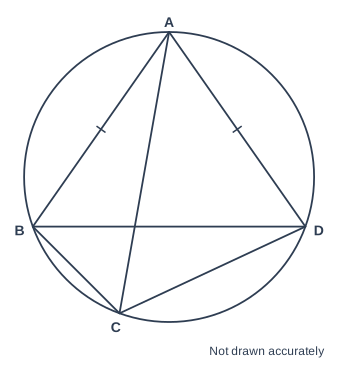
In the diagram, ABCD is a cyclic quadrilateral with AB = AD. The diagonals AC and BD are drawn.
Prove that AC bisects angle BCD (that is, angle ACB = angle ACD).
Model answer
Angle ACB = angle ADB (angles in the same segment are equal, both standing on chord AB) Angle ACD = angle ABD (angles in the same segment are equal, both standing on chord AD) AB = AD, so triangle ABD is isosceles and angle ABD = angle ADB (base angles of an isosceles triangle) So angle ACB = angle ADB = angle ABD = angle ACD, and AC bisects angle BCD.
Explanation
Look for angles at the circumference that stand on the same chord: angle ACB and angle ADB both stand on AB, and angle ACD and angle ABD both stand on AD. The equal sides AB and AD make the two angles at B and D in triangle ABD equal, which links everything together.
Mark scheme
1 mark
B1 for angle ACB = angle ADB, because angles in the same segment are equal
both stand on AB
1 mark
B1 for angle ACD = angle ABD, because angles in the same segment are equal
both stand on AD
1 mark
B1 for angle ABD = angle ADB, because AB = AD so triangle ABD is isosceles
1 mark
B1 for a complete proof with all reasons, concluding angle ACB = angle ACD
Ready to try the rest? Every answer you write is marked against the mark scheme, so you can see exactly where the marks are.
Ctrl + Enter to check
Study HelperHints first, answers after you try
Stuck on this one? Ask for a hint and I’ll point you in the right direction, without giving the answer away. Once you’ve checked your answer, I’ll show you how the marks are awarded.