Practise 37 exam-style questions on Sine rule and cosine rule for AQA GCSE Maths (Higher non-calculator). Write your answer as you would in the exam and get it marked in seconds against the mark scheme, point by point, with the Study Helper on hand if you get stuck.
37 questions
1–5 marks each
Instant marking
No sign-up needed
20 questions, marked as you go
Sample questions with model answers
Here are 4 of the questions in this topic, each with a model answer, an explanation of why it earns the marks and the mark scheme an examiner would use.
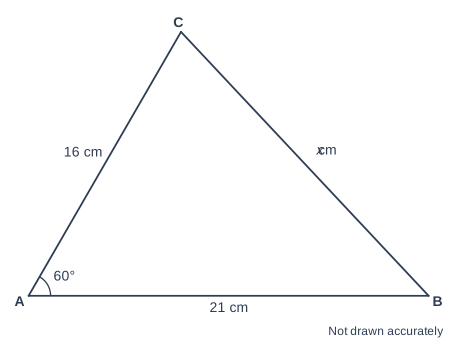
You know two sides and the angle between them, so use the cosine rule to find the third side. Since \(\cos 60^\circ = \frac{1}{2}\), the last term is half of \(2 \times 16 \times 21\). Remember to take the square root at the end.
The cosine rule is \(a^2 = b^2 + c^2 - 2bc\cos A\)
Explain why the cosine rule gives Pythagoras' theorem when angle A = 90°.
Model answer
When A = 90°, \(\cos A = \cos 90^\circ = 0\). So \(2bc\cos A = 2bc \times 0 = 0\) and the cosine rule becomes \(a^2 = b^2 + c^2\). This is Pythagoras' theorem, with a (opposite the right angle) as the hypotenuse.
Explanation
The term \(-2bc\cos A\) is a correction to Pythagoras' theorem for triangles that are not right-angled. It is zero for a right angle, negative for an acute angle (making a shorter) and positive for an obtuse angle (making a longer).
Mark scheme
1 mark
B1 for \(\cos 90^\circ = 0\)
1 mark
B1 for so \(2bc\cos A = 0\), leaving \(a^2 = b^2 + c^2\), which is Pythagoras' theorem
accept 'the last term is zero, so a² = b² + c²'; mention of the hypotenuse is not required
Question 3
3 marks
In triangle PQR PQ = x cm PR = 2x cm angle QPR = 60° \(QR = 6\sqrt{3}\) cm
Substitute the algebraic sides into the cosine rule exactly as you would numbers, taking care with \((2x)^2 = 4x^2\) and \((6\sqrt{3})^2 = 36 \times 3 = 108\). A length must be positive, so take only the positive square root.
Mark scheme
1 mark
M1 for \((6\sqrt{3})^2 = x^2 + (2x)^2 - 2 \times x \times 2x \times \cos 60^\circ\)
oe
1 mark
M1dep for \(108 = 3x^2\)
oe, e.g. \(108 = 5x^2 - 2x^2\) or \(x^2 = 36\)
1 mark
A1 for 6
do not accept ±6 as the final answer; correct answer with no working scores full marks
Question 4
4 marks
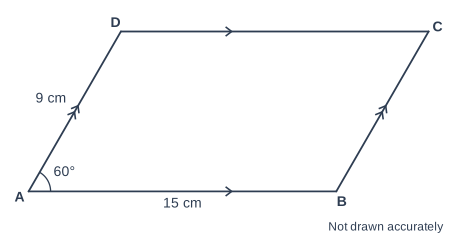
The diagram shows parallelogram ABCD.
Work out the length of the longer diagonal of ABCD.
Model answer
Co-interior angles add up to 180°, so angle ABC = 180° − 60° = 120°. The longer diagonal is AC, opposite the 120° angle. \(AC^2 = 15^2 + 9^2 - 2 \times 15 \times 9 \times \cos 120^\circ\) \(AC^2 = 225 + 81 + 135 = 441\) AC = 21 cm
Explanation
Each diagonal splits the parallelogram into two triangles. The longer diagonal is opposite the obtuse angle, 120°, and because \(\cos 120^\circ\) is negative the term \(2 \times 15 \times 9 \times \frac{1}{2} = 135\) is added. Using the 60° angle instead gives the shorter diagonal, \(\sqrt{171}\).
Mark scheme
1 mark
B1 for angle ABC = 120° (or angle ADC = 120°)
may be implied by the use of 120° in the cosine rule
correct answer with no working scores full marks; the shorter diagonal BD = \(\sqrt{171}\) as the answer scores at most B1
Ready to try the rest? Every answer you write is marked against the mark scheme, so you can see exactly where the marks are.
Ctrl + Enter to check
Study HelperHints first, answers after you try
Stuck on this one? Ask for a hint and I’ll point you in the right direction, without giving the answer away. Once you’ve checked your answer, I’ll show you how the marks are awarded.