Practise 28 exam-style questions on Properties of quadrilaterals and triangles for AQA GCSE Maths (Higher non-calculator). Write your answer as you would in the exam and get it marked in seconds against the mark scheme, point by point, with the Study Helper on hand if you get stuck.
28 questions
1–5 marks each
Instant marking
No sign-up needed
20 questions, marked as you go
Sample questions with model answers
Here are 4 of the questions in this topic, each with a model answer, an explanation of why it earns the marks and the mark scheme an examiner would use.
Question 1
2 marks
Ali says, "Every square is a rhombus." Bea says, "Every rhombus is a square."
Who is correct? Give a reason for your answer.
Model answer
Ali is correct. A rhombus is a quadrilateral with four equal sides. A square has four equal sides, so every square is a rhombus. But a rhombus does not need right angles (for example, one with angles 60°, 120°, 60°, 120°), so not every rhombus is a square.
Explanation
Use the definitions: a rhombus needs only four equal sides, while a square needs four equal sides and four right angles. A square meets the rhombus definition, but a rhombus with angles that are not 90° is a counter-example to Bea's statement.
Mark scheme
1 mark
B1 for Ali (only)
1 mark
B1dep for a correct reason, e.g. a square has four equal sides so it is a rhombus, but a rhombus does not have to have right angles so it is not always a square
accept a description or sketch of a rhombus without right angles as a counter-example to Bea
Question 2
2 marks
Liam says,
"The diagonals of a rectangle always cut its corner angles in half."
Is Liam correct? Give a reason for your answer.
Model answer
No. In rectangle ABCD, the diagonal AC makes triangle ABC with a right angle at B. If AB and BC are different lengths, triangle ABC is not isosceles, so angles BAC and BCA are not equal and are not both 45°. So the diagonal does not cut the 90° corner in half. It only does this when the rectangle is a square.
Explanation
Diagonals bisect the angles of a rhombus (and so of a square), not of a general rectangle. A long thin rectangle shows it clearly: the diagonal lies close to the long side, so the two parts of the corner angle are very different.
Mark scheme
1 mark
B1 for No
do not award for 'No' with no reason or an incorrect reason
1 mark
B1dep for a correct reason, e.g. it is only true when the rectangle is a square; in a rectangle ABCD with AB ≠ BC, triangle ABC is not isosceles so angle BAC ≠ angle BCA (they cannot both be 45°)
accept a correct counter-example, e.g. a long thin rectangle where the diagonal is much closer to the long side
Question 3
3 marks
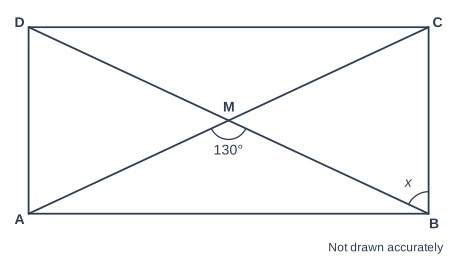
The diagram shows a rectangle ABCD. The diagonals AC and BD meet at M. Angle AMB = 130°.
Work out the size of angle x.
Model answer
The diagonals of a rectangle are equal in length and bisect each other, so MA = MB. Triangle AMB is isosceles, so angle MBA = (180 − 130) ÷ 2 = 25° Angle ABC = 90°, so x = 90 − 25 = 65°
Explanation
Because the diagonals of a rectangle are equal and cut each other in half, the four triangles around M are isosceles. The base angle at B and angle x make up the right angle at the corner B. A common mistake is to assume the diagonals cross at right angles, which is only true for a square.
Mark scheme
1 mark
M1 for MA = MB, because the diagonals of a rectangle are equal and bisect each other
may be implied by angle MBA = angle MAB
1 mark
M1 for angle MBA = \(\dfrac{180 - 130}{2}\) = 25°
1 mark
A1 for 65°
correct answer with no working scores full marks
Question 4
4 marks
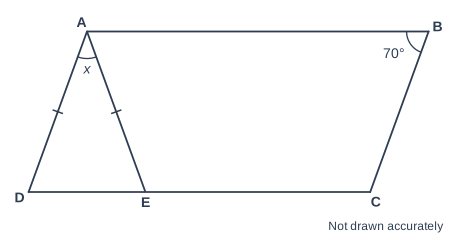
The diagram shows a parallelogram ABCD. E is a point on DC so that AE = AD. Angle ABC = 70°.
Work out the size of angle x. Give reasons for your answer.
Model answer
Angle ADC = angle ABC = 70° (opposite angles of a parallelogram are equal) AE = AD, so triangle ADE is isosceles and angle AED = angle ADE = 70° (base angles of an isosceles triangle are equal) x = 180 − 70 − 70 = 40° (angles in a triangle add up to 180°)
Explanation
Opposite angles of a parallelogram are equal, so the angle at D is also 70°. The equal sides AD and AE make the angles at D and E equal, and the triangle's angle sum gives the angle at A. Make sure each step has its geometric reason.
Mark scheme
1 mark
M1 for angle ADC = 70°
or angle ADE = 70°
1 mark
M1 for angle AED = 70°
ft their angle ADC
1 mark
A1 for 40°
1 mark
B1 for correct reasons: opposite angles of a parallelogram are equal; base angles of an isosceles triangle are equal; angles in a triangle add up to 180°
alternative valid reasons accepted, e.g. co-interior angles add up to 180° (angle DAB = 110°) and alternate angles are equal (angle EAB = angle AED)
Ready to try the rest? Every answer you write is marked against the mark scheme, so you can see exactly where the marks are.
Ctrl + Enter to check
Study HelperHints first, answers after you try
Stuck on this one? Ask for a hint and I’ll point you in the right direction, without giving the answer away. Once you’ve checked your answer, I’ll show you how the marks are awarded.