Practise 19 exam-style questions on Proportion as equality of ratios for AQA GCSE Maths (Higher non-calculator). Write your answer as you would in the exam and get it marked in seconds against the mark scheme, point by point, with the Study Helper on hand if you get stuck.
19 questions
1–5 marks each
Instant marking
No sign-up needed
19 questions, marked as you go
Sample questions with model answers
Here are 4 of the questions in this topic, each with a model answer, an explanation of why it earns the marks and the mark scheme an examiner would use.
Question 1
2 marks
Work out the value of \(x\).
\(5 : x = 15 : 24\)
Model answer
15 ÷ 5 = 3, so each part of the first ratio is multiplied by 3. \(x = 24 \div 3 = 8\)
Explanation
Two ratios in proportion have the same multiplier between them: 5 has been multiplied by 3 to get 15, so \(x\) multiplied by 3 gives 24. Or write the ratios as equal fractions and cross-multiply: \(15x = 120\).
Mark scheme
1 mark
M1 for 15 ÷ 5 (= 3) or \(15x = 5 \times 24\)
oe, e.g. \(\dfrac{5}{x} = \dfrac{15}{24}\)
1 mark
A1 for 8
correct answer with no working scores full marks
Question 2
2 marks
At the same time of day, a vertical post 1.5 m tall casts a shadow 2 m long, and a vertical tree casts a shadow 14 m long. The ratio height : length of shadow is the same for the post and the tree.
The ratios are equal, so the tree's shadow is 7 times as long as the post's shadow and the tree must be 7 times as tall. Alternatively, each height is 0.75 of its shadow length, and 0.75 × 14 = 10.5
Write the equal ratios as equal fractions and cross-multiply. This gives a quadratic equation, which factorises. The question says \(x\) is positive, so the solution \(x = -3\) must be rejected.
Mark scheme
1 mark
M1 for \(x(x - 3) = 18\)
oe, e.g. \(x^2 - 3x - 18 = 0\)
1 mark
M1dep for \((x - 6)(x + 3) = 0\)
or a correct substitution into the quadratic formula
1 mark
A1 for \(x = 6\) only
x = 6 and x = −3 with −3 not rejected scores M1 M1 A0; correct answer with no working scores full marks
Question 4
4 marks
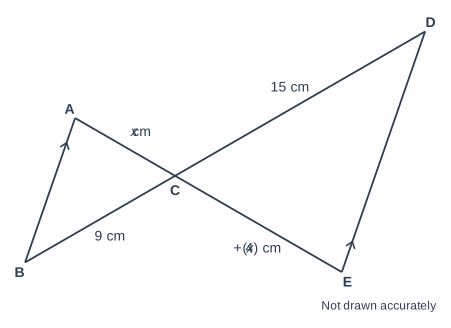
In the diagram, AB is parallel to DE. The straight lines AE and BD cross at C.
Work out the length of AE.
Model answer
AB is parallel to DE, so triangles ABC and EDC are similar (alternate angles are equal, and the angles at C are vertically opposite). AC : CE = BC : CD \(x : (x + 4) = 9 : 15 = 3 : 5\) \(5x = 3(x + 4)\) \(5x = 3x + 12\) \(x = 6\) AE = AC + CE = 6 + 10 = 16 cm
Explanation
The parallel lines make the two triangles similar, so corresponding sides are in the same ratio: AC corresponds to CE and BC corresponds to CD. Form an equation from the equal ratios and solve it, then add AC and CE. Giving x = 6 as the final answer misses the last step.
Mark scheme
1 mark
M1 for \(\dfrac{x}{x + 4} = \dfrac{9}{15}\)
oe, e.g. x : (x + 4) = 9 : 15 or 3 : 5
1 mark
M1dep for \(15x = 9(x + 4)\) or \(5x = 3x + 12\)
oe
1 mark
A1 for \(x = 6\)
1 mark
A1 for 16 (cm)
correct answer with no working scores full marks
Ready to try the rest? Every answer you write is marked against the mark scheme, so you can see exactly where the marks are.
Ctrl + Enter to check
Study HelperHints first, answers after you try
Stuck on this one? Ask for a hint and I’ll point you in the right direction, without giving the answer away. Once you’ve checked your answer, I’ll show you how the marks are awarded.