
Level:
Correct: 0
Incorrect: 0
Marks: 0/0
Exam Practice
Course:
Topics:
AQA GCSE Maths (Higher non-calculator) Smart practice A mixed round aimed at your weak spots
Unit 1
Number
Unit 2
Algebra
Unit 3
Ratio, proportion and rates of change
Unit 4
Geometry and measures
Unit 5
Probability
Unit 6
Statistics
Avg
score:
–
Topics
done:
0/97

Expected outcomes

Practise 20 exam-style questions on Expected outcomes for AQA GCSE Maths (Higher non-calculator). Write your answer as you would in the exam and get it marked in seconds against the mark scheme, point by point, with the Study Helper on hand if you get stuck.

  • 20 questions
  • 1–5 marks each
  • Instant marking
  • No sign-up needed
20 questions, marked as you go

Sample questions with model answers

Here are 4 of the questions in this topic, each with a model answer, an explanation of why it earns the marks and the mark scheme an examiner would use.

Question 1

1 mark

Jo is going to flip a fair coin 50 times.
She says,
"I will get exactly 25 heads."

Is Jo correct?
Give a reason for your answer.

Model answer

No. 25 is the number of heads she would expect, but the result of each flip is random, so she could get more or fewer than 25 heads.

Explanation

The expected number \(0.5 \times 50 = 25\) is what you would get on average, not what must happen. Because each flip is random, the actual number of heads varies from one set of 50 flips to another.

Mark scheme
  1. 1 mark

    B1 for No with a correct reason, e.g. each flip is random, so she may not get exactly 25 heads

    oe, e.g. 25 is the number of heads she would expect, but the actual number can be more or less than 25; do not accept No on its own or a reason saying the coin is biased
Question 2

2 marks

Amy and Ben play a game with two fair coins.
They flip both coins.
Amy wins if both coins land the same way up.
Ben wins if one coin lands on heads and the other lands on tails.

Ben says,
"The game is not fair. There are three possible results: two heads, two tails, or one head and one tail. I only win with one of them."

Is Ben correct?
Give a reason for your answer.

Model answer

The equally likely outcomes are HH, HT, TH, TT.
Amy wins with HH or TT: probability \(\dfrac{2}{4} = \dfrac{1}{2}\)
Ben wins with HT or TH: probability \(\dfrac{2}{4} = \dfrac{1}{2}\)
No, Ben is not correct. The game is fair.

Explanation

Ben's three results are not equally likely, because one head and one tail can happen in two ways (HT or TH). Listing the outcomes for each coin separately gives four equally likely outcomes, and each player wins with two of them.

Mark scheme
  1. 1 mark

    B1 for listing the four equally likely outcomes HH, HT, TH, TT

    oe, e.g. a sample space or tree diagram; or \(P(\text{one head and one tail}) = \dfrac{1}{2}\)

  2. 1 mark

    B1dep for No with a reason, e.g. Ben wins with 2 of the 4 outcomes, so both players have a probability of \(\dfrac{1}{2}\) of winning and the game is fair

    oe; the reason must show the three results are not equally likely or that each player has a probability of \(\dfrac{1}{2}\)

Question 3

3 marks

A bag contains red, blue and yellow counters only.
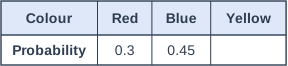
The table shows the probabilities of taking a red counter and a blue counter at random from the bag.

A counter is taken at random from the bag, its colour is recorded and it is put back.
This is done 80 times.

Work out how many more times you would expect a blue counter to be taken than a yellow counter.

Table with columns "Colour", "Red", "Blue", "Yellow". Colour: Probability; Red: 0.3; Blue: 0.45; Yellow: (blank).

Model answer

\(P(\text{yellow}) = 1 - (0.3 + 0.45) = 0.25\)
Expected blue \(= 0.45 \times 80 = 36\)
Expected yellow \(= 0.25 \times 80 = 20\)
\(36 - 20 = 16\)

Explanation

The three probabilities add up to 1, so yellow has probability 0.25. Multiply each probability by 80 to get the expected numbers and find the difference (or multiply the difference in probabilities, 0.2, by 80).

Mark scheme
  1. 1 mark

    M1 for \(1 - (0.3 + 0.45)\) or 0.25 as the probability of yellow

    oe

  2. 1 mark

    M1 for \(0.45 \times 80\) or 36, and their \(0.25 \times 80\) or 20

    or their \((0.45 - 0.25) \times 80\)

  3. 1 mark

    A1 for 16

    correct answer with no working scores full marks

Question 4

4 marks

Sam plays a game with two fair six-sided dice.
It costs £1 to play the game.
If both dice show the same number, Sam gets £5
Otherwise Sam gets nothing.

Sam plays the game 36 times.
Work out how much money Sam should expect to win or lose.
You must show your working.

Model answer

Same number: (1, 1), (2, 2), (3, 3), (4, 4), (5, 5), (6, 6), which is 6 out of 36 outcomes.
\(P(\text{same}) = \dfrac{6}{36} = \dfrac{1}{6}\)
Expected wins in 36 games \(= \dfrac{1}{6} \times 36 = 6\)
Money received \(= 6 \times £5 = £30\)
Money paid \(= 36 \times £1 = £36\)
Sam should expect to lose \(£36 - £30 = £6\)

Explanation

Find the probability of a win from the 36 equally likely pairs, then the expected number of wins. Compare what Sam expects to receive with what he pays: he pays £1 every game but only receives £5 about one game in six, so on average he loses money.

Mark scheme
  1. 1 mark

    M1 for \(\dfrac{6}{36}\) or \(\dfrac{1}{6}\) as the probability that both dice show the same number

    oe

  2. 1 mark

    M1dep for their \(\dfrac{1}{6} \times 36\) or 6 expected wins

  3. 1 mark

    M1 for their \(6 \times 5\) or £30 compared with \(36 \times 1\) or £36

    or £5 \(-\) £6 per 6 games

  4. 1 mark

    A1 for lose £6

    must say lose (or −£6 with the meaning clear); answer only scores 0

Ready to try the rest? Every answer you write is marked against the mark scheme, so you can see exactly where the marks are.

Study Helper Hints first, answers after you try

Stuck on this one? Ask for a hint and I’ll point you in the right direction, without giving the answer away. Once you’ve checked your answer, I’ll show you how the marks are awarded.