Practise 28 exam-style questions on Compound units: speed, density and pressure for AQA GCSE Maths (Higher non-calculator). Write your answer as you would in the exam and get it marked in seconds against the mark scheme, point by point, with the Study Helper on hand if you get stuck.
28 questions
1–5 marks each
Instant marking
No sign-up needed
20 questions, marked as you go
Sample questions with model answers
Here are 4 of the questions in this topic, each with a model answer, an explanation of why it earns the marks and the mark scheme an examiner would use.
Question 1
2 marks
A train travels at an average speed of 84 km/h for 45 minutes.
How far does the train travel?
Model answer
45 minutes = \(\dfrac{3}{4}\) hour = 0.75 hours Distance = speed × time = \(84 \times 0.75 = 63\) km
Explanation
The speed is in kilometres per hour, so the time must be in hours: 45 minutes is \(\dfrac{45}{60} = 0.75\) hours, not 0.45 hours. Then distance = speed × time.
Mark scheme
1 mark
M1 for \(84 \times 0.75\) or \(84 \times \dfrac{45}{60}\) oe
e.g. 84 ÷ 4 = 21 and 21 × 3; \(84 \times 0.45\) scores M0
1 mark
A1 for 63 (km)
correct answer with no working scores full marks
Question 2
2 marks
A cheetah can run at 30 m/s. A car is travelling at 100 km/h.
Which is faster, the cheetah or the car? You must show your working.
Model answer
30 m/s = \(30 \times 3600 = 108\,000\) m per hour = 108 km/h 108 km/h > 100 km/h The cheetah is faster.
Explanation
Speeds can only be compared when they are in the same units. Changing m/s to km/h means multiplying by 3600 (seconds in an hour) and dividing by 1000 (metres in a kilometre). This direction avoids the awkward division 100 000 ÷ 3600.
Mark scheme
1 mark
M1 for converting one speed so that they can be compared, e.g. \(30 \times 3600 \div 1000\) (= 108 km/h) or \(100\,000 \div 3600\) (= 27.7...) m/s
1 mark
A1 for cheetah with 108 km/h oe
or cheetah with car speed [27.7, 27.8] m/s; must have a correct value with the conclusion; answer only scores 0
Question 3
3 marks
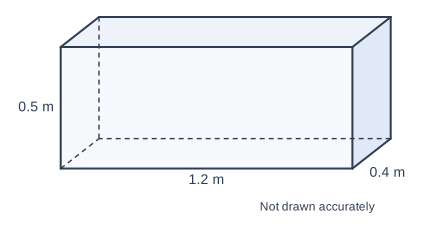
The diagram shows a solid cuboid. The cuboid has a weight of 300 newtons. It can rest on the ground on any of its faces.
Work out the greatest pressure the cuboid can exert on the ground.
Model answer
Areas of the faces: \(1.2 \times 0.4 = 0.48\) m², \(1.2 \times 0.5 = 0.6\) m², \(0.4 \times 0.5 = 0.2\) m² The greatest pressure is on the smallest face. Pressure = \(300 \div 0.2 = 1500\) N/m²
Explanation
Pressure = force ÷ area, so the same force gives the greatest pressure when the area is smallest. Find the area of each different face and divide the weight by the smallest one. Dividing by 0.2 is the same as multiplying by 5.
Mark scheme
1 mark
M1 for the area of any face (0.48, 0.6 or 0.2 m²) and 300 ÷ that area
e.g. 300 ÷ 0.48 = 625 or 300 ÷ 0.6 = 500
1 mark
M1 for using the smallest face, \(0.4 \times 0.5\) (= 0.2)
or all three pressures found
1 mark
A1 for 1500 (N/m²)
correct answer with no working scores full marks
Question 4
4 marks
Amira runs a 42 km marathon in 3 hours 20 minutes. Ben runs a 10 km race at an average speed of 3.6 m/s.
Who has the greater average speed? You must show your working.
Model answer
Amira: 42 km = 42 000 m 3 hours 20 minutes = 200 minutes = \(200 \times 60 = 12\,000\) seconds Amira's average speed = \(42\,000 \div 12\,000 = 3.5\) m/s Ben's average speed = 3.6 m/s 3.6 > 3.5, so Ben has the greater average speed.
Explanation
Change Amira's distance and time into metres and seconds so that her speed is in the same units as Ben's. Be careful with the time: 3 hours 20 minutes is 200 minutes, not 3.2 hours. Ben's race is shorter, but only the speeds are being compared.
Mark scheme
1 mark
M1 for 42 000 (m) or 12 000 (seconds)
or \(3\frac{1}{3}\) hours or 200 minutes
1 mark
M1 for Amira's speed in a unit that can be compared, e.g. \(42\,000 \div 12\,000\) or \(42 \div 3\frac{1}{3}\) (= 12.6 km/h)
1 mark
M1dep for 3.5 (m/s), or Ben's speed as 12.96 (km/h) to compare with 12.6
1 mark
A1 for Ben with 3.5 (m/s) and 3.6 (m/s) oe
or Ben with 12.6 km/h and 12.96 km/h; must have correct values for both; answer only scores 0
Ready to try the rest? Every answer you write is marked against the mark scheme, so you can see exactly where the marks are.
Ctrl + Enter to check
Study HelperHints first, answers after you try
Stuck on this one? Ask for a hint and I’ll point you in the right direction, without giving the answer away. Once you’ve checked your answer, I’ll show you how the marks are awarded.