Practise 36 exam-style questions on Standard form for AQA GCSE Maths (Higher non-calculator). Write your answer as you would in the exam and get it marked in seconds against the mark scheme, point by point, with the Study Helper on hand if you get stuck.
36 questions
1–5 marks each
Instant marking
No sign-up needed
20 questions, marked as you go
Sample questions with model answers
Here are 4 of the questions in this topic, each with a model answer, an explanation of why it earns the marks and the mark scheme an examiner would use.
Question 1
2 marks
Work out \((3 \times 10^{4}) \times (5 \times 10^{6})\)
Multiply the numbers and add the powers of 10. The result \(15 \times 10^{10}\) is not in standard form because 15 is bigger than 10, so write 15 as \(1.5 \times 10\) and increase the power by 1.
Mark scheme
1 mark
M1 for \(15 \times 10^{10}\) or 150 000 000 000
1 mark
A1 for \(1.5 \times 10^{11}\)
correct answer with no working scores full marks
Question 2
2 marks
Work out an estimate for \((6.1 \times 10^{5}) \times (2.9 \times 10^{-2})\)
Round the first numbers to 1 significant figure, but keep the powers of 10 exactly as they are. Multiply the numbers and add the powers, then make sure the answer is in standard form: \(18 \times 10^3\) becomes \(1.8 \times 10^4\).
Mark scheme
1 mark
M1 for \(6 \times 3\) (= 18) and \(10^{5} \times 10^{-2} = 10^{3}\)
or \(18 \times 10^{3}\) or 18 000
1 mark
A1 for \(1.8 \times 10^{4}\)
accept \(1.83 \times 10^{4}\) from \(6.1 \times 3\)
Question 3
3 marks
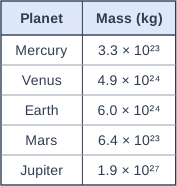
The table shows the approximate masses of five planets.
Ella says,
"Jupiter is more than 300 times as heavy as the Earth."
Is Ella correct? You must show your working.
Model answer
300 times the Earth's mass \(= 300 \times 6.0 \times 10^{24} = 1800 \times 10^{24} = 1.8 \times 10^{27}\) kg Jupiter's mass is \(1.9 \times 10^{27}\) kg, which is more than \(1.8 \times 10^{27}\) kg. So Ella is correct.
Explanation
Either work out 300 times the Earth's mass and compare it with Jupiter's, or divide Jupiter's mass by the Earth's: \(1.9 \div 6 \times 10^{3}\), which is about 317. The powers of 10 differ by 3, so Jupiter is about \(0.3 \times 10^3\) times as heavy.
Mark scheme
1 mark
M1 for \((1.9 \times 10^{27}) \div (6.0 \times 10^{24})\) or \(300 \times 6.0 \times 10^{24}\)
1 mark
M1dep for \(1.8 \times 10^{27}\) or a value in the range [316, 317]
e.g. \(1900 \div 6\)
1 mark
A1 for Yes with a correct comparison, e.g. \(300 \times\) the Earth's mass is \(1.8 \times 10^{27}\), which is less than \(1.9 \times 10^{27}\)
must have correct values; answer only scores 0
Question 4
4 marks
A sample contains \(3 \times 10^{5}\) bacteria. The number of bacteria doubles every 20 minutes.
Work out the number of bacteria in the sample after 2 hours. Give your answer in standard form.
Doubling six times multiplies the number by \(2^6 = 64\), not by \(2 \times 6 = 12\). Multiply 3 by 64 and keep the \(10^5\), then adjust: \(192 = 1.92 \times 10^2\), so the power becomes \(10^7\).
Mark scheme
1 mark
M1 for 6 doublings (2 hours \(\div\) 20 minutes)
1 mark
M1 for \(\times 2^{6}\) or \(\times 64\)
ft their number of doublings; or repeated doubling shown
1 mark
M1dep for \(192 \times 10^{5}\) or 19 200 000
1 mark
A1 for \(1.92 \times 10^{7}\)
correct answer with no working scores full marks
Ready to try the rest? Every answer you write is marked against the mark scheme, so you can see exactly where the marks are.
Ctrl + Enter to check
Study HelperHints first, answers after you try
Stuck on this one? Ask for a hint and I’ll point you in the right direction, without giving the answer away. Once you’ve checked your answer, I’ll show you how the marks are awarded.