
Level:
Correct: 0
Incorrect: 0
Marks: 0/0
Exam Practice
Course:
Topics:
AQA GCSE Maths (Higher non-calculator) Smart practice A mixed round aimed at your weak spots
Unit 1
Number
Unit 2
Algebra
Unit 3
Ratio, proportion and rates of change
Unit 4
Geometry and measures
Unit 5
Probability
Unit 6
Statistics
Avg
score:
–
Topics
done:
0/97

Transformations

Practise 28 exam-style questions on Transformations for AQA GCSE Maths (Higher non-calculator). Write your answer as you would in the exam and get it marked in seconds against the mark scheme, point by point, with the Study Helper on hand if you get stuck.

  • 28 questions
  • 1–5 marks each
  • Instant marking
  • No sign-up needed
20 questions, marked as you go

Sample questions with model answers

Here are 4 of the questions in this topic, each with a model answer, an explanation of why it earns the marks and the mark scheme an examiner would use.

Question 1

1 mark

The point P(3, 2) is enlarged by scale factor −2 with centre (0, 0).

Lily says that the image of P is (6, 4).
Lily is wrong.

What mistake has Lily made?

Model answer

Lily has enlarged by scale factor 2 instead of −2. The image should be on the opposite side of the centre: (−6, −4).

Explanation

With a negative scale factor the image goes on the opposite side of the centre. From (0, 0) the point P is 3 right and 2 up, so with scale factor −2 the image is 6 left and 4 down, at (−6, −4).

Mark scheme
  1. 1 mark

    B1 for a correct mistake, e.g. she has used scale factor 2 instead of −2, or she has put the image on the same side of the centre instead of the opposite side

    accept 'she ignored the negative sign'; the correct image (−6, −4) given alone does not describe the mistake
Question 2

2 marks

Shape A has an area of 36 cm².
Shape A is enlarged by scale factor \(-\dfrac{1}{2}\) to give shape B.

Ravi works out the area of shape B.

Area of B = 36 × \(\left(-\dfrac{1}{2}\right)\) = −18 cm²

Ravi's answer is wrong.
What mistake has Ravi made?
Work out the correct area of shape B.

Model answer

Ravi multiplied the area by the scale factor. Areas are multiplied by the scale factor squared.
\(\left(-\dfrac{1}{2}\right)^2 = \dfrac{1}{4}\)
Area of B \(= 36 \times \dfrac{1}{4} = 9\) cm²

Explanation

An enlargement multiplies every length by the scale factor, so it multiplies areas by the scale factor squared. Squaring removes the negative sign: a negative scale factor only tells you the image is inverted on the other side of the centre, and an area can never be negative.

Mark scheme
  1. 1 mark

    B1 for a correct mistake, e.g. he multiplied the area by the scale factor instead of by the scale factor squared

    accept 'an area cannot be negative' with a reference to squaring; do not accept 'he should have divided'

  2. 1 mark

    B1 for 9 (cm²)

    from \(36 \times \frac{1}{4}\)

Question 3

3 marks

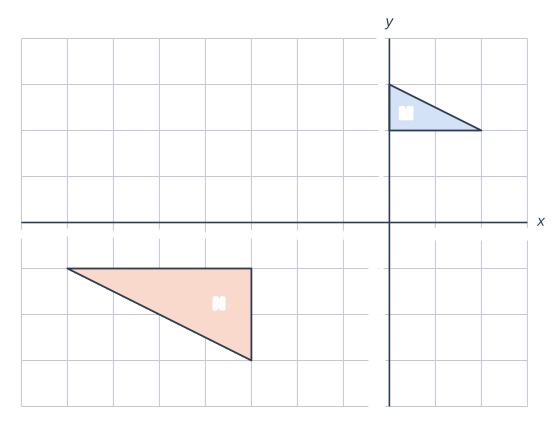
Here is a grid showing triangle M and triangle N.

Describe fully the single transformation that maps triangle M onto triangle N.

A coordinate grid with x from −8 to 3 and y from −4 to 4; each grid square is 1 unit across, and the axes cross at the origin O. Shape M is a shaded triangle with vertices (0, 2), (2, 2) and (0, 3). Shape N is a shaded triangle with vertices (−3, −1), (−7, −1) and (−3, −3).

Model answer

The horizontal side is 2 units on M and 4 units on N, and N is upside down on the other side of the centre, so the scale factor is −2.
Lines through matching vertices, e.g. (0, 2) to (−3, −1) and (0, 3) to (−3, −3), cross at (−1, 1).
Enlargement, scale factor −2, centre (−1, 1)

Explanation

With a negative scale factor the image is on the opposite side of the centre and is inverted, and the lines joining matching vertices cross at the centre (between the shapes). From (−1, 1) to (0, 2) is 1 right and 1 up; to its image (−3, −1) it is 2 left and 2 down, twice as far in the opposite direction.

Mark scheme
  1. 1 mark

    B1 for enlargement

    accept enlarge or enlarged; 0 marks if more than one transformation is given

  2. 1 mark

    B1 for scale factor −2

    do not accept 2

  3. 1 mark

    B1 for centre (−1, 1)

Question 4

4 marks

An enlargement with centre (2, 2) and scale factor k maps the point P(m, 4) to the point P′(−1, −1).

Work out the value of k and the value of m.

Model answer

From the centre (2, 2): P′ is \(\begin{pmatrix}-3\\-3\end{pmatrix}\) away and P is \(\begin{pmatrix}m - 2\\2\end{pmatrix}\) away.
\(\begin{pmatrix}-3\\-3\end{pmatrix} = k\begin{pmatrix}m - 2\\2\end{pmatrix}\)
y: \(-3 = 2k\), so \(k = -\dfrac{3}{2}\)
x: \(-3 = -\dfrac{3}{2}(m - 2)\), so \(m - 2 = 2\) and \(m = 4\)

Explanation

An enlargement multiplies the vector from the centre to a point by the scale factor. The y-coordinates involve no unknown other than k, so use them first; then use the x-coordinates to find m. The negative value of k tells you P′ is on the opposite side of the centre from P.

Mark scheme
  1. 1 mark

    M1 for using movements from the centre, e.g. \(-1 - 2 = k(4 - 2)\) or \(\begin{pmatrix}-3\\-3\end{pmatrix} = k\begin{pmatrix}m - 2\\2\end{pmatrix}\)

  2. 1 mark

    A1 for \(k = -\dfrac{3}{2}\)

    accept −1.5

  3. 1 mark

    M1 for \(-3 = k(m - 2)\) with their k

    oe, e.g. \(m - 2 = -3 \div -\frac{3}{2}\)

  4. 1 mark

    A1 for \(m = 4\)

    correct answers with no working score full marks

Ready to try the rest? Every answer you write is marked against the mark scheme, so you can see exactly where the marks are.

Study Helper Hints first, answers after you try

Stuck on this one? Ask for a hint and I’ll point you in the right direction, without giving the answer away. Once you’ve checked your answer, I’ll show you how the marks are awarded.