Level:
Correct: 0
Incorrect: 0
Marks: 0/0
Exam Practice
Course:
Topics:
AQA GCSE Maths (Higher non-calculator) Smart practice A mixed round aimed at your weak spots
Unit 1
Number
Unit 2
Algebra
Unit 3
Ratio, proportion and rates of change
Unit 4
Geometry and measures
Unit 5
Probability
Unit 6
Statistics
Avg
score:
–
Topics
done:
0/97

Geometric reasoning and proof

Practise 28 exam-style questions on Geometric reasoning and proof for AQA GCSE Maths (Higher non-calculator). Write your answer as you would in the exam and get it marked in seconds against the mark scheme, point by point, with the Study Helper on hand if you get stuck.

  • 28 questions
  • 1–5 marks each
  • Instant marking
  • No sign-up needed
20 questions, marked as you go

Sample questions with model answers

Here are 4 of the questions in this topic, each with a model answer, an explanation of why it earns the marks and the mark scheme an examiner would use.

Question 1

2 marks

Use the fact that the base angles of an isosceles triangle are equal to prove that each angle of an equilateral triangle is 60°.

Model answer

Let ABC be an equilateral triangle, so AB = BC = CA.
AB = AC, so angle ABC = angle ACB (base angles of an isosceles triangle).
BA = BC, so angle BAC = angle BCA (base angles of an isosceles triangle).
So all three angles are equal.
The angles add up to 180°, so each angle is 180 ÷ 3 = 60°.

Explanation

An equilateral triangle is isosceles in more than one way, so you can use the base-angle fact twice to show all three angles are equal. Then the angle sum of 180° shares equally between them.

Mark scheme
  1. 1 mark

    B1 for showing all three angles are equal, e.g. in equilateral triangle ABC, AB = AC so angle B = angle C, and BA = BC so angle A = angle C

  2. 1 mark

    B1 for three equal angles add up to 180°, so each is 180 ÷ 3 = 60°

    complete argument needed
Question 2

3 marks

In triangle ABC, angle ABC = angle ACB.
The bisector of angle BAC meets BC at D.

Prove that AB = AC.

Model answer

Angle ABD = angle ACD (given)
Angle BAD = angle CAD (AD bisects angle BAC)
So angle ADB = angle ADC (angles in a triangle add up to 180°)
AD = AD (common side)
So triangles ABD and ACD are congruent (ASA).
So AB = AC.

Explanation

This is the converse of the isosceles triangle fact: if two angles of a triangle are equal, the sides opposite them are equal. Two pairs of equal angles force the third angles to be equal, and the shared side AD lies between two of the pairs, so ASA applies.

Mark scheme
  1. 1 mark

    B1 for angle ABD = angle ACD (given) and angle BAD = angle CAD (AD bisects angle BAC)

  2. 1 mark

    B1 for AD is common, so triangles ABD and ACD are congruent (AAS, or ASA using angle ADB = angle ADC from the angle sum of a triangle)

  3. 1 mark

    B1 for AB = AC (corresponding sides of congruent triangles)

    complete argument needed

Question 3

3 marks

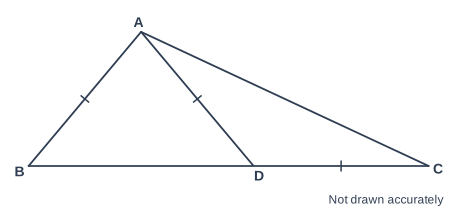
The diagram shows triangle ABC.
D is a point on BC such that AB = AD = DC.

Prove that angle ABC = 2 × angle ACB.

Geometry diagram, marked "Not drawn accurately". Triangle ABC. Line segment AD is drawn. D lies on side BC. AB, AD and DC are each marked with one short dash (equal lengths).

Model answer

Let angle ACB = x.
DA = DC, so angle DAC = angle DCA = x (base angles of an isosceles triangle).
Angle ADB is an exterior angle of triangle ADC, so angle ADB = x + x = 2x.
AB = AD, so angle ABD = angle ADB = 2x (base angles of an isosceles triangle).
So angle ABC = 2x = 2 × angle ACB.

Explanation

Start by naming the angle at C, then work through the two isosceles triangles in turn. The exterior angle at D links them: it is the sum of the two equal angles in triangle ADC, and it is a base angle of triangle ABD.

Mark scheme
  1. 1 mark

    B1 for angle DAC = angle DCA = x (base angles of isosceles triangle ADC, DA = DC)

  2. 1 mark

    B1 for angle ADB = 2x (exterior angle of triangle ADC equals the sum of the interior opposite angles)

    or angle ADC = 180 − 2x and angle ADB = 180 − (180 − 2x)

  3. 1 mark

    B1 for angle ABD = angle ADB = 2x (base angles of isosceles triangle ABD, AB = AD), so angle ABC = 2 × angle ACB

    complete argument needed

Question 4

4 marks

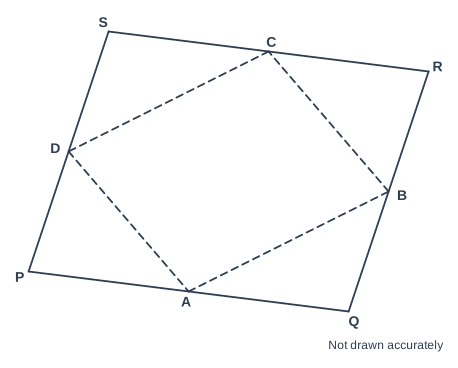
The diagram shows a quadrilateral PQRS.
A, B, C and D are the midpoints of PQ, QR, RS and SP.

You may use this result:
the line joining the midpoints of two sides of a triangle is parallel to the third side and half its length.

Prove that ABCD is a parallelogram.

Geometry diagram, marked "Not drawn accurately". Quadrilateral PQRS. Quadrilateral ABCD, drawn with dashed lines. A lies on side PQ. B lies on side QR. C lies on side RS. D lies on side PS.

Model answer

Join P to R.
In triangle PQR, A and B are the midpoints of PQ and QR, so AB is parallel to PR and \(AB = \dfrac{1}{2}PR\).
In triangle PSR, D and C are the midpoints of PS and SR, so DC is parallel to PR and \(DC = \dfrac{1}{2}PR\).
So AB and DC are both parallel to PR, which means AB is parallel to DC, and AB = DC.
ABCD has a pair of opposite sides that are equal and parallel, so it is a parallelogram.

Explanation

The diagonal PR splits PQRS into two triangles, and the given result applies to each. Both AB and DC turn out to be parallel to PR and half its length, so they are equal and parallel to each other. This works for any quadrilateral, which is what makes it a proof.

Mark scheme
  1. 1 mark

    B1 for using the diagonal PR (or QS) to make two triangles

  2. 1 mark

    B1 for in triangle PQR, AB is parallel to PR and \(AB = \dfrac{1}{2}PR\)

  3. 1 mark

    B1 for in triangle PSR, DC is parallel to PR and \(DC = \dfrac{1}{2}PR\)

  4. 1 mark

    B1 for so AB is parallel to DC and AB = DC; a quadrilateral with one pair of opposite sides equal and parallel is a parallelogram

    alternative: also use QS to show AD parallel to BC, so both pairs of opposite sides are parallel

Ready to try the rest? Every answer you write is marked against the mark scheme, so you can see exactly where the marks are.

Study Helper Hints first, answers after you try

Stuck on this one? Ask for a hint and I’ll point you in the right direction, without giving the answer away. Once you’ve checked your answer, I’ll show you how the marks are awarded.