Practise 28 exam-style questions on Comparing lengths, areas and volumes with ratio for AQA GCSE Maths (Higher non-calculator). Write your answer as you would in the exam and get it marked in seconds against the mark scheme, point by point, with the Study Helper on hand if you get stuck.
28 questions
1–5 marks each
Instant marking
No sign-up needed
20 questions, marked as you go
Sample questions with model answers
Here are 4 of the questions in this topic, each with a model answer, an explanation of why it earns the marks and the mark scheme an examiner would use.
Question 1
2 marks
Write the ratio 45 cm : 1.2 m in its simplest form.
Model answer
1.2 m = 120 cm 45 : 120 Divide both by 15: 3 : 8
Explanation
Before simplifying a ratio, both quantities must be in the same units, so change 1.2 m into 120 cm. Then divide both parts by their highest common factor, 15. The simplified ratio has no units.
Mark scheme
1 mark
M1 for 45 : 120 oe
both lengths in the same units, e.g. 0.45 : 1.2
1 mark
A1 for 3 : 8
correct answer with no working scores full marks; 75 : 2 or 3 : 0.08 scores 0
Question 2
2 marks
A vertical pole 1.5 m tall casts a shadow 2 m long on level ground. At the same time, a vertical tree casts a shadow 12 m long on the same level ground.
How tall is the tree?
Model answer
The sun's rays make the same angle with the ground, so the two right-angled triangles are similar. Scale factor = \(12 \div 2 = 6\) Height of tree = \(1.5 \times 6 = 9\) m
Explanation
The pole and its shadow form a right-angled triangle that is similar to the one made by the tree and its shadow, because the angle of the sun is the same. So the ratio height : shadow (which is the tangent of the angle of the sun) is the same for both: 1.5 : 2 = 9 : 12.
Mark scheme
1 mark
M1 for \(12 \div 2\) (= 6) or \(\dfrac{1.5}{2}\) (= 0.75) oe
e.g. \(\dfrac{h}{12} = \dfrac{1.5}{2}\)
1 mark
A1 for 9 (m)
correct answer with no working scores full marks; 11.5 (from 1.5 + 10) scores 0
Question 3
3 marks
Two pentagons are mathematically similar. The smaller pentagon has an area of 18 cm². The larger pentagon has an area of 50 cm². One side of the smaller pentagon is 6 cm long.
Work out the length of the corresponding side of the larger pentagon.
Model answer
Area ratio = 18 : 50 = 9 : 25 Length ratio = \(\sqrt{9} : \sqrt{25} = 3 : 5\) Side of larger pentagon = \(6 \times \dfrac{5}{3} = 10\) cm
Explanation
The area scale factor is the square of the length scale factor, so square-root the area ratio to get the length ratio. Simplifying 18 : 50 to 9 : 25 first gives square numbers that are easy to root without a calculator.
Mark scheme
1 mark
M1 for 18 : 50 = 9 : 25 or \(\dfrac{50}{18} = \dfrac{25}{9}\)
1 mark
M1dep for length ratio 3 : 5 or \(\sqrt{\dfrac{25}{9}} = \dfrac{5}{3}\)
1 mark
A1 for 10 (cm)
correct answer with no working scores full marks; 16.6... (from \(6 \times \frac{50}{18}\)) scores 0
Question 4
4 marks
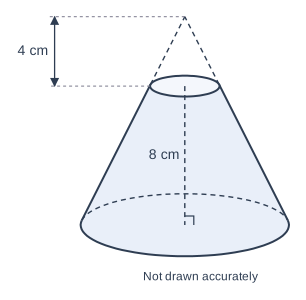
A solid cone has a height of 12 cm. The cone is cut parallel to its base to remove a small cone of height 4 cm from the top. The part that is left is a frustum, as shown in the diagram.
Work out the ratio volume of small cone : volume of frustum Give your answer in its simplest form.
Model answer
The small cone and the original cone are similar. Length ratio = 4 : 12 = 1 : 3 Volume ratio (small cone : original cone) = \(1^3 : 3^3 = 1 : 27\) Volume of frustum = 27 − 1 = 26 parts Volume of small cone : volume of frustum = 1 : 26
Explanation
The small cone that is cut off is similar to the whole cone, with length scale factor 3, so the whole cone has 27 times the volume of the small cone. The frustum is what is left, 27 − 1 = 26 parts. The frustum itself is not similar to either cone, so you must subtract.
Mark scheme
1 mark
M1 for length ratio 4 : 12 or 1 : 3
the small cone and the original cone are similar
1 mark
M1dep for volume ratio 1 : 27
1 mark
M1dep for 27 − 1 (= 26)
1 mark
A1 for 1 : 26
correct answer with no working scores full marks; 1 : 27 scores M1 M1 M0 A0; 1 : 2 or 1 : 8 scores 0
Ready to try the rest? Every answer you write is marked against the mark scheme, so you can see exactly where the marks are.
Ctrl + Enter to check
Study HelperHints first, answers after you try
Stuck on this one? Ask for a hint and I’ll point you in the right direction, without giving the answer away. Once you’ve checked your answer, I’ll show you how the marks are awarded.