Practise 28 exam-style questions on Gradients and intercepts for AQA GCSE Maths (Higher non-calculator). Write your answer as you would in the exam and get it marked in seconds against the mark scheme, point by point, with the Study Helper on hand if you get stuck.
28 questions
1–5 marks each
Instant marking
No sign-up needed
20 questions, marked as you go
Sample questions with model answers
Here are 4 of the questions in this topic, each with a model answer, an explanation of why it earns the marks and the mark scheme an examiner would use.
Question 1
1 mark
The height, h cm, of a candle t hours after it is lit is given by \(h = 24 - 3t\)
What does the 3 represent?
Model answer
The 3 is the rate at which the candle burns: its height decreases by 3 cm each hour.
Explanation
In a linear formula the number multiplying the variable is the rate of change. Here \(-3\) is the gradient, so h falls by 3 cm for every 1 hour. The 24 is the starting height when \(t = 0\).
Mark scheme
1 mark
B1 for the height of the candle goes down by 3 cm every hour
oe, e.g. 'the candle burns 3 cm per hour'; must refer to the rate of decrease in context (height and time); do not accept 'the gradient' or 'how fast it burns' with no values or units
Question 2
2 marks
The length, L cm, of a spring when a mass of m kg hangs from it is given by \(L = 4m + 12\)
What do the 4 and the 12 represent?
Model answer
4 is the increase in length for each kilogram: the spring stretches 4 cm per kg. 12 is the length of the spring with no mass on it: 12 cm.
Explanation
L = 4m + 12 has the form \(y = mx + c\). The gradient, 4, is the rate of change of length with mass (cm per kg), and the intercept, 12, is the value of L when \(m = 0\). Answers must say what the numbers mean in this context, not just 'gradient' and 'intercept'.
Mark scheme
1 mark
B1 for 4: the spring gets 4 cm longer for each extra kilogram
oe, e.g. 'the length increases by 4 cm per kg'; must be in context
1 mark
B1 for 12: the length of the spring (12 cm) when no mass hangs from it
oe, e.g. 'the original length', 'the length when m = 0'
Question 3
3 marks
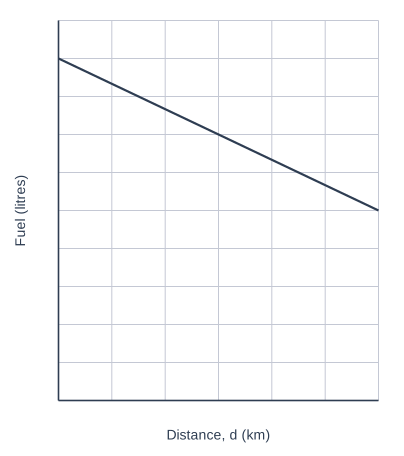
A car's fuel tank is full at the start of a journey. The graph shows the amount of fuel left in the tank after the car has travelled d km.
The car keeps using fuel at the same rate. How far can the car travel on a full tank of fuel?
Model answer
Full tank: 45 litres. After 300 km there are 25 litres left, so 20 litres are used every 300 km. That is 1 litre every 15 km. \(45 \times 15 = 675\) km
Explanation
The intercept on the fuel axis is the amount in a full tank, and the gradient is the rate at which fuel is used. The tank is empty where the line would cross the distance axis, so continue the pattern: 1 litre per 15 km means 45 litres last 675 km.
Mark scheme
1 mark
M1 for the rate of fuel use from the graph, e.g. 20 litres per 300 km, 10 litres per 150 km or gradient \(-\dfrac{1}{15}\)
oe
1 mark
M1 for \(45 \div \dfrac{1}{15}\) or \(45 \times 15\) or \(\dfrac{45}{20} \times 300\)
oe, e.g. solving \(45 - \dfrac{d}{15} = 0\)
1 mark
A1 for 675 km
correct answer with no working scores full marks
Question 4
4 marks
Some identical plastic cups are stacked one inside another. A stack of 4 cups is 15 cm tall. A stack of 10 cups is 27 cm tall. The height of the stack increases by the same amount for each cup that is added.
How many cups are in a stack that is 41 cm tall?
Model answer
6 more cups add \(27 - 15 = 12\) cm, so each cup adds 2 cm. Height \(= 2n + c\): \(15 = 2 \times 4 + c\), so \(c = 7\) \(h = 2n + 7\) \(2n + 7 = 41\) \(2n = 34\) \(n = 17\)
Explanation
The height is a linear function of the number of cups. The gradient is the extra height for each cup, found from the change in height divided by the change in number of cups. The intercept, 7 cm, is the part of the first cup that does not fit inside the next one; a common error is to divide 41 by the height of one cup.
Mark scheme
1 mark
M1 for \((27 - 15) \div (10 - 4)\) or 2 cm per cup
oe
1 mark
M1 for \(15 - 4 \times \text{their } 2\) or 7, or for \(h = 2n + 7\)
oe
1 mark
M1 for \(\text{their } 2n + \text{their } 7 = 41\) or \((41 - 27) \div 2\)
oe, e.g. \(10 + (41 - 27) \div 2\)
1 mark
A1 for 17
correct answer with no working scores full marks
Ready to try the rest? Every answer you write is marked against the mark scheme, so you can see exactly where the marks are.
Ctrl + Enter to check
Study HelperHints first, answers after you try
Stuck on this one? Ask for a hint and I’ll point you in the right direction, without giving the answer away. Once you’ve checked your answer, I’ll show you how the marks are awarded.