Level:
Correct: 0
Incorrect: 0
Marks: 0/0
Exam Practice
Course:
Topics:
AQA GCSE Maths (Higher non-calculator) Smart practice A mixed round aimed at your weak spots
Unit 1
Number
Unit 2
Algebra
Unit 3
Ratio, proportion and rates of change
Unit 4
Geometry and measures
Unit 5
Probability
Unit 6
Statistics
Avg
score:
–
Topics
done:
0/97

Combined events and tree diagrams

Practise 36 exam-style questions on Combined events and tree diagrams for AQA GCSE Maths (Higher non-calculator). Write your answer as you would in the exam and get it marked in seconds against the mark scheme, point by point, with the Study Helper on hand if you get stuck.

  • 36 questions
  • 1–5 marks each
  • Instant marking
  • No sign-up needed
20 questions, marked as you go

Sample questions with model answers

Here are 4 of the questions in this topic, each with a model answer, an explanation of why it earns the marks and the mark scheme an examiner would use.

Question 1

2 marks

The probability that Ravi is late for work on any day is 0.2
Whether he is late on one day is independent of whether he is late on any other day.

Ravi says,

"The probability that I am late on both Monday and Tuesday is 0.2 + 0.2 = 0.4"

What mistake has Ravi made?
Work out the correct probability.

Model answer

Ravi has added the probabilities. For independent events happening together you multiply them.
P(late on both days) = 0.2 × 0.2 = 0.04

Explanation

'And' for independent events means multiply; 'or' for mutually exclusive events means add. Being late on Monday and being late on Tuesday can both happen, so adding is wrong. A quick check: the chance of both happening must be smaller than the chance of either one.

Mark scheme
  1. 1 mark

    B1 for saying he has added the probabilities when he should have multiplied them

    oe, e.g. 'for both events to happen you multiply'

  2. 1 mark

    B1 for 0.04

    oe

Question 2

2 marks

Amy and Ben are each taking a driving test.
The probability that Amy passes is 0.4
The probability that Ben passes is 0.25
You may assume that their results are independent.

Work out the probability that at least one of them passes.

Model answer

P(neither passes) = 0.6 × 0.75 = 0.45
P(at least one passes) = 1 − 0.45 = 0.55

Explanation

The opposite of 'at least one passes' is 'neither passes', which you get by multiplying the probabilities of each failing. Adding 0.4 + 0.25 = 0.65 is wrong because it counts the case where both pass twice.

Mark scheme
  1. 1 mark

    M1 for 1 − 0.6 × 0.75

    oe, e.g. 0.4 + 0.25 − 0.4 × 0.25, or 0.4 × 0.75 + 0.6 × 0.25 + 0.4 × 0.25

  2. 1 mark

    A1 for 0.55

    oe
    correct answer with no working scores full marks

Question 3

3 marks

Sara is going to throw a fair coin.
She says,

"The probability of getting exactly 1 head in 2 throws is the same as the probability of getting exactly 2 heads in 4 throws, because each time it is half of the throws."

Is Sara correct?
You must show your working.

Model answer

2 throws: 4 equally likely outcomes, and HT and TH have exactly 1 head.
P(exactly 1 head) \(= \dfrac{2}{4} = \dfrac{1}{2}\)
4 throws: \(2 \times 2 \times 2 \times 2 = 16\) equally likely outcomes.
Exactly 2 heads: HHTT, HTHT, HTTH, THHT, THTH, TTHH, which is 6 outcomes.
P(exactly 2 heads) \(= \dfrac{6}{16} = \dfrac{3}{8}\)
\(\dfrac{1}{2}\) and \(\dfrac{3}{8}\) are not equal, so Sara is not correct.

Explanation

Each throw is independent with probability \(\dfrac{1}{2}\), so every sequence of 4 throws has probability \(\dfrac{1}{16}\). Count the sequences carefully: there are 6 ways to place 2 heads among 4 throws. 'Half of the throws' does not make the probabilities equal.

Mark scheme
  1. 1 mark

    M1 for P(exactly 1 head in 2 throws) \(= \dfrac{2}{4}\) (HT, TH)

    oe, e.g. \(2 \times \dfrac{1}{2} \times \dfrac{1}{2}\)

  2. 1 mark

    M1 for 6 outcomes with exactly 2 heads out of 16 (HHTT, HTHT, HTTH, THHT, THTH, TTHH)

    oe, e.g. \(6 \times \dfrac{1}{16}\)

  3. 1 mark

    A1 for No, with \(\dfrac{1}{2}\) and \(\dfrac{3}{8}\)

    oe, e.g. \(\dfrac{8}{16}\) and \(\dfrac{6}{16}\)
    must have correct values for both
    answer only scores 0

Question 4

4 marks

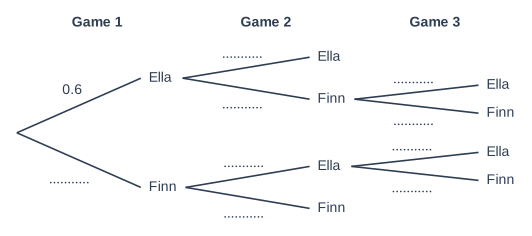
Ella and Finn play a table tennis match.
The first player to win two games wins the match.
The probability that Ella wins any game is 0.6
The results of the games are independent and every game has a winner.
The tree diagram shows the possible results of the games.

Work out the probability that Ella wins the match.

A probability tree diagram drawn from left to right with 3 stages of branches, headed "Game 1", "Game 2" and "Game 3". Each branch has its outcome written at its end and its probability written beside it. First stage, 2 branches: "Ella" with probability 0.6, "Finn" with probability left blank (a dotted line to fill in). After "Ella", the second stage branches are "Ella" with probability left blank (a dotted line to fill in), "Finn" with probability left blank (a dotted line to fill in). After "Ella" then "Finn", the third stage branches are "Ella" with probability left blank (a dotted line to fill in), "Finn" with probability left blank (a dotted line to fill in). After "Finn", the second stage branches are "Ella" with probability left blank (a dotted line to fill in), "Finn" with probability left blank (a dotted line to fill in). After "Finn" then "Ella", the third stage branches are "Ella" with probability left blank (a dotted line to fill in), "Finn" with probability left blank (a dotted line to fill in). Some paths stop early: "Ella" then "Ella" and "Finn" then "Finn" have no further branches.

Model answer

Ella wins the match with: EE, EFE or FEE
P(EE) = 0.6 × 0.6 = 0.36
P(EFE) = 0.6 × 0.4 × 0.6 = 0.144
P(FEE) = 0.4 × 0.6 × 0.6 = 0.144
P(Ella wins the match) = 0.36 + 0.144 + 0.144 = 0.648

Explanation

The match can end after two games, so some paths on the tree stop early. List every way Ella can win two games before Finn does: EE, EFE and FEE. Multiply along each path and add. A common error is to include a third game after EE.

Mark scheme
  1. 1 mark

    M1 for 0.6 × 0.6 (= 0.36)

    Ella wins games 1 and 2

  2. 1 mark

    M1 for 0.6 × 0.4 × 0.6 (= 0.144) or 0.4 × 0.6 × 0.6

    oe

  3. 1 mark

    M1dep for 0.36 + 0.144 + 0.144

    all three paths added; dependent on at least one of the previous M marks

  4. 1 mark

    A1 for 0.648

    oe
    correct answer with no working scores full marks

Ready to try the rest? Every answer you write is marked against the mark scheme, so you can see exactly where the marks are.

Study Helper Hints first, answers after you try

Stuck on this one? Ask for a hint and I’ll point you in the right direction, without giving the answer away. Once you’ve checked your answer, I’ll show you how the marks are awarded.