Practise 28 exam-style questions on Average and instantaneous rates of change for AQA GCSE Maths (Higher non-calculator). Write your answer as you would in the exam and get it marked in seconds against the mark scheme, point by point, with the Study Helper on hand if you get stuck.
28 questions
1–5 marks each
Instant marking
No sign-up needed
20 questions, marked as you go
Sample questions with model answers
Here are 4 of the questions in this topic, each with a model answer, an explanation of why it earns the marks and the mark scheme an examiner would use.
Question 1
2 marks
Work out the average rate of change of \(y = x^3\) between \(x = 1\) and \(x = 3\)
Model answer
When \(x = 1\), \(y = 1\). When \(x = 3\), \(y = 27\). Average rate of change \(= \dfrac{27 - 1}{3 - 1} = \dfrac{26}{2} = 13\)
Explanation
The average rate of change is the gradient of the chord joining the points where \(x = 1\) and \(x = 3\). Work out both \(y\)-values, then divide the change in \(y\) by the change in \(x\). Forgetting to divide gives 26.
Mark scheme
1 mark
M1 for \(\dfrac{27 - 1}{3 - 1}\)
oe
1 mark
A1 for 13
correct answer with no working scores full marks
Question 2
2 marks
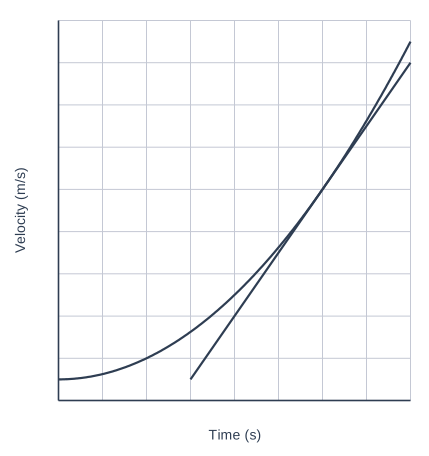
The graph shows the velocity of a car in the first 8 seconds of its journey. A tangent has been drawn to the curve at 6 seconds.
Use the tangent to estimate the acceleration of the car at 6 seconds.
Model answer
The tangent passes through (4, 8) and (8, 32). Gradient \(= \dfrac{32 - 8}{8 - 4} = \dfrac{24}{4} = 6\) The acceleration at 6 seconds is about 6 m/s².
Explanation
Acceleration is the rate of change of velocity, so on a velocity-time graph it is the gradient. On a curve, the gradient at one instant is the gradient of the tangent there. Dividing the velocity at 6 seconds by 6 does not give the acceleration.
Mark scheme
1 mark
M1 for change in velocity ÷ change in time using two points on the tangent, e.g. \(\dfrac{32 - 8}{8 - 4}\)
oe
1 mark
A1 for 6 (m/s²)
accept [5.5, 6.5]
Question 3
3 marks
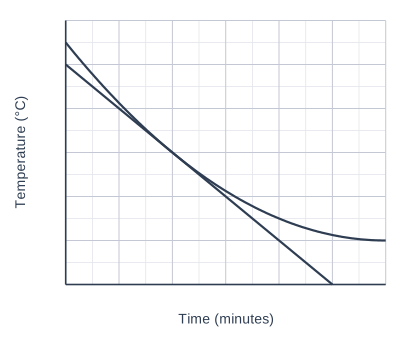
The graph shows the temperature of a cup of tea as it cools. A tangent has been drawn to the curve at 10 minutes.
Use the tangent to estimate the rate at which the tea is cooling at 10 minutes. Give the units of your answer.
Model answer
The tangent passes through (0, 100) and (25, 0). Gradient \(= \dfrac{0 - 100}{25 - 0} = -4\) The tea is cooling at about 4 °C per minute at 10 minutes.
Explanation
The rate of change of temperature at an instant is the gradient of the tangent at that point. The gradient is negative because the temperature is falling, so the tea is cooling at about 4 °C per minute. Use points on the tangent, not on the curve, and pick ones far apart to make the estimate accurate.
Mark scheme
1 mark
M1 for reading two points on the tangent, e.g. (0, 100) and (25, 0)
or (15, 40) and (20, 20), etc.
1 mark
M1dep for change in temperature ÷ change in time, e.g. \(\dfrac{100 - 0}{25 - 0}\)
oe
1 mark
A1 for 4 °C per minute
accept [3.5, 4.5]; accept −4 °C per minute; units required
Question 4
4 marks
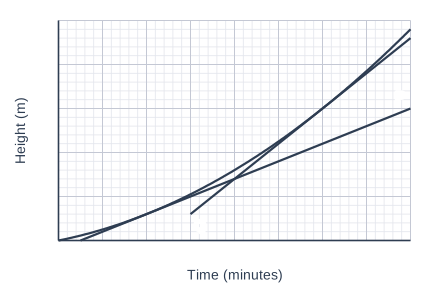
A hot air balloon rises from the ground. The graph shows its height during the first 8 minutes. Tangent P has been drawn to the curve at 2 minutes and tangent Q has been drawn at 6 minutes.
How many times faster is the balloon rising at 6 minutes than at 2 minutes? You must show your working.
Model answer
Tangent P passes through (3, 10) and (8, 30): gradient \(= \dfrac{30 - 10}{8 - 3} = \dfrac{20}{5} = 4\) m per minute Tangent Q passes through (4, 14) and (8, 46): gradient \(= \dfrac{46 - 14}{8 - 4} = \dfrac{32}{4} = 8\) m per minute \(8 \div 4 = 2\) The balloon is rising 2 times as fast at 6 minutes as at 2 minutes.
Explanation
The rate at which the balloon rises at an instant is the gradient of the tangent at that time. Find each gradient from two points on the tangent, not on the curve, and then divide to compare. Comparing the heights (30 m and 6 m) instead of the gradients is a common mistake.
Mark scheme
1 mark
M1 for the gradient of tangent P using two points on it, e.g. \(\dfrac{30 - 10}{8 - 3}\)
oe
1 mark
A1 for 4 (m per minute)
accept [3.5, 4.5]
1 mark
M1 for the gradient of tangent Q using two points on it, e.g. \(\dfrac{46 - 14}{8 - 4}\)
oe
1 mark
A1 for 8 (m per minute) and 2 (times faster)
accept [7.5, 8.5] for the gradient of Q; ft their gradients for the number of times; answer only scores 0
Ready to try the rest? Every answer you write is marked against the mark scheme, so you can see exactly where the marks are.
Ctrl + Enter to check
Study HelperHints first, answers after you try
Stuck on this one? Ask for a hint and I’ll point you in the right direction, without giving the answer away. Once you’ve checked your answer, I’ll show you how the marks are awarded.