Practise 29 exam-style questions on Linear equations for AQA GCSE Maths (Higher non-calculator). Write your answer as you would in the exam and get it marked in seconds against the mark scheme, point by point, with the Study Helper on hand if you get stuck.
29 questions
1–5 marks each
Instant marking
No sign-up needed
20 questions, marked as you go
Sample questions with model answers
Here are 4 of the questions in this topic, each with a model answer, an explanation of why it earns the marks and the mark scheme an examiner would use.
Question 1
2 marks
Solve \(7x + 3 = 3x + 23\)
Model answer
\(7x - 3x = 23 - 3\) \(4x = 20\) \(x = 5\)
Explanation
Subtract the smaller x term (3x) from both sides so the x terms are on one side, then subtract 3 from both sides. Whatever you do to one side you must do to the other. Check: \(7 \times 5 + 3 = 38\) and \(3 \times 5 + 23 = 38\).
Mark scheme
1 mark
M1 for collecting the x terms on one side and the numbers on the other, e.g. \(4x = 20\)
allow one sign or arithmetic error in rearranging
1 mark
A1 for \(x = 5\)
correct answer with no working scores full marks
Question 2
2 marks
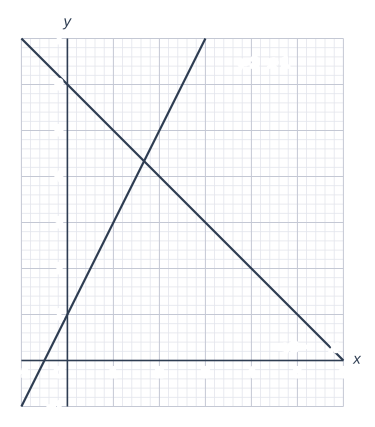
The graph shows the lines \(y = 2x + 1\) and \(y = 6 - x\)
Use the graph to find an estimate for the solution of \(2x + 1 = 6 - x\)
Model answer
The lines cross at about (1.7, 4.3). The solution is the x-coordinate: \(x \approx 1.7\)
Explanation
Where the two lines cross, \(2x + 1\) and \(6 - x\) have the same value, so the x-coordinate of the crossing point solves the equation. The answer is x, not the y-coordinate. Algebra gives the exact value \(3x = 5\), \(x = \frac{5}{3}\).
Mark scheme
1 mark
M1 for using the point where the lines cross
1 mark
A1 for an answer in [1.6, 1.8]
accept \(1\frac{2}{3}\); do not accept the y-coordinate of the crossing point; correct answer with no working scores full marks
Question 3
3 marks
The mean of these four numbers is 12
\(3x\) \(2x + 5\) \(x - 1\) 14
Work out the value of \(x\).
Model answer
Total = mean × 4 = 12 × 4 = 48 \(3x + 2x + 5 + x - 1 + 14 = 48\) \(6x + 18 = 48\) \(6x = 30\), so \(x = 5\)
Explanation
The total of the numbers is the mean multiplied by how many numbers there are. Add the four expressions and set the total equal to 48. Check: the numbers are 15, 15, 4 and 14, which add up to 48.
Mark scheme
1 mark
M1 for \(3x + 2x + 5 + x - 1 + 14\) (= \(6x + 18\))
1 mark
M1 for \(6x + 18 = 48\) or \(\frac{6x + 18}{4} = 12\)
1 mark
A1 for \(x = 5\)
correct answer with no working scores full marks
Question 4
4 marks
Kate walks from her home to the station at an average speed of 4 km/h. She cycles back along the same route at an average speed of 12 km/h. Her total travelling time is 1 hour 20 minutes.
Work out the distance from Kate's home to the station.
Model answer
Let the distance be d km. Time walking = \(\dfrac{d}{4}\) hours, time cycling = \(\dfrac{d}{12}\) hours 1 hour 20 minutes = \(\dfrac{4}{3}\) hours \(\dfrac{d}{4} + \dfrac{d}{12} = \dfrac{4}{3}\) Multiply by 12: \(3d + d = 16\) \(4d = 16\), so \(d = 4\) The station is 4 km from Kate's home.
Explanation
Use time = distance ÷ speed for each part of the journey and add the times. Change 1 hour 20 minutes to \(\frac{4}{3}\) hours, not 1.2 hours. Check: walking 4 km takes 1 hour and cycling 4 km takes 20 minutes.
Mark scheme
1 mark
M1 for one time as an expression: \(\frac{d}{4}\) or \(\frac{d}{12}\)
time = distance ÷ speed
1 mark
M1 for \(\frac{d}{4} + \frac{d}{12} = \frac{4}{3}\)
oe, e.g. \(= 1\frac{1}{3}\), or 15d + 5d = 80 in minutes
1 mark
M1dep for clearing the fractions, e.g. \(3d + d = 16\)
1 mark
A1 for 4 km
correct answer with no working scores full marks
Ready to try the rest? Every answer you write is marked against the mark scheme, so you can see exactly where the marks are.
Ctrl + Enter to check
Study HelperHints first, answers after you try
Stuck on this one? Ask for a hint and I’ll point you in the right direction, without giving the answer away. Once you’ve checked your answer, I’ll show you how the marks are awarded.