
Level:
Correct: 0
Incorrect: 0
Marks: 0/0
Exam Practice
Course:
Topics:
AQA GCSE Maths (Higher non-calculator) Smart practice A mixed round aimed at your weak spots
Unit 1
Number
Unit 2
Algebra
Unit 3
Ratio, proportion and rates of change
Unit 4
Geometry and measures
Unit 5
Probability
Unit 6
Statistics
Avg
score:
–
Topics
done:
0/97

Conditional probability

Practise 36 exam-style questions on Conditional probability for AQA GCSE Maths (Higher non-calculator). Write your answer as you would in the exam and get it marked in seconds against the mark scheme, point by point, with the Study Helper on hand if you get stuck.

  • 36 questions
  • 1–5 marks each
  • Instant marking
  • No sign-up needed
20 questions, marked as you go

Sample questions with model answers

Here are 4 of the questions in this topic, each with a model answer, an explanation of why it earns the marks and the mark scheme an examiner would use.

Question 1

2 marks

The table shows how some students travel to school.

A student who walks to school is chosen at random.
Work out the probability that this student is a girl.
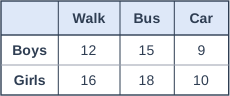
Table with columns (row headings), "Walk", "Bus", "Car". Boys; Walk: 12; Bus: 15; Car: 9 | Girls; Walk: 16; Bus: 18; Car: 10.

Model answer

Students who walk = 12 + 16 = 28
Girls who walk = 16
Probability \(= \dfrac{16}{28} = \dfrac{4}{7}\)

Explanation

The student is chosen from those who walk, so the denominator is the total of the Walk column, not the number of girls or the number of students. The numerator is the girls in that column.

Mark scheme
  1. 1 mark

    M1 for 28 students who walk (12 + 16), or a fraction with denominator 28

  2. 1 mark

    A1 for \(\dfrac{16}{28}\)

    oe, e.g. \(\dfrac{4}{7}\)
    correct answer with no working scores full marks

Question 2

2 marks

Two fair six-sided dice are rolled.
Given that the total of the two scores is 8, work out the probability that both dice show the same number.

Model answer

Outcomes with a total of 8: (2, 6), (3, 5), (4, 4), (5, 3), (6, 2), which is 5 equally likely outcomes.
Only (4, 4) has both dice the same.
Probability \(= \dfrac{1}{5}\)

Explanation

Knowing the total is 8 cuts the sample space down from 36 outcomes to the 5 that give 8. These 5 are still equally likely, so count how many of them are doubles. The answer \(\dfrac{1}{36}\) is the probability of (4, 4) before you know the total.

Mark scheme
  1. 1 mark

    M1 for the 5 equally likely outcomes with a total of 8: (2, 6), (3, 5), (4, 4), (5, 3), (6, 2)

    oe, e.g. a fraction with denominator 5

  2. 1 mark

    A1 for \(\dfrac{1}{5}\)

    do not accept \(\dfrac{1}{36}\)
    correct answer with no working scores full marks

Question 3

3 marks

Two fair six-sided dice are rolled.
Given that at least one of the dice shows a 6, work out the probability that the total of the two scores is at least 10

Model answer

Outcomes with at least one 6: (6, 1), (6, 2), (6, 3), (6, 4), (6, 5), (6, 6), (1, 6), (2, 6), (3, 6), (4, 6), (5, 6), which is 11 outcomes.
Total at least 10: (6, 4), (6, 5), (6, 6), (4, 6), (5, 6), which is 5 outcomes.
Probability \(= \dfrac{5}{11}\)

Explanation

The condition reduces the sample space to the 11 outcomes containing a 6 (not 12, because (6, 6) is only one outcome). Among these, count the ones with a total of 10, 11 or 12. Note that (5, 5) has a total of 10 but no 6, so it is not included.

Mark scheme
  1. 1 mark

    M1 for 11 equally likely outcomes with at least one 6

    oe, e.g. a sample space with these 11 outcomes identified

  2. 1 mark

    M1 for 5 of these with a total of at least 10: (6, 4), (6, 5), (6, 6), (4, 6), (5, 6)

  3. 1 mark

    A1 for \(\dfrac{5}{11}\)

    do not accept \(\dfrac{5}{36}\) or \(\dfrac{6}{36}\)
    correct answer with no working scores full marks

Question 4

4 marks

A bag contains 5 red counters and 3 blue counters.
Two counters are taken at random from the bag without replacement.

Given that at least one of the counters is red, work out the probability that both counters are red.

Model answer

P(both red) \(= \dfrac{5}{8} \times \dfrac{4}{7} = \dfrac{20}{56}\)
P(both blue) \(= \dfrac{3}{8} \times \dfrac{2}{7} = \dfrac{6}{56}\)
P(at least one red) \(= 1 - \dfrac{6}{56} = \dfrac{50}{56}\)
P(both red given at least one red) \(= \dfrac{20}{56} \div \dfrac{50}{56} = \dfrac{20}{50} = \dfrac{2}{5}\)

Explanation

'At least one red' is every path except blue-blue, so its probability is \(1 - \dfrac{6}{56}\). 'Both red' is part of that event, so divide its probability by \(\dfrac{50}{56}\). Giving \(\dfrac{20}{56}\) ignores the condition.

Mark scheme
  1. 1 mark

    M1 for P(both red) \(= \dfrac{5}{8} \times \dfrac{4}{7}\) (\(= \dfrac{20}{56}\))

    oe

  2. 1 mark

    M1 for P(at least one red) \(= 1 - \dfrac{3}{8} \times \dfrac{2}{7}\) (\(= \dfrac{50}{56}\))

    oe, e.g. \(\dfrac{20}{56} + \dfrac{15}{56} + \dfrac{15}{56}\)

  3. 1 mark

    M1dep for \(\dfrac{20}{56} \div \dfrac{50}{56}\)

    ft their values

  4. 1 mark

    A1 for \(\dfrac{2}{5}\)

    oe, e.g. \(\dfrac{20}{50}\)
    correct answer with no working scores full marks

Ready to try the rest? Every answer you write is marked against the mark scheme, so you can see exactly where the marks are.

Study Helper Hints first, answers after you try

Stuck on this one? Ask for a hint and I’ll point you in the right direction, without giving the answer away. Once you’ve checked your answer, I’ll show you how the marks are awarded.