Practise 18 exam-style questions on Algebraic notation for AQA GCSE Maths (Higher non-calculator). Write your answer as you would in the exam and get it marked in seconds against the mark scheme, point by point, with the Study Helper on hand if you get stuck.
18 questions
1–4 marks each
Instant marking
No sign-up needed
18 questions, marked as you go
Sample questions with model answers
Here are 4 of the questions in this topic, each with a model answer, an explanation of why it earns the marks and the mark scheme an examiner would use.
Question 1
2 marks
Simplify \(4 \times p \times q \times p \times 3\)
Multiply the numbers together first and write the result at the front, then write the letters in alphabetical order, using a power for a letter that appears more than once. Writing \(12p2q\) or \(7p^2q\) (adding 4 and 3) are common mistakes.
Mark scheme
1 mark
B1 for a coefficient of 12, e.g. \(12ppq\)
1 mark
B1 for \(12p^2q\)
accept \(12qp^2\); fully correct answer scores 2
Question 2
2 marks
Kim thinks of a number, \(n\). She adds 4 to her number and then multiplies the result by 5 She writes the expression \(5n + 4\)
What mistake has Kim made? Write down the correct expression.
Model answer
Kim's expression multiplies \(n\) by 5 first and then adds 4. She needs brackets so that the whole of \(n + 4\) is multiplied by 5. \(5(n + 4)\)
Explanation
The order of operations means multiplication happens before addition, so \(5n + 4\) means 'multiply by 5, then add 4'. Brackets show that the addition happens first: \(5(n + 4)\), which expands to \(5n + 20\).
Mark scheme
1 mark
B1 for a correct description of the mistake, e.g. she has not used brackets, so her expression multiplies \(n\) by 5 and then adds 4
1 mark
B1 for \(5(n + 4)\)
accept \(5n + 20\) or \((n + 4) \times 5\)
Question 3
3 marks
A taxi company charges a fixed fee of £\(a\) plus \(b\) pence for each mile travelled.
Write a formula for the total cost, £\(C\), of a journey of \(m\) miles.
Model answer
Cost of the miles \(= bm\) pence \(= \dfrac{bm}{100}\) pounds \(C = a + \dfrac{bm}{100}\)
Explanation
The cost of the miles is \(b \times m = bm\) pence, but the fixed fee and the total are in pounds, so divide by 100 to change pence into pounds before adding. A formula needs the subject: write \(C = \ldots\), not just an expression.
Mark scheme
1 mark
B1 for \(bm\) (the cost of the miles in pence)
accept \(b \times m\)
1 mark
M1 for converting pence to pounds, e.g. \(\dfrac{bm}{100}\)
1 mark
A1 for \(C = a + \dfrac{bm}{100}\)
oe, e.g. \(C = \dfrac{100a + bm}{100}\) or \(C = a + 0.01bm\); must be a formula starting \(C =\); do not accept \(C = a + bm\)
Question 4
4 marks
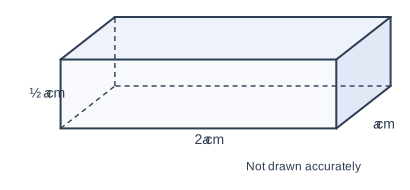
The diagram shows a cuboid. The cuboid has length \(2a\) cm, width \(a\) cm and height \(\dfrac{1}{2}a\) cm.
Work out an expression for the total surface area of the cuboid. Give your answer in its simplest form.
Model answer
Top and bottom: \(2a \times a = 2a^2\) each Front and back: \(2a \times \dfrac{1}{2}a = a^2\) each Two ends: \(a \times \dfrac{1}{2}a = \dfrac{1}{2}a^2\) each Total \(= 2(2a^2 + a^2 + \dfrac{1}{2}a^2) = 2 \times \dfrac{7}{2}a^2 = 7a^2\) cm²
Explanation
A cuboid has three pairs of identical faces, so find the area of three different faces and double the total. Multiplying \(a\) by \(\dfrac{1}{2}a\) gives \(\dfrac{1}{2}a^2\). A common mistake is to find the volume (\(a^3\)) instead, or to add only three faces.
Mark scheme
1 mark
M1 for the area of one face, e.g. \(2a \times a = 2a^2\) or \(2a \times \dfrac{1}{2}a = a^2\) or \(a \times \dfrac{1}{2}a = \dfrac{1}{2}a^2\)
1 mark
M1 for the areas of all three different faces, \(2a^2\), \(a^2\) and \(\dfrac{1}{2}a^2\)
1 mark
M1dep for doubling and adding, e.g. \(2(2a^2 + a^2 + \dfrac{1}{2}a^2)\)
1 mark
A1 for \(7a^2\) (cm²)
correct answer with no working scores full marks
Ready to try the rest? Every answer you write is marked against the mark scheme, so you can see exactly where the marks are.
Ctrl + Enter to check
Study HelperHints first, answers after you try
Stuck on this one? Ask for a hint and I’ll point you in the right direction, without giving the answer away. Once you’ve checked your answer, I’ll show you how the marks are awarded.