Practise 28 exam-style questions on Recognising and sketching graphs for AQA GCSE Maths (Higher non-calculator). Write your answer as you would in the exam and get it marked in seconds against the mark scheme, point by point, with the Study Helper on hand if you get stuck.
28 questions
1–5 marks each
Instant marking
No sign-up needed
20 questions, marked as you go
Sample questions with model answers
Here are 4 of the questions in this topic, each with a model answer, an explanation of why it earns the marks and the mark scheme an examiner would use.
Question 1
1 mark
Which of these is equal to \(\sin 150^\circ\)?
Choose your answer.
\(\sin 30^\circ\)
\(-\sin 30^\circ\)
\(\cos 30^\circ\)
\(\sin 210^\circ\)
Model answer
The graph of \(y = \sin x\) is symmetrical about \(x = 90^\circ\), so \(\sin 150^\circ = \sin(180^\circ - 150^\circ) = \sin 30^\circ\) \(= \dfrac{1}{2}\).
Explanation
Between 0° and 180° the sine graph is symmetrical about 90°, so angles the same distance either side of 90° have equal sines: \(\sin 150^\circ = \sin 30^\circ = 0.5\). \(\sin 210^\circ\) and \(-\sin 30^\circ\) are both \(-0.5\), and \(\cos 30^\circ = \frac{\sqrt{3}}{2}\).
Mark scheme
1 mark
B1 for \(\sin 30^\circ\)
Question 2
2 marks
The graph of \(y = k^x\) passes through the point (3, 125).
Work out the value of k.
Model answer
\(k^3 = 125\) \(k = \sqrt[3]{125} = 5\)
Explanation
Substitute the coordinates into the equation: \(x = 3\) and \(y = 125\) give \(k^3 = 125\). The cube root of 125 is 5. A common mistake is to divide 125 by 3.
Mark scheme
1 mark
M1 for \(k^3 = 125\)
1 mark
A1 for \(k = 5\)
correct answer with no working scores full marks
Question 3
3 marks
Show that the line \(y = -x\) does not meet the graph of \(y = \dfrac{1}{x}\)
Model answer
At a meeting point \(-x = \dfrac{1}{x}\) Multiply by x: \(-x^2 = 1\), so \(x^2 = -1\) The square of a real number cannot be negative, so there is no solution. So the line \(y = -x\) does not meet the graph of \(y = \dfrac{1}{x}\).
Explanation
Graphs meet where their y-values are equal, so set the expressions equal and solve. Here the equation leads to \(x^2 = -1\), which is impossible. This matches the shapes: \(y = \frac{1}{x}\) is only in the top-right and bottom-left quarters, while \(y = -x\) passes through the other two.
Mark scheme
1 mark
M1 for \(-x = \dfrac{1}{x}\)
Alternative: M1 for the line \(y = -x\) has x and y of opposite signs (it passes only through the second and fourth quadrants and the origin)
1 mark
M1dep for \(x^2 = -1\) or \(-x^2 = 1\)
Alternative: M1 for on \(y = \frac{1}{x}\), x and y always have the same sign (first and third quadrants), and it does not pass through the origin
1 mark
A1 for stating that no real number squared is negative, so there are no solutions and the graphs do not meet
Alternative: A1 for a complete conclusion from the signs; answer only scores 0
Question 4
4 marks
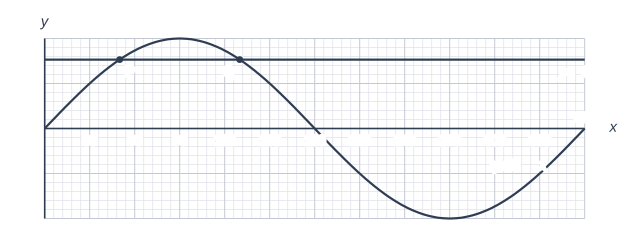
The diagram shows the graph of \(y = \sin x\) for \(0^\circ \le x \le 360^\circ\) and the line \(y = k\) The line meets the graph at the points P and Q. The x-coordinate of P is 50°.
Work out the x-coordinate of Q. The line \(y = -k\) meets the graph at two points. Work out the x-coordinates of these two points.
Model answer
The graph is symmetrical about \(x = 90^\circ\): Q is at \(180^\circ - 50^\circ = 130^\circ\) For \(y = -k\), the part of the graph from 180° to 360° is the part from 0° to 180° turned upside down and moved 180° to the right: \(180^\circ + 50^\circ = 230^\circ\) and \(360^\circ - 50^\circ = 310^\circ\)
Explanation
Use the symmetry of the sine graph rather than a calculator: \(\sin(180^\circ - x) = \sin x\), and the values between 180° and 360° are the negatives of those between 0° and 180°. So \(\sin 230^\circ = \sin 310^\circ = -\sin 50^\circ = -k\).
Mark scheme
1 mark
B1 for 130°
1 mark
M1 for using the symmetry of the graph for \(y = -k\), e.g. \(180^\circ + 50^\circ\) or \(360^\circ - 50^\circ\)
may be implied by one correct value
1 mark
A1 for 230°
1 mark
A1 for 310°
correct answers with no working score full marks
Ready to try the rest? Every answer you write is marked against the mark scheme, so you can see exactly where the marks are.
Ctrl + Enter to check
Study HelperHints first, answers after you try
Stuck on this one? Ask for a hint and I’ll point you in the right direction, without giving the answer away. Once you’ve checked your answer, I’ll show you how the marks are awarded.